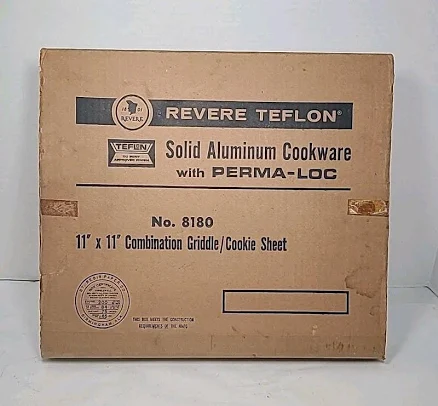
Vintage Revere Teflon 11"x 11" Combination Griddle/ Cookie Sheet W/ Original Box, Is It Non-Toxic?
Vintage Teflon product contains PFAS; risk is real.
This vintage Revere griddle has Teflon-type coating Teflon nonstick coating, which is a PFAS-containing material. No testing or brand information exists to confirm safety.
The better-graded swap
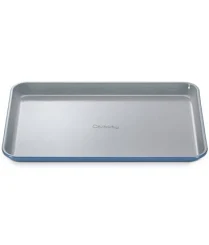
Caraway
Caraway Nonstick Ceramic Medium Baking Sheet
100/100 safety
Same rubric that flunked this product. The swap earned Excellent.
Still want this one anyway? Check the price on Amazon. We’d swap it.
Material
Teflon-type coating (Teflon) nonstick coating
Brand disclosure
Brand is silent on PFAS
Lab data
No public lab test
You may also be interested in
Top-graded picks in the categories readers replace first, every one scored on the same rubric.

- polypropylene filter housing, carbon/sediment cartridge
- We found no PFAS statement from the brand
- Bacterial growth in spent cartridges
3 hazards checked on this product, all on its full breakdown.

Aquasure
Premier Series 75 GPD Under Sink Reverse Osmosis Water Filtration System
- RO membrane, carbon filters, stainless steel housing
- We found no PFAS statement from the brand
- Bacterial and microbial growth in housing and filters
4 hazards checked on this product, all on its full breakdown.

Avocado
Vegan Mattress
- organic cotton, natural latex, coconut coir, recycled steel coils
- The brand calls it PFAS-free, which we have not verified
- Heavy metals
2 hazards checked on this product, all on its full breakdown.
Is Vintage Revere Teflon 11"x Original Box non-toxic? What it is made of
This griddle uses Teflon-type coating (polytetrafluoroethylene), the original Teflon nonstick coating developed in the 1940s. Teflon-type coating itself is stable at normal cooking temperatures (below 500°F), but when heated above 600°F it can degrade and release fumes that may cause polymer fume fever in humans and are acutely toxic to birds. Vintage cookware from this era typically had thinner, less durable coatings than modern formulations, making degradation and flaking more likely after decades of use.
What’s concerning
Category baseline
The starting point for this type of product, before anything specific to this product is counted.
No PFAS disclosure
No public statement from the brand about PFAS in this product.
PTFE / Teflon confirmed
Uses Teflon-type coating (Teflon), a Teflon-family coating in the PFAS family.
Teflon-type coating thermal degradation and fume release
Vintage Teflon-type coating coatings are thinner and more brittle than modern formulations; overheating above 600°F or damage to the coating surface can release polymer fume fever-inducing particles. Risk is significantly elevated if the griddle has been used for 20+ years or shows visible wear.
Coating flaking and microplastic ingestion
Age-related deterioration of Teflon-type coating coatings can cause small flakes to shed into food. While Teflon-type coating is considered inert in the gastrointestinal tract, chronic ingestion of nonstick coating fragments is not well-studied and represents an unknowable chronic risk.
Corrosion and rust on metal substrate
Once the Teflon-type coating begins to peel or crack, the underlying aluminum or steel can corrode, creating rough spots that further damage the coating and increase oxidation. Rust debris can contaminate food if griddle is used after significant substrate damage.
What’s reassuring
Aluminum leaching
Revere griddles typically feature aluminum substrates under the Teflon-type coating layer. If coating is intact, leaching risk is minimal at normal cooking temperatures; however, if nonstick surface is compromised, direct contact between aluminum and acidic or salty foods can increase leaching rates.
Lead
No recalls or testing reports on record for Revere griddle handle coatings; however, vintage cookware from the pre-1970s era sometimes contained lead in decorative glazes. This product's vintage status warrants visual inspection of any colored or glazed handle portions.
Source, ATSDR ↗How is this PFAS grade calculated?
The brand's record and disclosure
Revere, now owned by World Kitchen LLC, has not published transparency statements on PFAS phase-out timelines or alternative material adoption for historical product lines. The company has faced no major documented recalls specific to Teflon-type coating fume release in their griddles, though Teflon-type coating degradation is a known aging risk for all vintage nonstick cookware regardless of brand. No current certifications (e.g., GOTS, OEKO-TEX equivalents for cookware) apply to bakeware of this vintage.
How it compares in its category
Vintage Teflon-type coating nonstick griddles are now considered lower-assurance alternatives to ceramic, stainless steel, or cast iron bakeware. Modern nonstick surfaces increasingly use PFOA-free and Teflon-type coating-free polymers (silicone, ceramic hybrids), or brands have committed to phase-out schedules. This 11x11 combination piece is a dual-purpose design uncommon in current safety-conscious product lines, limiting direct comparison to current equivalents.
If you buy it
Never heat this griddle above 400-450°F, as vintage Teflon-type coating coatings are more prone to degradation and fume release at higher temperatures. Inspect the surface regularly for cracks, peeling, or discoloration; if coating is visibly compromised, discontinue use. Hand wash only; avoid metal utensils and abrasive scrubbing that accelerate coating wear. Store in a dry place to prevent rust on any exposed aluminum or steel edges, which can progress to coating failure.
What is not known about PFAS in this product?
- Basis
- Model estimate, 82% confidence, not a lab result
- Lab test
- None on record for this exact product
- Brand statement
- Revere has made none
Formulations change between production runs, so check the current label. How we grade.
What are the PFAS-free alternatives to Vintage Revere Teflon 11"x 11" Combination Griddle/ Cookie Sheet W/ Original Box?
- ceramic nonstick coating
- A third party reports verifying it as PFAS-free
- Ceramic coating degradation over time
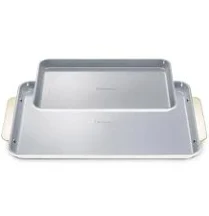
- ceramic nonstick coating
- A third party reports verifying it as PFAS-free
- Coating degradation and durability
2 hazards checked on this product, all on its full breakdown.
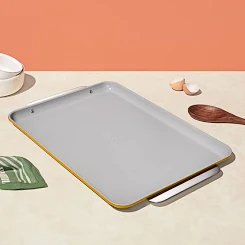
- ceramic nonstick coating
- The brand calls it PFAS-free, which we have not verified
- Ceramic coating degradation and particle shedding
3 hazards checked on this product, all on its full breakdown.
More bakeware grades
How we score, every product runs through the same public 0-100 rubric based on materials, coatings, brand disclosure, lab findings, and recalls. See the full methodology → Spotted a mistake? Report an error.