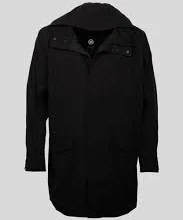
Canada Goose Barclay Rain Jacket Men
Moderate concern; water-repellent coating treatment likely contains PFAS. No disclosure.
Canada Goose does not publicly disclose PFAS content or treatment details for this jacket. Water-repellent rain jackets typically use PFAS-based water-repellent coating finishes unless explicitly stated otherwise.
Still want this one anyway? Check the price on Amazon. We’d swap it.
Material
Nylon shell with water-repellent coating water-repellent finish
Brand disclosure
Brand is silent on PFAS
Lab data
No public lab test
What Canada Goose Barclay Rain Jacket Men is made of, ingredients and materials
The Barclay uses a nylon shell (polyamide), a synthetic polymer that is chemically stable and does not leach monomers into skin under normal wear. The critical component is the water-repellent coating (water-repellent coating) finish applied to the surface. water-repellent coating coatings are typically applied to nylon to shed water without blocking breathability, but many commercial water-repellent coating treatments historically relied on long-chain PFAS (perfluorinated compounds) that persist indefinitely in the environment and bioaccumulate. Canada Goose has not publicly disclosed whether this jacket uses legacy PFAS-based water-repellent coating, fluorine-free alternatives, or a mixed formulation, making direct assessment impossible.
What’s concerning
Waterproof / stain-resistant treatment
Water-repellent coating treatments have historically used PFAS.
Category baseline
The starting point for this type of product, before anything specific to this product is counted.
No PFAS disclosure
No public statement from the brand about PFAS in this product.
PFAS
Water-repellent nylon rain jackets typically use water-repellent coating treatments; Canada Goose does not disclose formulation. Long-chain PFAS were industry standard; phase-out is ongoing but not universal. Direct skin contact during wear poses low acute risk, but manufacturing/laundering releases raise environmental and occupational concerns.
Source, ATSDR ↗Formaldehyde / VOCs
Formaldehyde-releasing resins are sometimes used to stabilize nylon finishes and increase wrinkle resistance. The water-repellent coating treatment itself may contain trace formaldehyde as a cross-linker. Off-gassing is typically minimal in outerwear but elevated in new, unwashed garments; washing reduces this significantly.
Source, ATSDR ↗Nylon degradation under heat or UV
Prolonged exposure to high heat (dryers, iron, sun) can cause nylon to degrade and potentially release oligomers or residual monomers. The water-repellent coating finish may also break down, mobilizing bound chemical additives. This is a use/care issue, not a manufacturing defect.
Microplastic shedding during washing
Synthetic textiles including nylon shed microfibers during laundering. This is an environmental concern rather than a direct safety hazard to the wearer, but frequent washing of this jacket will contribute to microplastic pollution. Using a washing machine filter or choosing delicate, cold-water cycles minimizes shedding.
What’s reassuring
Azo dyes in synthetic textiles
No recalls or reports specific to Canada Goose jackets. Nylon dyeing can use azo dyes, some of which are restricted (carcinogenic amines) in EU and some US state regulations. Without fiber source or dye certification disclosure, this cannot be ruled out but is not documented as a problem for this brand or product.
The full breakdown
The brand's record and disclosure
Canada Goose does not publish detailed chemical composition or water-repellent coating supplier information for its products, nor does it maintain a formal PFAS commitment or phase-out timeline comparable to competitors like Patagonia or Arc'teryx. The brand has faced criticism for opacity on environmental and chemical safety practices but has not faced major recalls for toxicant content in apparel. No independent laboratory testing of this specific jacket for PFAS residues has been published in consumer safety databases.
How it compares in its category
Most premium rain jackets in this price range use water-repellent coating-treated synthetic shells; the Barclay is typical. However, some brands now disclose use of PFAS-free water-repellent coating (e.g., wax-based or Teflon-family coating alternatives) or offer transparency on supplier practices. Canada Goose's lack of disclosure places it behind industry leaders on chemical transparency, though the nylon base material itself is not inherently riskier than competitors' materials.
If you buy it
Wash separately in cool water with mild detergent to minimize leaching of any residual water-repellent coating finish chemicals; hot water or harsh detergents can degrade the coating and potentially mobilize trapped compounds. Avoid extended heat (dryers above 60°C/140°F) as nylon can degrade and release residual monomers or finish additives. Do not iron or expose to direct flame. Reapply water-repellent coating after 50-100 washes using third-party fluorine-free or low-PFAS products if you want to reduce reliance on the original finish. Store dry in a ventilated space to prevent mildew and bacterial growth in the fabric.
What we don’t know
- Basis
- Model estimate, 45% confidence, not a lab result
- Lab test
- None on record for this exact product
- Brand statement
- Canada Goose has made none
Formulations change between production runs, so check the current label. How we grade.
More rain jackets grades
How we score, every product runs through the same public 0-100 rubric based on materials, coatings, brand disclosure, lab findings, and recalls. See the full methodology → Spotted a mistake? Report an error.