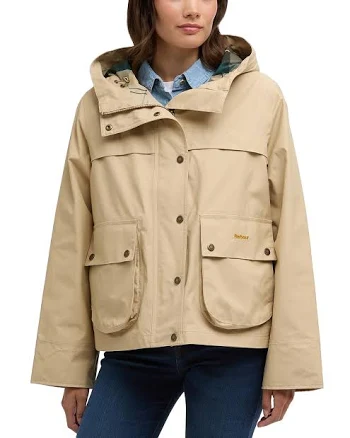
Barbour Women's Baythorpe Waterproof Jacket
Traditional waterproofing process; PFAS composition undisclosed by brand.
Barbour's heritage waxed cotton jackets use traditional water-repellent coating treatments whose PFAS content is not publicly stated. Without transparency or third-party testing, moderate concern remains for conventional waterproof finishes.
Still want this one anyway? Check the price on Amazon. We’d swap it.
Material
waxed cotton or cotton blend with water-repellent coating waterproof finish
Brand disclosure
Brand is silent on PFAS
Lab data
No public lab test
What Barbour Women's Baythorpe Waterproof is made of, ingredients and materials
Barbour's Baythorpe uses waxed cotton or cotton blend fabric treated with a water-repellent coating (water-repellent coating) finish to achieve waterproofing. The wax base is a traditional approach, but Barbour has not disclosed whether the water-repellent coating finish contains PFAS compounds, which are standard in many commercial waterproof textiles. The wax layer can degrade over time and with washing, potentially requiring reapplication to maintain water resistance.
What’s concerning
Waterproof / stain-resistant treatment
Water-repellent coating treatments have historically used PFAS.
Category baseline
The starting point for this type of product, before anything specific to this product is counted.
No PFAS disclosure
No public statement from the brand about PFAS in this product.
PFAS
Barbour has not disclosed water-repellent coating composition for this model. Traditional waterproofing processes in waxed cotton jackets commonly incorporate PFAS to maintain durability; the brand's silence on this ingredient suggests standard industry practice rather than PFAS-free formulation.
Source, ATSDR ↗Antimony in polyester blend (if present)
If this jacket contains polyester as part of the blend, antimony oxide may be used as a catalyst in polyester synthesis, though exposure from wearing is minimal. Barbour has not specified polyester percentage, so presence cannot be confirmed.
Degradation of wax and water-repellent coating over time
Waxed cotton jackets require periodic reapplication of wax or water-repellent coating treatment; frequent rewashing accelerates breakdown. Shedding wax particles or water-repellent coating residues into household laundry is possible but not a documented health hazard.
What’s reassuring
Formaldehyde / VOCs
No recalls or reports of formaldehyde-release issues are on record for Barbour jackets. Cotton blends and waxed finishes do not typically require high formaldehyde-resin binders, though any synthetic dyes or sizing could carry trace residuals.
Source, ATSDR ↗Azo dyes and colorant safety
No established safety incidents or regulatory actions against Barbour for azo dyes in apparel are on record. The brand uses conventional dyeing; heavy metal content in pigments is not documented as a concern in this product category at this price tier.
The full breakdown
The brand's record and disclosure
Barbour has not publicly committed to PFAS-free waterproofing or provided ingredient transparency for this jacket's finish. The brand maintains a heritage positioning around traditional waxed cotton but has not addressed concerns about modern chemical waterproofing additives. No major safety recalls or azo dye controversies are on record for this product line.
How it compares in its category
Waxed cotton jackets occupy a middle ground, traditional wax finishes avoid some modern synthetic coatings but often rely on PFAS-based water-repellent coating topcoats for enhanced water resistance. Competitors using Teflon-type coating-coated nylon (Gore-Tex style) carry different chemical profiles but known degradation pathways. Fully PFAS-free waterproof alternatives exist but are less common at Barbour's price and style tier.
If you buy it
Wash infrequently to preserve the water-repellent coating finish and extend replacement intervals. Use cool water and avoid high heat drying, which can degrade synthetic components. Reapply wax or water-repellent coating treatment as water beading diminishes, typically annually depending on use. If water no longer beads on the surface after care attempts, replacement may be necessary rather than repair.
What we don’t know
- Basis
- Model estimate, 45% confidence, not a lab result
- Lab test
- None on record for this exact product
- Brand statement
- Barbour has made none
Formulations change between production runs, so check the current label. How we grade.
More rain jackets grades
How we score, every product runs through the same public 0-100 rubric based on materials, coatings, brand disclosure, lab findings, and recalls. See the full methodology → Spotted a mistake? Report an error.