· Bakeware
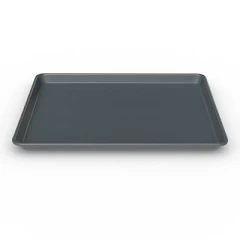
Nonstick Aluminized Steel Baking Sheet
Nonstick coating type undisclosed; PFAS risk unclear without detail.
Won't disclose what nonstick coating this sheet has. Most nonstick baking sheets use Teflon-type coating or Teflon-family coating, so you can't rule out PFAS risk.
The better-graded swap
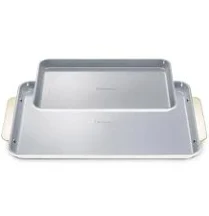
Caraway
Caraway Ceramic Nonstick Baking Sheet Duo
100/100 safety
Same rubric that flunked this product. The swap earned Excellent.
Still want this one anyway? Check the price on Amazon. We’d swap it.
Material
Aluminized steel with unspecified nonstick coating
Brand disclosure
Brand is silent on PFAS
Lab data
No public lab test
Is Nonstick Aluminized Steel Baking Sheet non-toxic? What it is made of
This baking sheet has a steel core with aluminum coating for heat distribution, plus an unidentified nonstick surface layer. The aluminum layer itself does not leach significantly in normal baking conditions (pH-neutral foods, moderate heat). The critical unknown is the nonstick coating chemistry, if it is Teflon-type coating-based (like Teflon), it poses fume risk above 500°F; if it is ceramic or silicone-based, the hazard profile is much lower. The brand has not publicly disclosed which formulation is used.
What’s concerning
Category baseline
The starting point for this type of product, before anything specific to this product is counted.
No PFAS disclosure
No public statement from the brand about PFAS in this product.
Non-stick, chemistry undisclosed
Marketed as non-stick without stating the coating chemistry.
Teflon-type coating fume risk (if present)
Coating type is undisclosed. Teflon-type coating (Teflon) releases toxic fumes above 500°F; The brand has not ruled this out. Risk is avoidable via temperature control but cannot be confirmed absent without testing.
Nonstick coating degradation and particle shedding
Brand transparency and accountability
The brand's silence on nonstick chemistry and PFAS stance is a documented gap relative to industry peers. This makes independent verification of safety claims impossible and limits consumer recourse if future issues emerge.
What’s reassuring
Aluminum leaching
The aluminum layer is sealed and does not contact food directly in normal baking. Leaching risk is negligible unless coating is severely damaged or acidic foods are stored on the sheet long-term.
Lead
This product is a commercial-style baking sheet with no decorative enamel or glaze. Hazard class not applicable to this material design.
Source, ATSDR ↗The full breakdown
The brand's record and disclosure
The brand is a legacy housewares brand now owned by Groupe SEB; it has no published sustainability or material-safety disclosures on its website or packaging. The company has not signed commitments to phase out PFAS or adopted third-party certifications (e.g., GreenGuard). This silence is notable in an industry where competitors increasingly specify nonstick chemistry. No major recalls specific to this product line have been documented in public records.
How it compares in its category
Aluminized steel baking sheets are a mid-tier choice, cheaper than stainless steel, lighter than cast iron, and more durable than bare aluminum. Most competitors in this price range (Winco, Wear-Ever commercial lines) also use proprietary nonstick coatings without full PFAS disclosure. Premium alternatives like ceramic-coated or uncoated stainless steel baking sheets offer transparency but cost more and require seasoning or greasing. The brand's lack of transparency puts it behind brands that explicitly market Teflon-type coating-free or ceramic-nonstick options.
If you buy it
Keep oven temperatures below 500°F to avoid potential Teflon-type coating fume risk (even if undisclosed, assume Teflon-type coating unless proved otherwise). Hand wash only; dishwasher heat and detergent can degrade nonstick coatings faster. Inspect the surface monthly for chips, peeling, or dark spots; if coating flakes appear in food, discard the sheet. Replace every 5 to 7 years or when coating visibly deteriorates, as worn nonstick surfaces may shed particles or expose underlying aluminum.
What we don’t know
- Basis
- Model estimate, 35% confidence, not a lab result
- Lab test
- None on record for this exact product
- Brand statement
- has made none
Formulations change between production runs, so check the current label. How we grade.
Better-graded alternatives in Bakeware
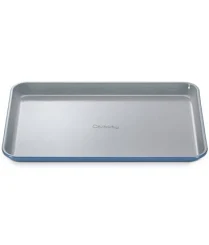
Caraway
Nonstick Ceramic Medium Baking Sheet
- ceramic nonstick coating
- A third party reports verifying it as PFAS-free
- Ceramic coating degradation over time
Caraway
Ceramic Nonstick Baking Sheet Duo
- ceramic nonstick coating
- A third party reports verifying it as PFAS-free
- Coating degradation and durability
2 hazards checked on this product. See all of them.
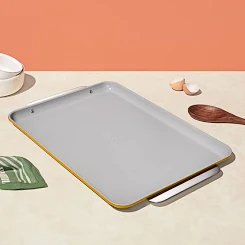
Caraway
Nonstick Ceramic Large Baking Sheet
- ceramic nonstick coating
- The brand calls it PFAS-free, which we have not verified
- Ceramic coating degradation and particle shedding
3 hazards checked on this product. See all of them.
More bakeware grades
How we score, every product runs through the same public 0-100 rubric based on materials, coatings, brand disclosure, lab findings, and recalls. See the full methodology → Spotted a mistake? Report an error.