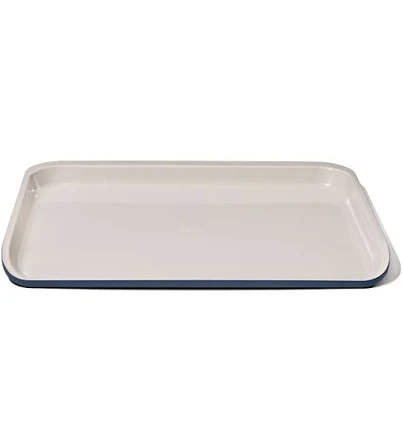
OXO Good Grips Non-Stick Pro Ceramic Coated Metal Bakeware Cookie Sheet
Ceramic-coated non-stick bakeware with undisclosed coating chemistry and no brand PFAS statement.
This ceramic-coated steel bakeware is marketed as non-stick, but OXO does not state the coating chemistry or provide a PFAS statement. The coating composition remains unverified.
The better-graded swap
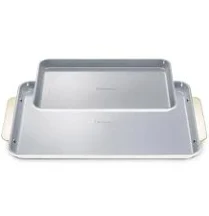
Caraway
Caraway Ceramic Nonstick Baking Sheet Duo
100/100 safety
Same rubric that flunked this product. The swap earned Excellent.
Still want this one anyway? Check the price on Amazon. We’d swap it.
Material
Ceramic-coated steel
Lab data
No public lab test
Is OXO Good Grips Non-Stick Pro Ceramic non-toxic? What it is made of
This product is carbon steel or mild steel substrate with a ceramic non-stick coating applied on top. Ceramic coatings are inorganic mineral-based systems that do not rely on Teflon-type coating (Teflon) or PFOA/PFAS chemistry, making them mechanically and chemically distinct from traditional Teflon-family coating non-sticks. The steel core is stable at baking temperatures and does not leach in normal use; ceramic coatings are generally considered inert when intact, though they can chip or degrade with mechanical damage or thermal shock.
What’s concerning
Category baseline
The starting point for this type of product, before anything specific to this product is counted.
No PFAS disclosure
No public statement from the brand about PFAS in this product.
Non-stick, chemistry undisclosed
Marketed as non-stick without stating the coating chemistry.
Coating degradation and leaching
Ceramic coatings can chip or peel with mechanical abuse or thermal shock, exposing steel underneath. Once breached, the coating no longer provides non-stick function and mild steel may corrode; steel itself is not toxic at food-contact levels, but loss of coating integrity signals product end-of-life.
What’s reassuring
Thermal fume risk (non-Teflon-type coating)
Unlike Teflon-type coating, ceramic coatings do not emit toxic fumes at normal cooking temperatures (baking up to 400-500°F). No established reports of polymer fume fever or decomposition products from ceramic-coated bakeware in normal use.
Heavy metals
OXO does not disclose the detailed composition of its ceramic coating. Standard ceramic cookware coatings in North America are formulated to avoid lead and cadmium, but without third-party testing or certification (e.g., California Prop 65 or CPSC compliance statements), this cannot be verified for this specific product.
Source, FDA ↗Aluminum substrate exposure
This product uses steel, not aluminum, so aluminum leaching is not a relevant hazard.
Microplastics
Bakeware is not a plastic-food-contact product; this hazard class does not apply.
Source, EPA ↗The full breakdown
The brand's record and disclosure
OXO does not publish detailed material safety data sheets or specific PFAS certifications for this product line, which is typical of consumer cookware manufacturers but leaves questions unanswered. The company has no documented major product recalls or safety controversies in the cookware category on public record. OXO's silence on PFAS and ceramic coating composition means verification relies on third-party testing or material science inference rather than brand transparency.
How it compares in its category
Ceramic-coated bakeware sits in the mid-concern tier of non-stick options, lower concern for PFAS exposure than traditional Teflon-type coating non-sticks, but less durable than uncoated steel or cast iron and prone to chipping. Vs stainless or bare steel sheets, it offers easier release but requires more careful handling. OXO's positioning is consumer-grade; professional-grade ceramic or bare steel bakeware may offer longer service life at higher cost.
If you buy it
Avoid preheating empty or at very high temperatures; ceramic coatings can degrade faster under thermal stress than Teflon-type coating. Hand-wash instead of dishwasher to prevent chipping and coating failure. Do not use metal utensils; ceramic scratches expose steel underneath. Replace if the coating visibly chips, flakes, or peels, as exposed steel can develop rust and the protective benefit is lost. Store flat or lined to avoid edge damage.
What we don’t know
- Basis
- Model estimate, 72% confidence, not a lab result
- Lab test
- None on record for this exact product
- Brand statement
- OXO has made a specific claim
Formulations change between production runs, so check the current label. How we grade.
Better-graded alternatives in Bakeware
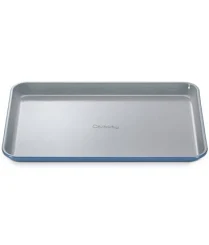
Caraway
Nonstick Ceramic Medium Baking Sheet
- ceramic nonstick coating
- A third party reports verifying it as PFAS-free
- Ceramic coating degradation over time
Caraway
Ceramic Nonstick Baking Sheet Duo
- ceramic nonstick coating
- A third party reports verifying it as PFAS-free
- Coating degradation and durability
2 hazards checked on this product. See all of them.
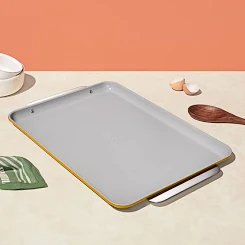
Caraway
Nonstick Ceramic Large Baking Sheet
- ceramic nonstick coating
- The brand calls it PFAS-free, which we have not verified
- Ceramic coating degradation and particle shedding
3 hazards checked on this product. See all of them.
More bakeware grades
How we score, every product runs through the same public 0-100 rubric based on materials, coatings, brand disclosure, lab findings, and recalls. See the full methodology → Spotted a mistake? Report an error.