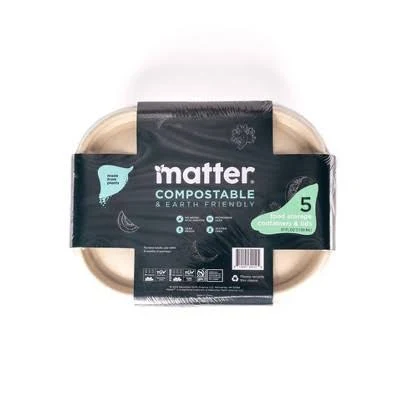
Matter Compostable Food Storage Container 5ct
BPI Certified Compostable certification on record.
This product carries BPI Certified Compostable certification, whose criteria restrict PFAS, which we record as third-party verification. Matter says its products do not contain any intentionally added PFAS.
Brand says: “Matter says its products do not contain any intentionally added PFAS.”
We flunk more products than we pass. This one earned its grade. How we grade
Material
Plant-based fiber pulp (compostable)
Brand disclosure
Third-party verified PFAS-free
Lab data
No public lab test
You may also be interested in
Top-graded picks in the categories readers replace first, every one scored on the same rubric.

- polypropylene filter housing, carbon/sediment cartridge
- We found no PFAS statement from the brand
- Bacterial growth in spent cartridges
3 hazards checked on this product, all on its full breakdown.

Aquasure
Premier Series 75 GPD Under Sink Reverse Osmosis Water Filtration System
- RO membrane, carbon filters, stainless steel housing
- We found no PFAS statement from the brand
- Bacterial and microbial growth in housing and filters
4 hazards checked on this product, all on its full breakdown.

Avocado
Vegan Mattress
- organic cotton, natural latex, coconut coir, recycled steel coils
- The brand calls it PFAS-free, which we have not verified
- Heavy metals
2 hazards checked on this product, all on its full breakdown.
What Matter Compostable Food Storage Container is made of, ingredients and materials
Matter containers are constructed from plant-based fiber pulp, a renewable material derived from agricultural waste or sustainably harvested plant cellulose. This material is inherently biodegradable and designed to break down in industrial composting environments without persistent chemical residues. Unlike conventional plastic or coated paperboard, fiber pulp-based food storage relies on the structural integrity of the cellulose matrix itself rather than synthetic polymers or problematic barrier coatings.
What’s concerning
Category baseline
The starting point for this type of product, before anything specific to this product is counted.
Microbe/mold growth if stored damp
Plant-based fiber is hygroscopic and provides a natural medium for microbial colonization if not kept dry or if food residues remain. Proper air drying and prompt cleaning reduce this risk significantly.
Cellulose degradation under repeated hot/wet stress
Fiber pulp is not designed for sustained microwave, oven, or dishwasher use. Repeated thermal cycling or prolonged moisture exposure may cause softening, warping, or separation of layers over time.
What’s reassuring
Third-party PFAS-free verification
A third party reports verifying this product as PFAS-free.
Base material not linked to PFAS
The main material recorded for this product is not one associated with PFAS.
Migration of processing residues (if any)
No established reports of harmful chemical migration from plant-based pulp food containers. BPI certification includes screening for prohibited substances, though full disclosure of all processing additives is not always publicly available.
Formaldehyde / VOCs
BPI Certified Compostable status typically excludes heavy formaldehyde-based binders; however, specific adhesive chemistry for this product is not publicly detailed. Industry standard formulations use low-toxicity binders, but direct manufacturer confirmation would provide certainty.
Source, ATSDR ↗Heavy metals
No public recalls or safety alerts for heavy metal contamination in Matter containers. Plant-based pulp products are not typically pigmented in ways that introduce arsenic, lead, or cadmium, but colorant source is not explicitly disclosed for this line.
Source, FDA ↗How is this PFAS grade calculated?
The brand's record and disclosure
Matter holds BPI (Biodegradable Products Institute) Certified Compostable certification, a third-party verification standard that includes screening for problematic chemicals in finished products. The brand has publicly committed to PFAS-free formulations and maintains transparency on material sourcing. No established safety recalls or disclosed controversies involving this product line are on record in public databases.
How it compares in its category
Plant-based fiber containers present lower concern than polypropylene (PP) or polyethylene terephthalate (PET) food storage, which carry microplastic shedding risks under repeated heating. They also avoid the PFAS-heavy coatings common in traditional coated paperboard alternatives used for grease/moisture barriers. The compostability certification distinguishes them from most single-use plastics, though they are less durable than glass or stainless steel for long-term repeated use.
If you buy it
Use for ambient-temperature or refrigerated storage; manufacturer data on microwave or oven safety is not universally published, so avoid high-heat exposure to preserve structural integrity. Replace containers if the fiber begins to separate, shows mold growth, or develops persistent odors, as these signal material degradation. Store in dry conditions to prevent premature moisture breakdown. After use, compost in an industrial composting facility where conditions support BPI certification standards; home composting may not achieve the temperature and timeframes needed for complete breakdown.
What is not known about PFAS in this product?
- Basis
- Model estimate, 82% confidence, not a lab result
- Lab test
- None on record for this exact product
- Brand statement
- Matter has made a specific claim
Formulations change between production runs, so check the current label. How we grade.
More food packaging grades
How we score, every product runs through the same public 0-100 rubric based on materials, coatings, brand disclosure, lab findings, and recalls. See the full methodology → Spotted a mistake? Report an error.