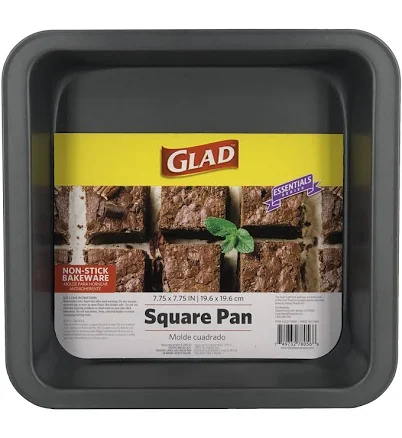
Dollar General Glad Square Cake Pan
Nonstick coating chemistry not disclosed, raising concern for potential PFAS.
This steel cake pan has a nonstick coating, but Glad does not disclose the coating chemistry or address PFAS. Unspecified nonstick coatings are commonly associated with PFAS use in cookware.
The better-graded swap
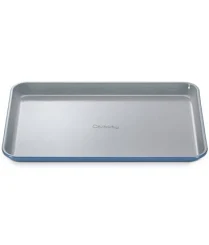
Caraway
Caraway Nonstick Ceramic Medium Baking Sheet
100/100 safety
Same rubric that flunked this product. The swap earned Excellent.
Still want this one anyway? Check the price on Amazon. We’d swap it.
Material
steel cake pan with unspecified nonstick coating
Brand disclosure
Brand is silent on PFAS
Lab data
No public lab test
Is Dollar General Glad Square Cake Pan non-toxic? What it is made of
This is a steel cake pan with an unspecified nonstick coating applied to the surface. Steel itself is not a material linked to PFAS in baking applications, but the coating is the critical unknown, it could be traditional Teflon-type coating (Teflon-like) requiring PFAS, ceramic hybrid, or silicone-based. Glad does not disclose the coating chemistry publicly, making it impossible to rule out PFAS or other fluorinated compounds. The coating's durability and safety depend entirely on whether it remains intact during heating and use.
What’s concerning
Category baseline
The starting point for this type of product, before anything specific to this product is counted.
No PFAS disclosure
No public statement from the brand about PFAS in this product.
Non-stick, chemistry undisclosed
Marketed as non-stick without stating the coating chemistry.
Teflon-type coating fume risk (if Teflon-type coating-based coating)
If the nonstick coating is traditional Teflon-type coating, heating above 500°F can decompose it and release fumes that cause polymer fume fever in humans and are acutely toxic to pet birds. Unknown coating formulation means this risk cannot be ruled out.
Coating degradation and microflaking
Budget nonstick coatings on steel pans are prone to chipping and peeling with repeated use and washing. Flaked coating particles ingested in food are not acutely toxic but indicate loss of nonstick function and potential adhesion failure.
What’s reassuring
Lead
No recalls or reports of heavy metal contamination in Glad cookware coatings. Modern U.S. cookware is subject to FDA limits, but the lack of coating transparency means compliance cannot be verified for this specific product.
Source, ATSDR ↗Steel substrate safety
Steel itself does not leach. If the nonstick coating fails and bare steel contacts acidic foods, no hazard is expected, though nonstick performance is lost.
Manufacturing process disclosure
No public information on whether the coating application or curing process uses PFAS-containing solvents or residual fluorine compounds beyond the coating itself.
The full breakdown
The brand's record and disclosure
Glad, owned by Clorox, manufactures primarily disposable food storage products and is not known as a cookware specialist. The company has not published transparency statements regarding PFAS in nonstick coatings or manufacturing standards for baking pans. No major recalls of Glad cookware for coating hazards are on record, but the lack of any public commitment to PFAS-free or fluorine-free formulations is conspicuous in an industry where competitors increasingly disclose coating materials.
How it compares in its category
Budget steel cake pans typically use either Teflon-type coating-based nonstick (the industry standard) or uncoated steel. Glad's model occupies the economy tier where coating materials are rarely specified. Competing budget brands like Pyrex and Wilton sometimes disclose ceramic or silicone coatings, while premium brands like All-Clad offer PFOA-free Teflon-type coating. The complete silence here places this product in a less transparent category than many direct competitors.
If you buy it
Use the pan only below 400°F to minimize any risk of coating decomposition and fume release. Avoid preheating empty above 300°F and never use under broilers. Hand wash only; dishwashers can accelerate coating wear. Inspect the coating regularly for flaking, discoloration, or bubbling. If damage appears, retire the pan immediately. Store dry to prevent water pooling that might weaken the coating adhesion over time.
What we don’t know
- Basis
- Model estimate, 35% confidence, not a lab result
- Lab test
- None on record for this exact product
- Brand statement
- Glad has made none
Formulations change between production runs, so check the current label. How we grade.
Better-graded alternatives in Bakeware
Caraway
Nonstick Ceramic Medium Baking Sheet
- ceramic nonstick coating
- A third party reports verifying it as PFAS-free
- Ceramic coating degradation over time
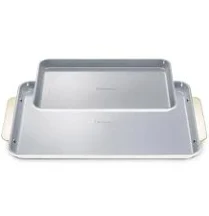
Caraway
Ceramic Nonstick Baking Sheet Duo
- ceramic nonstick coating
- A third party reports verifying it as PFAS-free
- Coating degradation and durability
2 hazards checked on this product. See all of them.
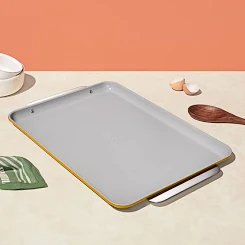
Caraway
Nonstick Ceramic Large Baking Sheet
- ceramic nonstick coating
- The brand calls it PFAS-free, which we have not verified
- Ceramic coating degradation and particle shedding
3 hazards checked on this product. See all of them.
More bakeware grades
How we score, every product runs through the same public 0-100 rubric based on materials, coatings, brand disclosure, lab findings, and recalls. See the full methodology → Spotted a mistake? Report an error.