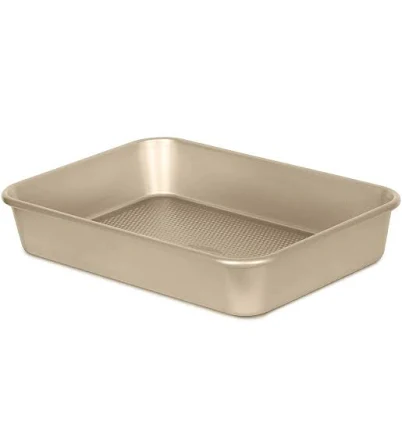
glad baking pan nonstick - oblong metal dish for cake and lasagna - heavy duty carbon steel bakeware, small, gold
Nonstick coating composition unknown; consider bare or ceramic alternatives.
Glad does not disclose the nonstick coating chemistry. Most nonstick bakeware uses Teflon-type coating or similar Teflon-family coating. No lab data or PFAS claims available.
The better-graded swap
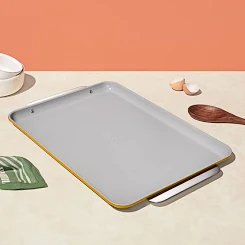
Caraway
Caraway Nonstick Ceramic Large Baking Sheet
90/100 safety
Same rubric that flunked this product. The swap earned Excellent.
Still want this one anyway? Check the price on Amazon. We’d swap it.
Material
Carbon steel with unspecified nonstick coating
Brand disclosure
Brand is silent on PFAS
Lab data
No public lab test
Is glad baking pan nonstick - oblong metal non-toxic? What it is made of
This pan combines a carbon steel substrate (iron-carbon alloy, not a material linked to PFAS) with an unspecified nonstick coating applied to the cooking surface. Glad does not publicly disclose the coating chemistry; industry standard for budget nonstick bakeware is Teflon-type coating (polytetrafluoroethylene), which is thermally stable under normal baking but degrades at high heat or if scratched. Carbon steel itself is chemically inert and does not leach iron or other metals into food under typical use.
What’s concerning
Category baseline
The starting point for this type of product, before anything specific to this product is counted.
No PFAS disclosure
No public statement from the brand about PFAS in this product.
Non-stick, chemistry undisclosed
Marketed as non-stick without stating the coating chemistry.
Teflon-type coating nonstick coating degradation and fume risk
If coating is Teflon-type coating-based (unconfirmed by Glad), overheating above 500°F or physical damage can degrade the surface and release polymer fumes. Normal baking use (under 450°F) presents minimal risk, but abuse or high-temperature broiling is a concern.
Coating delamination over time
Budget nonstick pans commonly develop flaking or peeling after repeated heating cycles and dishwasher exposure. Ingestion of loose coating fragments is the primary risk; replacement is the remedy.
Carbon steel reactivity with acidic foods
Bare carbon steel (any exposed areas from coating damage) can interact with very acidic foods like tomato sauce, potentially imparting a metallic taste. The nonstick coating protects against this if intact.
Thermal shock and coating cracking
Rapid temperature changes (e.g., moving a hot pan directly to cold water) can cause the coating to crack or separate from the steel substrate. Gradual cooling and hand-washing reduce this risk.
What’s reassuring
Lead
The product description mentions a gold exterior finish. No recalls or testing data are on record for Glad bakeware, and modern anodizing or paint standards exclude lead/cadmium in food-contact-adjacent surfaces, but the specific composition is not disclosed.
Source, ATSDR ↗The full breakdown
The brand's record and disclosure
Glad is a subsidiary of Clorox and primarily known for food storage bags and trash products. The company has not published detailed material safety data sheets or commitments regarding PFAS in its bakeware line. No significant cookware-related safety recalls or independent testing results are on record for Glad baking pans. The lack of transparency around nonstick coating chemistry is a common industry practice for budget brands and does not indicate misconduct, but limits informed assessment.
How it compares in its category
Budget nonstick bakeware (including this Glad pan) typically uses Teflon-type coating coatings without PFOA, which is standard post-2015 in North America. Bare carbon steel pans (uncoated) avoid nonstick coating risk entirely but require seasoning and are less non-stick. Ceramic or silicone-lined alternatives eliminate Teflon-type coating exposure but may be less durable. This product sits in the middle, affordable, durable, but with unverified coating safety and no brand differentiation on materials.
If you buy it
Preheat gradually to avoid thermal shock; keep oven temperature below 400-450 degrees Fahrenheit to minimize coating stress. Inspect the surface before each use for scratches, peeling, or discoloration; replace if the coating shows wear. Hand-wash only (dishwashers can degrade nonstick coatings faster) with soft sponges. Avoid metal utensils and acidic foods in direct contact with the coating. Store flat or padded to prevent contact damage.
What we don’t know
- Basis
- Model estimate, 35% confidence, not a lab result
- Lab test
- None on record for this exact product
- Brand statement
- Glad has made none
Formulations change between production runs, so check the current label. How we grade.
Better-graded alternatives in Bakeware
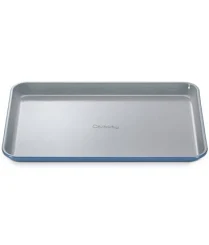
Caraway
Nonstick Ceramic Medium Baking Sheet
- ceramic nonstick coating
- A third party reports verifying it as PFAS-free
- Ceramic coating degradation over time
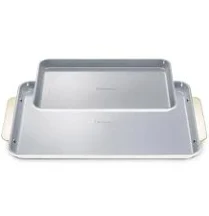
Caraway
Ceramic Nonstick Baking Sheet Duo
- ceramic nonstick coating
- A third party reports verifying it as PFAS-free
- Coating degradation and durability
2 hazards checked on this product. See all of them.
Caraway
Nonstick Ceramic Large Baking Sheet
- ceramic nonstick coating
- The brand calls it PFAS-free, which we have not verified
- Ceramic coating degradation and particle shedding
3 hazards checked on this product. See all of them.
More bakeware grades
How we score, every product runs through the same public 0-100 rubric based on materials, coatings, brand disclosure, lab findings, and recalls. See the full methodology → Spotted a mistake? Report an error.