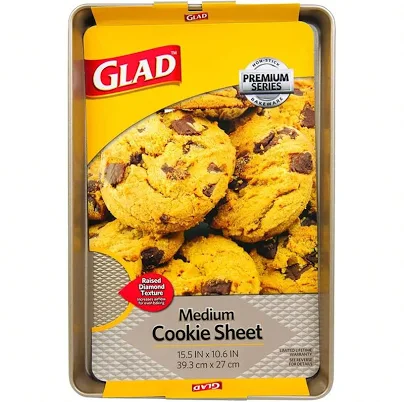
Glad Premium Nonstick Baking Sheet Parchment Paper Heavy Duty Raised Diamond Texture Medium Cookie Pan Bakeware,M
Skip until coating is disclosed or verified PFAS-free.
Nonstick baking parchment with unspecified coating, likely silicone base. No PFAS claims or third-party verification provided by Glad.
The better-graded swap
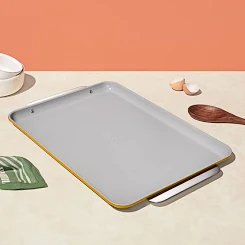
Caraway
Caraway Nonstick Ceramic Large Baking Sheet
90/100 safety
Same rubric that flunked this product. The swap earned Excellent.
Still want this one anyway? Check the price on Amazon. We’d swap it.
Material
Silicone-coated paper with unknown nonstick coating
Brand disclosure
Brand is silent on PFAS
Lab data
No public lab test
Is Glad Premium Nonstick Baking Sheet non-toxic? What it is made of
This product is parchment paper (cellulose base) coated with silicone on one or both sides to create nonstick properties. The silicone coating itself is generally stable at typical baking temperatures (up to 420-450°F) and does not off-gas significantly when used as directed. The critical unknown is whether Glad uses PFAS-containing compounds in the silicone formulation or in the paper manufacturing process to achieve water and grease resistance; most parchment manufacturers have historically relied on fluorochemicals, though some newer products use fluorine-free alternatives.
What’s concerning
Category baseline
The starting point for this type of product, before anything specific to this product is counted.
No PFAS disclosure
No public statement from the brand about PFAS in this product.
Non-stick, chemistry undisclosed
Marketed as non-stick without stating the coating chemistry.
Silicone coating degradation over time
Repeated heating, humidity, and moisture absorption can cause the silicone layer to crack or peel; this is primarily a performance issue but may release silicone particles into food if severe.
Thermal decomposition of coating at excessive temperatures
If used at temperatures above 450°F or in contact with direct flame, silicone coatings can break down and produce gaseous byproducts; however, normal baking use is below this threshold.
Coating adhesion failure releasing particles
Poor adhesion between silicone and paper base can result in flaking or separation during storage or use; particles entering food are unlikely to cause acute harm but represent a quality control indicator.
PFAS
The parchment industry historically uses fluorochemical compounds (PFOA, Teflon-type coating, or other PFAS) to achieve water and oil repellency; Glad has not confirmed whether this product is PFAS-free, making this a significant concern if the brand has not switched formulations.
Source, ATSDR ↗What’s reassuring
Bleaching agents and processing residues in paper base
Glad does not disclose whether the parchment paper is chlorine-bleached or oxygen-bleached; chlorine-bleached paper may carry trace dioxin and furan residues, though levels in food contact applications are typically regulated and negligible.
The full breakdown
The brand's record and disclosure
Glad (SC Johnson subsidiary) does not publicly disclose the specific chemistry of its parchment coatings on product labels or safety data sheets. The brand has not published commitments to PFAS-free parchment, nor has it faced documented recalls for this product category. SC Johnson has made selective PFAS phase-out pledges for some product lines, but parchment bakeware is not explicitly covered in publicly available statements. Without third-party testing or manufacturer certification, the PFAS status remains opaque.
How it compares in its category
Parchment paper presents lower concern than reusable silicone baking mats or nonstick cookware because it is single-use and does not degrade with repeated heating and cooling cycles. However, it is less durable than uncoated alternatives like cast iron or stainless steel. Some competitors (e.g., If You Care, Unbleached & Chlorine-Free parchment) market PFAS-free or fluorine-free coatings as a selling point, suggesting the Glad product may use traditional PFAS-containing formulations.
If you buy it
Use at temperatures up to the product's stated limit (typically 420-450°F); do not expose to direct flame or broiler heat, which can degrade the silicone coating and release gases. Replace if the paper darkens, tears, or begins to flake. Store in a cool, dry place away from direct sunlight to prevent coating breakdown. If PFAS exposure is a priority concern, contact Glad directly to request coating disclosure, or switch to a certified PFAS-free parchment alternative.
What we don’t know
- Basis
- Model estimate, 35% confidence, not a lab result
- Lab test
- None on record for this exact product
- Brand statement
- Glad has made none
Formulations change between production runs, so check the current label. How we grade.
Better-graded alternatives in Bakeware
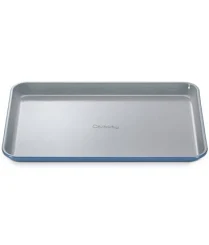
Caraway
Nonstick Ceramic Medium Baking Sheet
- ceramic nonstick coating
- A third party reports verifying it as PFAS-free
- Ceramic coating degradation over time
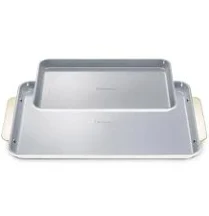
Caraway
Ceramic Nonstick Baking Sheet Duo
- ceramic nonstick coating
- A third party reports verifying it as PFAS-free
- Coating degradation and durability
2 hazards checked on this product. See all of them.
Caraway
Nonstick Ceramic Large Baking Sheet
- ceramic nonstick coating
- The brand calls it PFAS-free, which we have not verified
- Ceramic coating degradation and particle shedding
3 hazards checked on this product. See all of them.
More bakeware grades
How we score, every product runs through the same public 0-100 rubric based on materials, coatings, brand disclosure, lab findings, and recalls. See the full methodology → Spotted a mistake? Report an error.