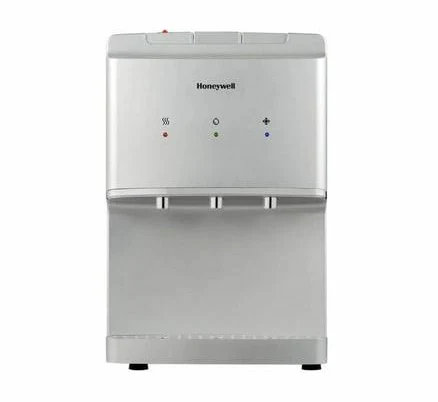
Honeywell Countertop Tri-Temperature Water Dispenser
Lower concern. Filter materials are not linked to PFAS.
This dispenser uses activated carbon and RO filtration media, which are not materials linked to PFAS. Honeywell has no public PFAS statement on record for this product and no lab testing is available.
We flunk more products than we pass. This one earned its grade. How we grade
Material
Activated carbon and RO filtration media
Brand disclosure
Brand is silent on PFAS
Lab data
No public lab test
You may also be interested in
Top-graded picks in the categories readers replace first, every one scored on the same rubric.

Aqua Pure
3M Aqua-Pure AP802B Whole House Filter Housing
- polypropylene filter housing, carbon/sediment cartridge
- We found no PFAS statement from the brand
- Bacterial growth in spent cartridges
3 hazards checked on this product. See all of them.

Aquasure
Premier Series 75 GPD Under Sink Reverse Osmosis Water Filtration System
- RO membrane, carbon filters, stainless steel housing
- We found no PFAS statement from the brand
- Bacterial and microbial growth in housing and filters
4 hazards checked on this product. See all of them.

Avocado
Vegan Mattress
- organic cotton, natural latex, coconut coir, recycled steel coils
- The brand calls it PFAS-free, which we have not verified
- Heavy metals
2 hazards checked on this product. See all of them.
What Honeywell Countertop Tri-Temperature is made of, ingredients and materials
This unit uses activated carbon and reverse osmosis (RO) membrane filtration, the two most widely deployed consumer water treatment media. Activated carbon adsorbs dissolved organic compounds and chlorine; RO membranes physically block particles, minerals, and some dissolved solids. Neither material is known to leach harmful substances into treated water under normal use. The housing is typically plastic (likely polypropylene or similar food-grade polymer), which does not degrade significantly during cold or ambient-temperature water storage.
What’s concerning
No PFAS disclosure
No public statement from the brand about PFAS in this product.
Bacterial growth in housing/reservoir if maintenance neglected
Any water storage device risks microbial colonization if collection basins, tubing, or tanks are not cleaned regularly. Honeywell does not prominently specify cleaning intervals in widely available product documentation.
Lead
Both media types have finite service life. Exceeding replacement intervals may reduce contaminant removal efficiency, though this is functional degradation rather than a direct safety hazard from leachates.
Source, ATSDR ↗Improper installation or cartridge sealing allowing bypass
If cartridges are not seated correctly or o-rings deteriorate, unfiltered water may bypass media and reach the dispenser outlet. User error in cartridge replacement is the primary risk vector.
What’s reassuring
Base material not linked to PFAS
The main material recorded for this product is not one associated with PFAS.
Plastic housing leachables (polypropylene or similar food-contact polymer)
Food-grade plastics used in water dispensers do not typically leach BPA or phthalates; however, no third-party testing data for this specific Honeywell model is publicly available to confirm polymer grade or migration rates.
The full breakdown
The brand's record and disclosure
Honeywell does not publish detailed material safety data sheets or third-party certifications (NSF, WQA) for this specific dispenser model in publicly available sources. The brand has not faced documented recalls or public safety complaints tied to this product category. Honeywell's general water filtration line carries no established history of contamination or hazardous leaching; however, the company does not voluntarily disclose PFAS testing or mitigation for its filter cartridges.
How it compares in its category
Countertop dispensers with carbon and RO filtration are among the lower-concern entry-level home water treatment options. They eliminate the need for pitcher-based manual filters (which require more frequent maintenance and have higher bacterial contamination risk if neglected) and avoid under-sink complexity. Compared to pitcher filters alone, RO adds membrane-level exclusion; compared to more expensive whole-house systems, they carry lower installation and ongoing cost with acceptable contaminant reduction for drinking and cooking water.
If you buy it
Replace cartridges on the manufacturer's schedule (typically every 6-12 months depending on water quality and usage volume) to prevent bacterial colonization and media saturation. Keep the unit away from direct sunlight and heat sources, as UV and warmth accelerate carbon exhaustion. Empty and rinse the collection basin weekly if water sits between uses; stagnant water in any reservoir poses bacterial growth risk independent of filter quality. Do not use hot water in the dispenser; stick to the unit's rated temperature range (typically ambient to 45-50 degrees C for cooling modes).
What we don’t know
- Basis
- Model estimate, 72% confidence, not a lab result
- Lab test
- None on record for this exact product
- Brand statement
- Honeywell has made none
Formulations change between production runs, so check the current label. How we grade.
Better-graded alternatives in Water Filters

Aquamira
Water Storage Treatment 2 oz Glass Bottles 60 gallons Purification
- glass bottles, sodium dichloroisocyanurate treatment chemical
- We found no PFAS statement from the brand
- Chemical overdose or misuse
5 hazards checked on this product. See all of them.

Big Berkey
Empty Housing with NO Filters Included
- Stainless steel housing and spigot
- We found no PFAS statement from the brand
- Bacterial growth and biofilm if filters not replaced
5 hazards checked on this product. See all of them.

LifeStraw
Home Glass Water Filter Pitcher
- Borosilicate glass pitcher, replaceable activated-carbon filter cartridge
- Bacterial growth in filter cartridge if unmaintained
5 hazards checked on this product. See all of them.
More water filters grades
How we score, every product runs through the same public 0-100 rubric based on materials, coatings, brand disclosure, lab findings, and recalls. See the full methodology → Spotted a mistake? Report an error.