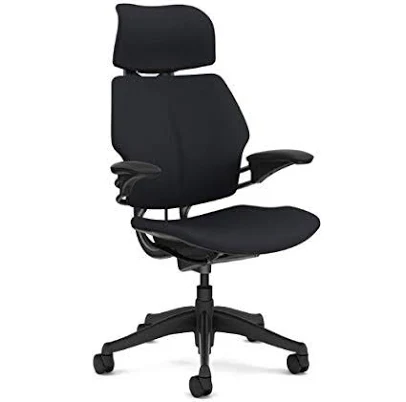
Freedom Chair with Headrest by Humanscale
Lower PFAS concern for the core structure; upholstery finish unknown, ask for material transparency.
The Freedom Chair with Headrest uses aluminum frame, mesh, and foam with no public evidence of Teflon-type coating or Teflon-family coating coatings. Humanscale won't disclose PFAS risks or testing.
We flunk more products than we pass. This one earned its grade. How we grade
Material
mesh fabric, aluminum frame, foam cushioning, polyurethane upholstery options
Brand disclosure
Brand is silent on PFAS
Lab data
No public lab test
You may also be interested in
Top-graded picks in the categories readers replace first, every one scored on the same rubric.

- polypropylene filter housing, carbon/sediment cartridge
- We found no PFAS statement from the brand
- Bacterial growth in spent cartridges
3 hazards checked on this product, all on its full breakdown.

Aquasure
Premier Series 75 GPD Under Sink Reverse Osmosis Water Filtration System
- RO membrane, carbon filters, stainless steel housing
- We found no PFAS statement from the brand
- Bacterial and microbial growth in housing and filters
4 hazards checked on this product, all on its full breakdown.

Avocado
Vegan Mattress
- organic cotton, natural latex, coconut coir, recycled steel coils
- The brand calls it PFAS-free, which we have not verified
- Heavy metals
2 hazards checked on this product, all on its full breakdown.
What Freedom Chair with Headrest by Humanscale is made of, ingredients and materials
The Freedom Chair combines an aluminum frame, mesh fabric seat-back, and foam cushioning with optional polyurethane upholstery. Aluminum frames are chemically stable and non-leaching in normal use. Mesh fabric carries lower off-gassing risk than solid upholstery if undyed or conventionally dyed, but polyurethane foam and any fabric topcoat finish are the primary chemical concern, these can emit volatile organic compounds (VOCs) during off-gassing, especially in the first weeks. The specific formulation of the polyurethane and whether it contains flame-retardant additives remains undisclosed by Humanscale.
What’s concerning
Category baseline
The starting point for this type of product, before anything specific to this product is counted.
No PFAS disclosure
No public statement from the brand about PFAS in this product.
Volatile organic compounds (VOCs) from polyurethane foam and upholstery finish
Polyurethane foam and any synthetic fabric topcoat can off-gas formaldehyde, toluene, and other VOCs, particularly in the first 1-3 weeks. Humanscale does not certify this chair to GREENGUARD, OEKO-TEX, or similar low-VOC standards, leaving actual exposure levels unknown.
Flame retardants
Office furniture commonly contains halogenated or organophosphate flame retardants to meet regulatory burn standards. Humanscale has not publicly committed to halogen-free or bioaccumulative-free formulations in the Freedom Chair, and chemical content is not disclosed.
Source, EPA ↗Formaldehyde / VOCs
Mesh fabric and foam bonding typically use urea-formaldehyde or melamine-formaldehyde resins. Without third-party testing (e.g., OEKO-TEX certification), residual formaldehyde emissions cannot be ruled out, particularly in the first months of use.
Source, ATSDR ↗Polyurethane degradation under heat or UV
Polyurethane upholstery degrades over time when exposed to prolonged heat, sunlight, or mechanical stress, potentially releasing breakdown products. Office chairs near windows or heat vents may experience accelerated wear and chemical release.
What’s reassuring
Base material not linked to PFAS
The main material recorded for this product is not one associated with PFAS.
Azo dyes in mesh or fabric colorants
No public record of azo dye concern for the Freedom Chair; however, Humanscale does not cite OEKO-TEX or equivalent dye certification, so carcinogenic azo compound exclusion is not independently verified.
How is this PFAS grade calculated?
The brand's record and disclosure
Humanscale markets itself as a sustainability-focused furniture manufacturer and holds ISO 14001 environmental management certification, but does not publicly disclose detailed chemical content or third-party testing for VOCs, flame retardants, or other additives in this chair. The brand's silence on upholstery finish composition, including presence or absence of brominated or chlorinated flame retardants, is a notable gap. No product-specific recalls or chemical controversies are documented for the Freedom Chair, but the lack of transparency is inconsistent with claims of environmental responsibility.
How it compares in its category
Office chairs typically integrate polyurethane foam and synthetic upholstery, making VOC off-gassing a category-wide concern; the Freedom Chair's mesh design reduces total upholstery surface area compared to fully padded alternatives, which may slightly lower VOC burden. Many competitors (Herman Miller, Steelcase) publish more detailed material safety data and VOC certifications (e.g., GREENGUARD Gold). Humanscale's refusal to disclose flame-retardant status puts it behind peers that have committed to halogen-free formulations.
If you buy it
Unbox the chair in a well-ventilated space and allow 48-72 hours of off-gassing before sustained use, especially if sensitive to chemical odors. Do not expose foam or upholstery to direct heat sources, which can accelerate VOC release and degrade polyurethane integrity. Clean mesh with a dry or damp cloth only, avoid solvents that may interact with coatings. Request the Safety Data Sheet (SDS) and material composition from the seller before purchase; if Humanscale cannot provide flame-retardant formulation details, consider that a red flag for chemical transparency.
What is not known about PFAS in this product?
- Basis
- Model estimate, 72% confidence, not a lab result
- Lab test
- None on record for this exact product
- Brand statement
- Humanscale has made none
Formulations change between production runs, so check the current label. How we grade.
More office chairs grades
How we score, every product runs through the same public 0-100 rubric based on materials, coatings, brand disclosure, lab findings, and recalls. See the full methodology → Spotted a mistake? Report an error.