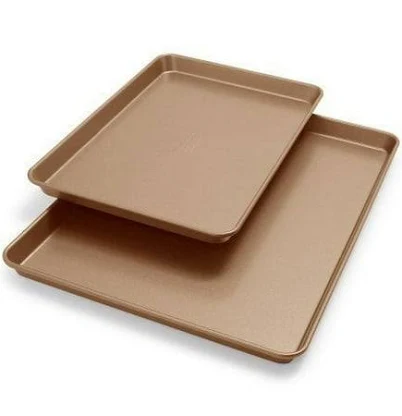
KitchenAid Professional-Grade Nonstick Jellyroll Pan and Baking Sheet
Nonstick coating chemistry not disclosed, raising concern about possible PFAS.
KitchenAid's nonstick coating on this jellyroll pan is not specified. The brand has no PFAS statement on record. Nonstick coatings without disclosed chemistry may contain PFAS.
The better-graded swap
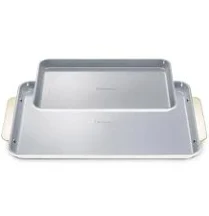
Caraway
Caraway Ceramic Nonstick Baking Sheet Duo
100/100 safety
Same rubric that flunked this product. The swap earned Excellent.
Still want this one anyway? Check the price on Amazon. We’d swap it.
Material
nonstick coating (type unspecified)
Lab data
No public lab test
Is KitchenAid Professional-Grade Nonstick non-toxic? What it is made of
KitchenAid has not publicly specified whether this pan uses Teflon-type coating (Teflon-based) or another nonstick polymer. The jellyroll pan is typically a shallow, flat aluminum or steel substrate with a nonstick topcoat applied industrially. Without disclosure, the exact resin chemistry and whether it contains PFAS-class fluorinated compounds cannot be confirmed from available sources. The coating durability and leaching profile depend entirely on formulation and adherence quality, both opaque here.
What’s concerning
Category baseline
The starting point for this type of product, before anything specific to this product is counted.
No PFAS disclosure
No public statement from the brand about PFAS in this product.
Non-stick, chemistry undisclosed
Marketed as non-stick without stating the coating chemistry.
Teflon-type coating fume inhalation risk
If this pan uses Teflon-type coating, overheating above manufacturer specification (typically 400-500°F) can decompose the polymer and release perfluorooctane and other volatile compounds. KitchenAid's silence on coating type prevents confirmation, but the risk is standard for conventional nonstick cookware used improperly.
Coating degradation and substrate leaching
Mechanical damage or prolonged use can expose underlying aluminum or steel substrate; bare aluminum in acidic foods (tomato sauce, vinegar) may leach trace aluminum into food. No field reports specific to KitchenAid jellyroll pans, but this is a known failure mode for all nonstick cookware with thin coatings.
Unspecified additive leaching
Without disclosure of the nonstick resin type and processing aids, it is impossible to rule out leaching of non-PFAS additives (plasticizers, slip agents, or curing residues) into high-fat foods or acidic baking preparations. The lack of third-party testing data or certifications leaves this unquantified.
Off-gassing during initial use or high heat
New nonstick cookware may emit minor VOCs during the first few uses or at temperature extremes. This is typically mild and transient but unpleasant and poorly characterized for this specific product.
What’s reassuring
Lead
No recalls or documented contamination in KitchenAid cookware; modern US manufacturing typically excludes these metals. However, the absence of explicit material certifications makes full assurance impossible without direct lab analysis.
Source, ATSDR ↗The full breakdown
The brand's record and disclosure
KitchenAid (Whirlpool Corporation subsidiary) does not publicly disclose nonstick coating chemistry or PFAS content for its cookware lines. The brand has faced no major recalls specific to nonstick coating failures or chemical leaching, but silence on formulation is a transparency red flag in an era of PFAS regulation and consumer awareness. No third-party certifications (e.g., GreenGuard, NSF) are visible for this product line.
How it compares in its category
Premium nonstick bakeware from major brands (All-Clad, Calphalon, Rachael Ray) also rarely disclose coating type publicly, making this par for the industry rather than an outlier. Some competitors now advertise PFOA-free or ceramic/mineral coatings; KitchenAid's silence suggests conventional formulation. Stainless steel or cast iron alternatives offer no nonstick coating hazard but require different technique and maintenance.
If you buy it
Hand wash only; do not use metal utensils or abrasive scouring that degrades the coating over time. Avoid prolonged heating above 400-500°F (check manual for exact spec) to minimize any volatile fume risk if Teflon-type coating is present. Replace the pan if coating shows visible wear, peeling, or scratching that exposes substrate. Store flat and dry to prevent coating adhesion failure.
What we don’t know
- Basis
- Model estimate, 35% confidence, not a lab result
- Lab test
- None on record for this exact product
- Brand statement
- Kitchenaid has made a specific claim
Formulations change between production runs, so check the current label. How we grade.
Better-graded alternatives in Bakeware
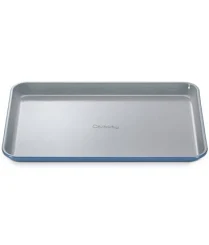
Caraway
Nonstick Ceramic Medium Baking Sheet
- ceramic nonstick coating
- A third party reports verifying it as PFAS-free
- Ceramic coating degradation over time
Caraway
Ceramic Nonstick Baking Sheet Duo
- ceramic nonstick coating
- A third party reports verifying it as PFAS-free
- Coating degradation and durability
2 hazards checked on this product. See all of them.

Caraway
Nonstick Ceramic Large Baking Sheet
- ceramic nonstick coating
- The brand calls it PFAS-free, which we have not verified
- Ceramic coating degradation and particle shedding
3 hazards checked on this product. See all of them.
More bakeware grades
How we score, every product runs through the same public 0-100 rubric based on materials, coatings, brand disclosure, lab findings, and recalls. See the full methodology → Spotted a mistake? Report an error.