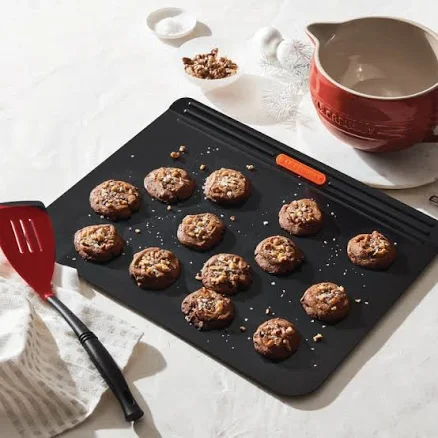
Le Creuset Non-stick Metal Bakeware Cookie Sheet, Is It Non-Toxic?
Avoid until Le Creuset reveals its nonstick coating chemistry.
Le Creuset won't say what nonstick coating this cookie sheet has. Nonstick metal bakeware typically carries PFAS risk unless the maker confirms otherwise.
The better-graded swap
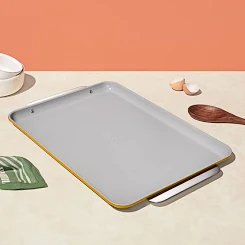
Caraway
Caraway Nonstick Ceramic Large Baking Sheet
90/100 safety
Same rubric that flunked this product. The swap earned Excellent.
Still want this one anyway? Check the price on Amazon. We’d swap it.
Material
Metal bakeware with proprietary non-stick coating (type unspecified)
Lab data
No public lab test
You may also be interested in
Top-graded picks in the categories readers replace first, every one scored on the same rubric.

- polypropylene filter housing, carbon/sediment cartridge
- We found no PFAS statement from the brand
- Bacterial growth in spent cartridges
3 hazards checked on this product, all on its full breakdown.

Aquasure
Premier Series 75 GPD Under Sink Reverse Osmosis Water Filtration System
- RO membrane, carbon filters, stainless steel housing
- We found no PFAS statement from the brand
- Bacterial and microbial growth in housing and filters
4 hazards checked on this product, all on its full breakdown.

Avocado
Vegan Mattress
- organic cotton, natural latex, coconut coir, recycled steel coils
- The brand calls it PFAS-free, which we have not verified
- Heavy metals
2 hazards checked on this product, all on its full breakdown.
Is Le Creuset Non-stick Metal Cookie Sheet non-toxic? What it is made of
Le Creuset's non-stick metal bakeware uses a proprietary coating applied to a steel substrate; the company has not publicly specified whether this coating is Teflon-type coating-based, ceramic, or silicone-based. Metal bakeware itself poses minimal leaching risk, but the non-stick layer is the critical unknown. If the coating contains Teflon-type coating (Teflon), overheating above 500 degrees Fahrenheit can release toxic fumes; if it's ceramic or newer alternative polymer, the risk profile is substantially lower. Without disclosure, you cannot assess the thermal degradation risk accurately.
What’s concerning
Category baseline
The starting point for this type of product, before anything specific to this product is counted.
No PFAS disclosure
No public statement from the brand about PFAS in this product.
Non-stick, chemistry undisclosed
Marketed as non-stick without stating the coating chemistry.
Teflon-type coating (Teflon) thermal decomposition fumes
Non-stick coating type is undisclosed. If Teflon-type coating-based, heating above 500F can release perfluorooctanoic acid and related gases; inhalation may cause polymer fume fever. Le Creuset has not stated whether Teflon-type coating is used.
Coating degradation and fragment ingestion
Non-stick coatings on metal bakeware can chip or peel over time with use and washing. Ingestion of coating fragments is a recognized risk if the coating is not food-safe or if it fragments into particles. Regular inspection is necessary.
Coating-to-substrate adhesion failure
Repeated thermal cycling and mechanical stress from washing can cause non-stick coatings to separate from the metal base, especially if the coating is thin or the adhesion chemistry is suboptimal. No specific recalls for Le Creuset bakeware, but this is a category-wide risk.
What’s reassuring
Metal substrate corrosion or reactivity
Steel-based bakeware does not typically leach heavy metals or reactive compounds under normal use. No known issues on record for Le Creuset metal bakeware substrate itself.
Proprietary coating allergenicity or off-gassing
Without detailed composition disclosure, potential volatile organic compounds (VOCs) or other off-gassing from the coating cannot be assessed. No complaints or safety alerts on record for this product line, but transparency gap remains.
How is this PFAS grade calculated?
The brand's record and disclosure
Le Creuset maintains a strong reputation for cookware durability and has ISO 14001 environmental certification, but the company has not published detailed material safety data sheets or coating composition for its non-stick bakeware line. The brand has faced no major product recalls related to non-stick bakeware in public records, which is a positive signal. However, silence on PFAS and coating chemistry is increasingly viewed as a red flag in the cookware category, especially as competitors like Caraway and GreenPan have begun marketing Teflon-type coating-free alternatives with explicit transparency.
How it compares in its category
Le Creuset's non-stick metal bakeware is positioned at the premium end of the market; comparable products from All-Clad, Calphalon, and OXO range from Teflon-type coating-explicit to ceramic-coated alternatives. Most mass-market non-stick bakeware still uses Teflon-type coating, so Le Creuset is not an outlier in this regard. The advantage of Le Creuset is manufacturing reputation and durability; the disadvantage is that premium pricing has not translated into premium transparency about what non-stick technology is actually in use.
If you buy it
Keep oven temperatures below 500 degrees Fahrenheit unless Le Creuset explicitly confirms the coating is Teflon-type coating-free. Hand-wash rather than dishwasher to extend coating life and reduce risk of scratching, which can accelerate degradation. Inspect the coating regularly for peeling, flaking, or discoloration; if damage is visible, discontinue use to avoid ingesting coating fragments or exposing yourself to fume risk if the product is heated further. Replace the bakeware if the non-stick surface becomes noticeably rougher or sticky, as this indicates loss of coating integrity.
What is not known about PFAS in this product?
- Basis
- Model estimate, 35% confidence, not a lab result
- Lab test
- None on record for this exact product
- Brand statement
- Le Creuset has made a specific claim
Formulations change between production runs, so check the current label. How we grade.
What are the PFAS-free alternatives to Le Creuset Non-stick Metal Bakeware Cookie Sheet?
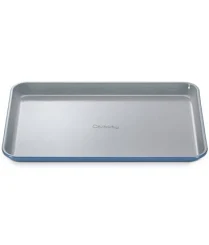
- ceramic nonstick coating
- A third party reports verifying it as PFAS-free
- Ceramic coating degradation over time
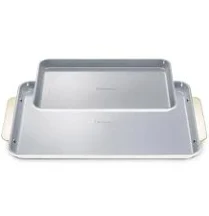
- ceramic nonstick coating
- A third party reports verifying it as PFAS-free
- Coating degradation and durability
2 hazards checked on this product, all on its full breakdown.
- ceramic nonstick coating
- The brand calls it PFAS-free, which we have not verified
- Ceramic coating degradation and particle shedding
3 hazards checked on this product, all on its full breakdown.
More bakeware grades
How we score, every product runs through the same public 0-100 rubric based on materials, coatings, brand disclosure, lab findings, and recalls. See the full methodology → Spotted a mistake? Report an error.