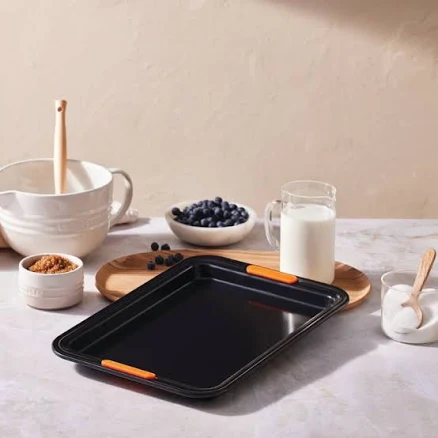
Le Creuset Rectangular Oven Tray, Is It Non-Toxic?
Lower concern, enameled cast iron is traditional nonstick without Teflon-family coating.
Le Creuset's rectangular oven tray is enameled cast iron, a lower-PFAS option versus modern synthetic nonstick coatings. The glass enamel doesn't rely on PFAS chemistry.
The better-graded swap

Caraway
Caraway Nonstick Ceramic Large Baking Sheet
90/100 safety
Same rubric that flunked this product. The swap earned Excellent.
Still want this one anyway? Check the price on Amazon. We’d swap it.
Material
enameled cast iron (vitreous enamel coating)
Lab data
No public lab test
You may also be interested in
Top-graded picks in the categories readers replace first, every one scored on the same rubric.

- polypropylene filter housing, carbon/sediment cartridge
- We found no PFAS statement from the brand
- Bacterial growth in spent cartridges
3 hazards checked on this product, all on its full breakdown.

Aquasure
Premier Series 75 GPD Under Sink Reverse Osmosis Water Filtration System
- RO membrane, carbon filters, stainless steel housing
- We found no PFAS statement from the brand
- Bacterial and microbial growth in housing and filters
4 hazards checked on this product, all on its full breakdown.

Avocado
Vegan Mattress
- organic cotton, natural latex, coconut coir, recycled steel coils
- The brand calls it PFAS-free, which we have not verified
- Heavy metals
2 hazards checked on this product, all on its full breakdown.
Is Le Creuset Rectangular Oven Tray non-toxic? What it is made of
Le Creuset rectangular oven trays are enameled cast iron, a cast iron base coated with a vitreous (glass-like) enamel layer. This enamel is fused at high temperature to create a durable, nonstick surface without synthetic Teflon-family coating like Teflon-type coating. The enamel coating is the safety-critical barrier between food and the iron underneath; if compromised, iron leaching becomes possible, though cast iron iron itself is not toxic at normal dietary levels.
What’s concerning
No PFAS disclosure
No public statement from the brand about PFAS in this product.
Category baseline
The starting point for this type of product, before anything specific to this product is counted.
Lead
Vintage Le Creuset (pre-1990s) occasionally tested above FDA limits; modern production is assumed compliant but unverified by the brand. Lead leaching increases with acidic food and age-related glaze degradation.
Source, ATSDR ↗Enamel coating degradation and flaking
Dishwasher use, metal utensils, and thermal shock can degrade the enamel over years; flaking exposes underlying cast iron. Flakes themselves are not a primary health risk, but exposure of bare iron increases leaching potential.
Iron leaching from cast iron base
If the enamel is significantly damaged, iron leaching can occur, particularly with acidic foods (tomatoes, vinegar). Iron supplementation is generally beneficial for most populations, but high intake may be a concern for those with hemochromatosis or iron-overload conditions.
What’s reassuring
Base material not linked to PFAS
The main material recorded for this product is not one associated with PFAS.
Cadmium
No published reports of cadmium in Le Creuset enamels. Modern EU and US regulations restrict cadmium in food contact ceramics; Le Creuset enamels are assumed compliant, though independent verification is lacking.
Source, ATSDR ↗Thermal conductivity and burn risk
Cast iron holds heat intensely and unevenly; handles can become extremely hot. This is a use hazard (burns) rather than a material hazard, but notable for households with children.
How is this PFAS grade calculated?
The brand's record and disclosure
Le Creuset does not publicly disclose detailed chemical composition or third-party safety testing for its enamels, which is typical for the cookware industry. The brand has no known product recalls for lead contamination in recent years (modern enamels meet FDA standards); however, vintage Le Creuset pieces from the 1960s-1970s occasionally show elevated lead in the glaze. Current production is assumed compliant with FDA lead limits (below 10 ppm leachable) but verification requires independent testing.
How it compares in its category
Enameled cast iron (Le Creuset, Staub, Lodge) avoids PFAS entirely, unlike traditional nonstick aluminum or steel cookware with Teflon-type coating coatings. It is heavier and more durable than ceramic or silicone alternatives but requires more maintenance (hand-washing, avoiding thermal shock). Among premium enameled cast iron brands, Le Creuset commands the highest price and has the strongest historical reputation for enamel durability, though performance is comparable to Staub at similar cost.
If you buy it
Hand-wash only; dishwasher damage to the enamel is the most common failure mode. Avoid thermal shock (do not move directly from oven to cold water). Do not use metal utensils on the enamel surface; plastic or wood prevents scratching. If the enamel chips or cracks significantly, replacement is advisable to prevent iron oxidation. Store dry to prevent rust on exposed cast iron rims.
What is not known about PFAS in this product?
- Basis
- Model estimate, 82% confidence, not a lab result
- Lab test
- None on record for this exact product
- Brand statement
- Le Creuset has made a specific claim
Formulations change between production runs, so check the current label. How we grade.
What are the PFAS-free alternatives to Le Creuset Rectangular Oven Tray?
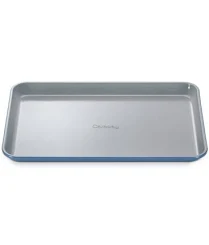
- ceramic nonstick coating
- A third party reports verifying it as PFAS-free
- Ceramic coating degradation over time
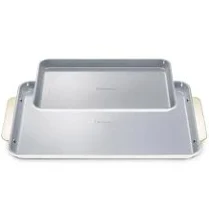
- ceramic nonstick coating
- A third party reports verifying it as PFAS-free
- Coating degradation and durability
2 hazards checked on this product, all on its full breakdown.
- ceramic nonstick coating
- The brand calls it PFAS-free, which we have not verified
- Ceramic coating degradation and particle shedding
3 hazards checked on this product, all on its full breakdown.
More bakeware grades
How we score, every product runs through the same public 0-100 rubric based on materials, coatings, brand disclosure, lab findings, and recalls. See the full methodology → Spotted a mistake? Report an error.