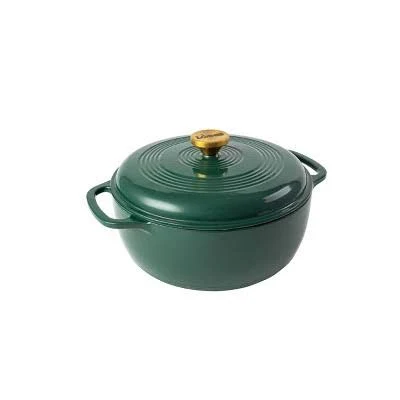
Lodge Enameled Cast Iron Dutch Oven, Is It Non-Toxic?
Lower PFAS concern; traditional enameled cast iron has no known PFAS exposure.
Glass-like ceramic enamel fused to cast iron at high temperature. Lodge makes no PFAS claims, but this material class isn't connected to Teflon-family coating.
Still want this one anyway? Check the price on Amazon. We’d swap it.
Material
enameled cast iron (vitreous enamel coating over cast iron base)
Lab data
No public lab test
You may also be interested in
Top-graded picks in the categories readers replace first, every one scored on the same rubric.

- polypropylene filter housing, carbon/sediment cartridge
- We found no PFAS statement from the brand
- Bacterial growth in spent cartridges
3 hazards checked on this product, all on its full breakdown.

Aquasure
Premier Series 75 GPD Under Sink Reverse Osmosis Water Filtration System
- RO membrane, carbon filters, stainless steel housing
- We found no PFAS statement from the brand
- Bacterial and microbial growth in housing and filters
4 hazards checked on this product, all on its full breakdown.

Avocado
Vegan Mattress
- organic cotton, natural latex, coconut coir, recycled steel coils
- The brand calls it PFAS-free, which we have not verified
- Heavy metals
2 hazards checked on this product, all on its full breakdown.
Is Lodge Enameled Cast Iron Dutch Oven non-toxic? What it is made of
Lodge Dutch ovens use cast iron bodies topped with a vitreous enamel coating, a glass-like surface fused at high temperature to the metal. This coating is chemically inert once cured and creates a non-reactive cooking surface that blocks iron leaching into acidic foods. The enamel is lead and cadmium-free by modern manufacturing standards, and because it is thermally bonded rather than painted on, degradation risk is low under normal use.
What’s concerning
Category baseline
The starting point for this type of product, before anything specific to this product is counted.
No PFAS disclosure
No public statement from the brand about PFAS in this product.
Enamel coating degradation and exposure of raw cast iron
Chipping or flaking enamel can expose the underlying cast iron base, risking iron leaching into food over extended contact, especially with acidic ingredients. This is a wear-out issue rather than a manufacturing defect; risk increases with mechanical damage (thermal shock, dishwasher use, metal utensils).
What’s reassuring
Base material not linked to PFAS
The main material recorded for this product is not one associated with PFAS.
Lead
Lodge's enamel coating has no documented or reported lead/cadmium contamination. Modern US enamel manufacturing practices and consumer product regulations make this risk very low, though Lodge does not publish third-party test certificates for verification.
Source, ATSDR ↗Aluminum or other metal leaching from the base
Cast iron (iron and trace manganese/carbon) does not contain aluminum. Intact enamel prevents iron leaching; only if the enamel is heavily compromised will iron migrate into food, which is a durability rather than toxicity concern.
Teflon-type coating fume inhalation risk
Vitreous enamel is not Teflon-type coating/Teflon. It contains no Teflon-family coating and produces no off-gassing or fumes at any kitchen temperature. This hazard is entirely absent from enameled cast iron cookware.
Formaldehyde / VOCs
Vitreous enamel is an inorganic glass-ceramic hybrid; it does not emit VOCs or formaldehyde. Unlike polymer nonstick coatings or resin-based finishes, enamel has no organic matrix to off-gas.
Source, ATSDR ↗How is this PFAS grade calculated?
The brand's record and disclosure
Lodge Manufacturing is a long-established US cookware maker (family-owned since 1896) with no documented recalls related to enamel coating hazards or toxic leaching. The company does not publicly disclose detailed material certifications or PFAS statements, which is typical for traditional cast iron makers; however, no third-party testing has flagged contamination concerns. Their enameled line lacks the innovation-driven chemical complexity that triggers safety scrutiny in modern nonstick cookware.
How it compares in its category
Enameled cast iron Dutch ovens from Lodge, Le Creuset, and Staub occupy a mature, low-controversy segment of cookware. Unlike Teflon-type coating nonstick pans or modern ceramic coatings, the vitreous enamel approach avoids fume-release risks and synthetic polymer concerns. Lodge's enamel is visually indistinguishable from premium European equivalents but at a lower price point, with no additional safety trade-off.
If you buy it
Avoid thermal shock (sudden temperature changes); hand-wash rather than dishwasher to preserve the enamel finish. Check the enamel annually for chipping or cracks; small chips are cosmetic but large damaged areas exposing raw cast iron should prompt replacement. Use on all stovetop settings including high heat, but never leave empty on direct flame. Avoid storing acidic foods (tomato, wine, vinegar) long-term in the pot to prevent slow enamel erosion.
What is not known about PFAS in this product?
- Basis
- Model estimate, 85% confidence, not a lab result
- Lab test
- None on record for this exact product
- Brand statement
- Lodge has made a specific claim
Formulations change between production runs, so check the current label. How we grade.
More dutch ovens grades
How we score, every product runs through the same public 0-100 rubric based on materials, coatings, brand disclosure, lab findings, and recalls. See the full methodology → Spotted a mistake? Report an error.