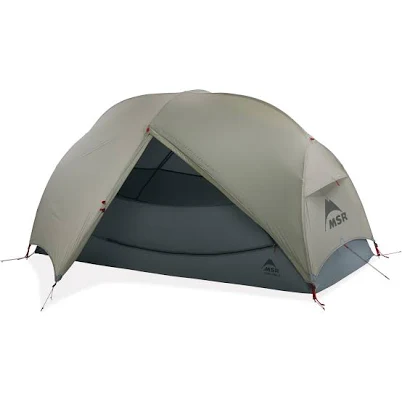
MSR Hubba Hubba LT 1 Backpacking Tent
Avoid until MSR discloses its water-repellent coating formula or certifies PFAS-free.
The Hubba Hubba LT uses ripstop nylon with a water-repellent finish typical of backpacking tents. MSR provides no public disclosure of the water-repellent coating treatment chemistry or PFAS status.
Still want this one anyway? Check the price on Amazon. We’d swap it.
Material
Ripstop nylon with water-repellent coating (water-repellent coating) coating
Brand disclosure
Brand is silent on PFAS
Lab data
No public lab test
What MSR Hubba Hubba LT 1 Backpacking Tent is made of, ingredients and materials
The Hubba Hubba LT uses ripstop nylon (likely 20D or 30D) as its primary fabric, chosen for strength-to-weight ratio on backpacking tents. The water-repellent coating (water-repellent coating) coating on the fly and floor is the chemical question, MSR does not publicly specify whether this is fluorinated PFAS-based or fluorine-free. Ripstop nylon itself is inert and well-tolerated; the coating's composition is where potential hazards concentrate.
What’s concerning
Category baseline
The starting point for this type of product, before anything specific to this product is counted.
No PFAS disclosure
No public statement from the brand about PFAS in this product.
Waterproof / stain-resistant treatment
Water-repellent coating treatments have historically used PFAS.
PFAS
Ripstop nylon water-repellent coating coatings are commonly fluorinated PFAS compounds (e.g., C6 or C8 variants). MSR does not disclose the specific chemistry; absence of evidence is not evidence of safety. Fluorine-free alternatives exist but MSR has not adopted or marketed them for this model.
Source, ATSDR ↗Nylon Degradation and Microfiber Release
Ripstop nylon degrades under UV and mechanical stress, potentially releasing microfibers. This is not unique to MSR but is inherent to synthetic tent fabrics; concerns are highest after years of use in intense sun or if fabric tears.
What’s reassuring
Off-gassing from Fabric Treatments
No field reports of respiratory irritation or odor complaints specific to Hubba Hubba LT. Initial off-gassing (if any) is minimal in ventilated outdoor use; not a significant hazard for this category.
Seam Sealant Composition
Factory seam sealing typically uses polyurethane-based adhesives; no toxicity data on MSR's specific formulation, and exposure is minimal in normal use since seams are interior-facing or under the outer fly.
Heavy metals
No reports of heavy metal contamination in MSR tent fabrics. Nylon dyes are typically azo dyes or acid dyes, regulated in outdoor textiles; no specific flag for this brand or product.
Source, FDA ↗The full breakdown
The brand's record and disclosure
MSR (owned by Clarus Corporation) has not published a formal PFAS disclosure or elimination timeline for their tent products as of available public records. The company does not advertise PFAS-free certifications on this model. MSR is known for safety-focused design and rigorous durability testing, but chemical transparency in textiles remains a gap. Direct contact with MSR about water-repellent coating chemistry will likely yield a generic 'meets regulatory standards' response without specifics.
How it compares in its category
Most mainstream backpacking tents (Big Agnes, REI Co-op, Nemo) use fluorinated water-repellent coating coatings without disclosure; MSR is not an outlier here. High-end alternatives marketed as PFAS-free (e.g., some Hilleberg models with wax-based or PFC-free treatments) exist but carry higher cost and often heavier weight. For a sub-2-lb ultralight tent, the water-repellent coating is standard practice across the industry, making MSR's opacity typical rather than exceptional.
If you buy it
Store dry and well-ventilated to prevent mold and off-gassing of any residual solvents; avoid prolonged heat exposure (dry only in shade or gentle breeze, never near heat). water-repellent coating coatings degrade with washing and UV exposure; refresh every 1-2 seasons with commercial water-repellent coating spray if water beading diminishes. Inspect seams and floor for wear annually; small holes can be patched with nylon repair kits. If PFAS exposure is a priority concern, this product remains a borderline choice without manufacturer transparency.
What we don’t know
- Basis
- Model estimate, 45% confidence, not a lab result
- Lab test
- None on record for this exact product
- Brand statement
- MSR has made none
Formulations change between production runs, so check the current label. How we grade.
More camping tents & tarps grades
How we score, every product runs through the same public 0-100 rubric based on materials, coatings, brand disclosure, lab findings, and recalls. See the full methodology → Spotted a mistake? Report an error.