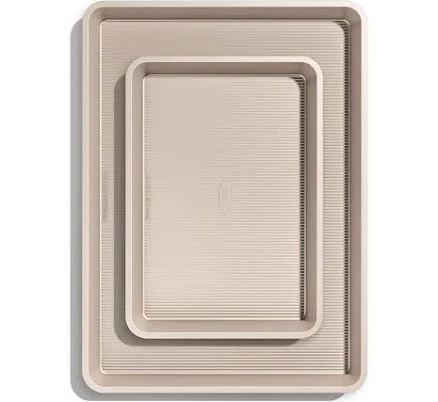
OXO Good Grips Nonstick Pro 2-Piece Sheet Pan Set
Skip until OXO discloses nonstick coating composition.
OXO does not specify what nonstick coating is used on these sheet pans. Without disclosure of Teflon-type coating or Teflon-family coating content, PFAS risk cannot be assessed from public information.
The better-graded swap

Caraway
Caraway Nonstick Ceramic Large Baking Sheet
90/100 safety
Same rubric that flunked this product. The swap earned Excellent.
Still want this one anyway? Check the price on Amazon. We’d swap it.
Material
Carbon steel with nonstick coating, composition unspecified
Lab data
No public lab test
Is OXO Good Grips Nonstick Pro 2-Piece Sheet non-toxic? What it is made of
OXO Good Grips Nonstick Pro sheet pans are carbon steel cores with an applied nonstick coating of unspecified composition. OXO has not publicly disclosed whether this coating contains Teflon-type coating (Teflon) or alternative fluorinated compounds, or if it is fluorine-free. Carbon steel itself is not a material linked to PFAS; the hazard profile depends entirely on the coating type, durability, and manufacturing process used.
What’s concerning
Category baseline
The starting point for this type of product, before anything specific to this product is counted.
No PFAS disclosure
No public statement from the brand about PFAS in this product.
Non-stick, chemistry undisclosed
Marketed as non-stick without stating the coating chemistry.
Teflon-type coating fume risk (thermal degradation)
If coating is Teflon-type coating-based, heating above 500F (260C) can release polymer fumes; OXO has not confirmed coating type, making risk assessment incomplete. Consumer adherence to safe temperature use is the primary mitigation.
Coating degradation and particle shedding
All applied nonstick coatings degrade with time and use. As the OXO coating chips or flakes, fragments may be ingested or inhaled; the extent and composition of shed particles cannot be determined without disclosure of coating formula.
Coating adhesion and delamination
Online consumer reports document uneven nonstick wear and occasional coating bubbling or peeling after 1-3 years of use. OXO has not published durability benchmarks or warranty terms addressing coating failure.
What’s reassuring
Lead
No public recalls or test reports have identified lead or cadmium in OXO nonstick cookware coatings. Carbon steel substrate itself is not a source of these metals under normal use.
Source, ATSDR ↗Aluminum leaching
These pans are carbon steel, not aluminum; aluminum leaching is not a concern for this product.
The full breakdown
The brand's record and disclosure
OXO (owned by Groupe SEB) has not published technical data sheets or safety certifications detailing the nonstick coating chemistry for this product line. The brand does not maintain a public PFAS or fluorine-free product directory. No widespread recalls or safety warnings specific to OXO nonstick cookware have been documented in major consumer safety databases, but the absence of transparency limits independent verification of PFAS content.
How it compares in its category
OXO nonstick sheet pans occupy the mid-market segment with moderate durability claims. Competitors offering full transparency include GreenPan (ceramic coatings, Teflon-type coating-free), Our Place (ceramic hybrid), and Caraway (proprietary Teflon-type coating-free formula). Traditional uncoated carbon steel and stainless steel sheet pans eliminate coating longevity and composition concerns entirely but require seasoning and higher skill. OXO's positioning relies on convenience rather than disclosed safety credentials.
If you buy it
Avoid preheating above 400F (204C) empty, as nonstick coating degradation risk rises sharply at higher temperatures. Use silicone or wooden utensils only; metal tools scratch and accelerate coating failure. Hand-wash with mild soap rather than dishwasher, which degrades nonstick coatings faster. If coating visibly flakes, peels, or becomes slick uneven after 2-3 years, replace the pans; continued use of degraded coating may increase exposure to coating particulates.
What we don’t know
- Basis
- Model estimate, 35% confidence, not a lab result
- Lab test
- None on record for this exact product
- Brand statement
- OXO has made a specific claim
Formulations change between production runs, so check the current label. How we grade.
Better-graded alternatives in Bakeware
Caraway
Nonstick Ceramic Medium Baking Sheet
- ceramic nonstick coating
- A third party reports verifying it as PFAS-free
- Ceramic coating degradation over time
Caraway
Ceramic Nonstick Baking Sheet Duo
- ceramic nonstick coating
- A third party reports verifying it as PFAS-free
- Coating degradation and durability
2 hazards checked on this product. See all of them.
Caraway
Nonstick Ceramic Large Baking Sheet
- ceramic nonstick coating
- The brand calls it PFAS-free, which we have not verified
- Ceramic coating degradation and particle shedding
3 hazards checked on this product. See all of them.
More bakeware grades
How we score, every product runs through the same public 0-100 rubric based on materials, coatings, brand disclosure, lab findings, and recalls. See the full methodology → Spotted a mistake? Report an error.