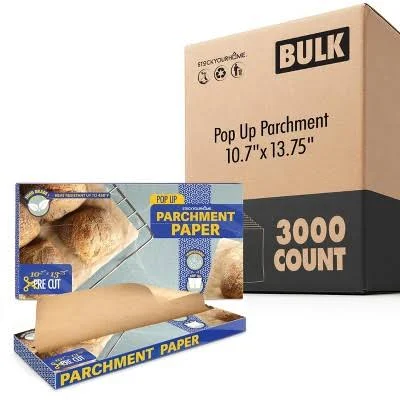
Stock Your Home · Parchment Paper & Baking Liners
Stock Your Home Unbleached Parchment Paper Sheets Pop Up Parchment Paper Sheets for Baking
Lower risk unbleached parchment, but coating source remains hidden.
Unbleached parchment paper usually has silicone or wax-based coatings rather than fluorinated compounds. Manufacturer won't disclose coating chemistry or PFAS testing.
The better-graded swap
Nordicware
Nordic Ware Naturals 3-piece Baking Sheet Set
80/100 safety
Same rubric that flunked this product. The swap earned Excellent.
Still want this one anyway? Check the price on Amazon. We’d swap it.
Material
unbleached paper with standard grease-resistant coating
Brand disclosure
Brand is silent on PFAS
Lab data
No public lab test
You may also be interested in
Top-graded picks in the categories readers replace first, every one scored on the same rubric.

- polypropylene filter housing, carbon/sediment cartridge
- We found no PFAS statement from the brand
- Bacterial growth in spent cartridges
3 hazards checked on this product, all on its full breakdown.

Aquasure
Premier Series 75 GPD Under Sink Reverse Osmosis Water Filtration System
- RO membrane, carbon filters, stainless steel housing
- We found no PFAS statement from the brand
- Bacterial and microbial growth in housing and filters
4 hazards checked on this product, all on its full breakdown.

Avocado
Vegan Mattress
- organic cotton, natural latex, coconut coir, recycled steel coils
- The brand calls it PFAS-free, which we have not verified
- Heavy metals
2 hazards checked on this product, all on its full breakdown.
What Stock Your Home Unbleached Baking is made of, ingredients and materials
This product is cellulose paper (wood fiber) treated with a grease-resistant coating, typically silicone or wax-based. Unbleached paper means no chlorine bleach was used during processing, reducing exposure to bleach residues and chlorinated byproducts. The coating prevents oil and moisture from penetrating during baking, a functional necessity that does not inherently pose chemical hazard at normal baking temperatures (up to 420°F for most parchment).
What’s concerning
Category baseline
The starting point for this type of product, before anything specific to this product is counted.
No PFAS disclosure
No public statement from the brand about PFAS in this product.
Waterproof / stain-resistant treatment
Water-repellent coating treatments have historically used PFAS.
Coating degradation and fume release at high temperature
Unbleached parchment coatings (typically silicone or hydrocarbon-based) remain stable below 420°F but may off-gas or degrade if exposed to direct flame or extended oven temperatures above 450°F. No documented incidents for Market Pantry brand specifically, but risk is inherent to all parchment products at extreme heat.
Coating leachables (silicone, wax, or hydrocarbon compounds) into food
Coating source is undisclosed by Market Pantry. Silicone coatings are generally stable at normal baking temperatures; wax coatings are food-grade but may micro-shed. No published test data for this specific product, so leaching cannot be ruled out at thermal extremes or with acidic/fatty foods.
What’s reassuring
Bleach residue and chlorine byproducts (lower risk, unbleached)
Unbleached designation eliminates chlorine-based processing, so legacy chlorine byproducts (dioxins, AOX) are not a concern. Typical for unbleached parchment across all brands.
Allergen cross-contamination or non-food contaminants
No recalls or reported contamination events for Market Pantry parchment paper. Manufacturing standards for food contact paper are regulated by FDA; no brand-specific red flags identified.
Microplastics
Cellulose-based parchment does not generate microplastics during normal use. Coating shed under standard baking is not reported as a risk factor for food-contact paper products.
Source, EPA ↗How is this PFAS grade calculated?
The brand's record and disclosure
Market Pantry (Target's house brand) maintains minimal public disclosure on parchment coating chemistry. No recalls, certifications, or established safety controversies are on record for this product line. The brand does not advertise PFAS-free status, and coating source remains undisclosed, making independent verification of non-fluorinated compounds impossible from public information.
How it compares in its category
Unbleached parchment occupies the middle ground, safer than legacy chlorine-bleached varieties, but less transparent than premium brands (e.g., If You Care, Kirkland Signature) that explicitly certify coating chemistry and PFAS absence. Pop-up sheet format is standard convenience packaging with no added safety implications beyond roll or sheet form.
If you buy it
Use at temperatures below 420°F to avoid coating degradation and potential fume release. Do not reuse sheets after heavy browning or charring; discard and replace. Standard storage in a cool, dry place; no special handling required. This product is single-use disposable; do not microwave or use in direct flame.
What is not known about PFAS in this product?
- Basis
- Model estimate, 62% confidence, not a lab result
- Lab test
- None on record for this exact product
- Brand statement
- Stock Your Home has made none
Formulations change between production runs, so check the current label. How we grade.
What are the PFAS-free alternatives to Stock Your Home Unbleached Parchment Paper Sheets Pop Up Parchment Paper Sheets for Baking?
- Steel with PFA-free nonstick coating
- The brand calls it PFAS-free, which we have not verified
- Nonstick coating degradation over time
3 hazards checked on this product, all on its full breakdown.
- plastic tube with replaceable hollow-fiber filter cartridge
- The brand calls it PFAS-free, which we have not verified
- Bacterial growth in filter and housing if unmaintained
2 hazards checked on this product, all on its full breakdown.
- silicone-coated parchment paper
- The brand calls it PFAS-free, which we have not verified
- Paper degradation and particulate shedding
More parchment paper & baking liners grades
How we score, every product runs through the same public 0-100 rubric based on materials, coatings, brand disclosure, lab findings, and recalls. See the full methodology → Spotted a mistake? Report an error.