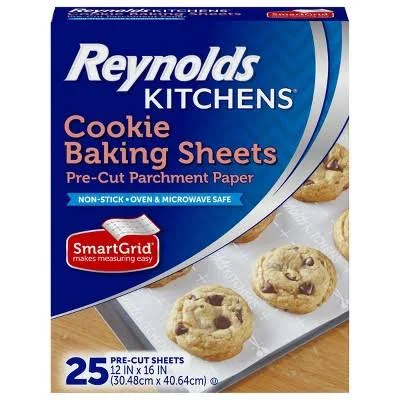
Reynolds Kitchens Cookie Baking Sheets Parchment Paper Non-Stick 22 Sheets
Non-stick parchment paper; PFAS risk unclear without coating transparency.
Reynolds does not disclose the non-stick coating composition. Parchment paper non-stick treatments often contain PFAS, but specifics unknown here. Consider uncoated parchment or silicone-lined alternatives if PFAS is a concern.
The better-graded swap
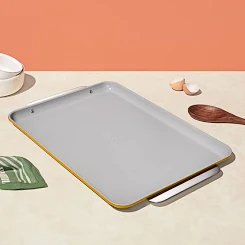
Caraway
Caraway Nonstick Ceramic Large Baking Sheet
90/100 safety
Same rubric that flunked this product. The swap earned Excellent.
Still want this one anyway? Check the price on Amazon. We’d swap it.
Material
paper with unspecified non-stick coating
Lab data
No public lab test
Are Reynolds Kitchens Cookie Baking Sheets non-toxic? What it is made of
Reynolds parchment paper is cellulose paper coated with a non-stick agent; the company does not publicly disclose whether this coating contains Teflon-type coating, silicone, or other synthetics. The coating enables food release and non-stick performance but introduces uncertainty about off-gassing at high temperatures and leaching into fatty foods. Parchment's paper base is generally stable under normal baking conditions (up to 420°F typical range), but the coating chemistry is the variable.
What’s concerning
Category baseline
The starting point for this type of product, before anything specific to this product is counted.
No PFAS disclosure
No public statement from the brand about PFAS in this product.
Non-stick, chemistry undisclosed
Marketed as non-stick without stating the coating chemistry.
PFAS
Reynolds does not disclose whether the non-stick coating contains Teflon-type coating. If present, overheating beyond 500°F can release polymer fumes; normal baking use (under 420°F) presents minimal risk, but the unknown formulation prevents certainty.
Source, ATSDR ↗Coating degradation and microparticle release
Repeated use, high heat, or physical abrasion can cause the coating to flake or shed into food. Degraded parchment should be discarded rather than reused to avoid ingestion of coating particles.
Leaching into fatty or acidic foods
Non-stick coatings can leach into foods with high fat content or low pH (oils, acidic fillings) if the coating deteriorates or if extended contact occurs. This risk is present but not quantified for Reynolds' specific formulation.
What’s reassuring
Bleaching residues or chlorine compounds in the paper base
Reynolds does not specify whether parchment is chlorine-free or oxygen-bleached. Standard commercial parchment is food-safe under FDA regulations, but unbleached alternatives carry lower residue risk if sensitivity is a concern.
Thermal stability of adhesives or binders
No established safety issues are on record for Reynolds parchment adhesives or paper binders under normal baking temperatures. This hazard is not substantiated by public data or recalls.
The full breakdown
The brand's record and disclosure
Reynolds maintains minimal public transparency about non-stick coating composition. The company has not published independent testing or third-party certifications (such as FDA clearance letters or NSF listings) that would confirm coating safety profiles. No major recalls or safety complaints are documented for this product in FDA or CPSC records. Reynolds' silence on PFAS and coating ingredients is consistent with industry-wide opacity on parchment formulations.
How it compares in its category
Parchment paper is considered a middle-ground option versus silicone baking mats (which pose microplastic/leaching risks when degraded) and uncoated paper (which offers no non-stick benefit). Unbleached or chlorine-free parchment alternatives exist from brands like If You Care, which disclose coating materials more openly. Reynolds is a market standard but not differentiated by transparency or certification in the parchment segment.
If you buy it
Keep parchment below 420°F to avoid potential coating degradation or fume release. Do not reuse sheets extensively; replace if coating shows wear, browning, or flaking. Use primarily for baked goods rather than prolonged contact with fatty or acidic foods to minimize leaching risk. Store in a cool, dry place away from direct heat, as exposure can degrade the coating prematurely.
What we don’t know
- Basis
- Model estimate, 35% confidence, not a lab result
- Lab test
- None on record for this exact product
- Brand statement
- Reynolds has made a specific claim
Formulations change between production runs, so check the current label. How we grade.
Better-graded alternatives in Bakeware
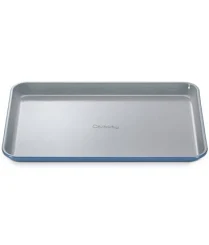
Caraway
Nonstick Ceramic Medium Baking Sheet
- ceramic nonstick coating
- A third party reports verifying it as PFAS-free
- Ceramic coating degradation over time
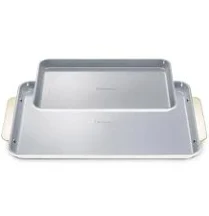
Caraway
Ceramic Nonstick Baking Sheet Duo
- ceramic nonstick coating
- A third party reports verifying it as PFAS-free
- Coating degradation and durability
2 hazards checked on this product. See all of them.
Caraway
Nonstick Ceramic Large Baking Sheet
- ceramic nonstick coating
- The brand calls it PFAS-free, which we have not verified
- Ceramic coating degradation and particle shedding
3 hazards checked on this product. See all of them.
More bakeware grades
How we score, every product runs through the same public 0-100 rubric based on materials, coatings, brand disclosure, lab findings, and recalls. See the full methodology → Spotted a mistake? Report an error.