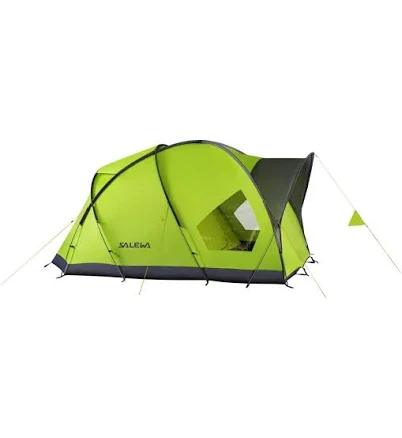
Salewa · Camping Tents & Tarps
Salewa Alpine Hut III Tent
Skip or contact Salewa directly, as tent waterproofing is a PFAS concern but brand won't say.
The Alpine Hut III is a 3-season mountaineering tent with polyester treated for water repellency. Salewa makes no public disclosure about PFAS-free water-repellent coating chemistry or third-party certification. Tent coatings have historically used PFAS, so verification is needed.
Still want this one anyway? Check the price on Amazon. We’d swap it.
Material
Polyester fabric with water-repellent coating (water-repellent coating) coating
Brand disclosure
Brand is silent on PFAS
Lab data
No public lab test
What Salewa Alpine Hut III Tent is made of, ingredients and materials
The Alpine Hut III uses polyester fabric as its primary material, which is chemically stable and does not off-gas harmful volatiles under normal camping conditions. The critical component is the water-repellent coating (water-repellent coating) coating applied to achieve waterproofing. water-repellent coating coatings on mass-market tents typically contain PFAS (PFAS "forever chemicals"), which are highly persistent chemicals that resist water and stains. Polyester itself is non-toxic, but the coating's chemical composition determines whether PFAS or alternative hydrophobic agents were used, and Salewa has not publicly disclosed which.
What’s concerning
Category baseline
The starting point for this type of product, before anything specific to this product is counted.
No PFAS disclosure
No public statement from the brand about PFAS in this product.
Waterproof / stain-resistant treatment
Water-repellent coating treatments have historically used PFAS.
PFAS
Standard practice in mass-market tent waterproofing; Salewa silent on specifics. PFAS bioaccumulates and persists in the environment and body. Coating remains on fabric throughout tent life and may leach with water contact or degradation.
Source, ATSDR ↗Polyester microfiber shedding
Polyester fabrics can release microfibers during washing or wear, particularly if the tent is aggressively cleaned or damaged. Shed microfibers may enter soil and water systems. Normal camping use poses minimal shedding risk compared to repeated washing.
Formaldehyde / VOCs
Polyester fabrics sometimes use formaldehyde-based resins for shrink resistance or dye fixation. Salewa does not disclose finishing chemistry. Off-gassing is typically minimal outdoors but could accumulate if tent is stored sealed in warm, humid conditions.
Source, ATSDR ↗Azo dyes in colored fabric
If the tent uses colored polyester panels, azo dyes may be present, though most commercial dyes are now regulated to avoid highly toxic anilines. No specific recalls or warnings exist for Salewa tents; risk is general to the product class and minimal under normal use.
water-repellent coating degradation and re-application exposure
As the water-repellent coating wears, water absorption increases, and the tent may require re-treatment. Commercial water-repellent coating re-treatments typically contain fluorine-based PFAS. This creates repeated exposure cycles if the tent is maintained over many seasons.
The full breakdown
The brand's record and disclosure
Salewa, owned by Intersport International, does not maintain publicly accessible information about PFAS use or alternatives in their tent coatings. The brand has not signed industry commitments like the Outdoor Industry Association's Roadmap to Responsible Outdoor Apparel and Gear or provided third-party testing data on water-repellent coating chemistry. This silence does not confirm PFAS presence, but it means consumers cannot verify what chemical system protects the tent. Contacting Salewa's customer service directly is the only way to determine whether this specific model uses legacy PFAS, fluorine-free water-repellent coating, or proprietary alternatives.
How it compares in its category
Most traditional polyester tents under USD 400 use PFAS-based water-repellent coating coatings; this is the industry norm, not an outlier. Competing models from brands like MSR, Big Agnes, and Coleman typically face the same water-repellent coating opacity. Some premium brands (e.g., Hilleberg) now offer fluorine-free options or explicit PFAS-free certifications, though at higher cost and sometimes with trade-offs in durability or water beading. The Alpine Hut III sits in the mainstream price-performance segment where PFAS in coatings remains common and undisclosed.
If you buy it
Store the tent dry in a cool location away from direct heat or UV, as water-repellent coating coatings degrade over time and UV exposure may accelerate breakdown. Do not wash in hot water or use harsh detergents, as these strip the water-repellent coating; rinse gently with cool water if needed. Reapply water-repellent coating as needed (typically every 1-3 seasons depending on use) using commercial fluorine-based or fluorine-free products, understanding that fluorine-based re-treatments will reintroduce PFAS. Do not store wet or damp, as mold and mildew can form on polyester, though this is a durability issue, not a toxicity hazard.
What we don’t know
- Basis
- Model estimate, 45% confidence, not a lab result
- Lab test
- None on record for this exact product
- Brand statement
- Salewa has made none
Formulations change between production runs, so check the current label. How we grade.
More camping tents & tarps grades
How we score, every product runs through the same public 0-100 rubric based on materials, coatings, brand disclosure, lab findings, and recalls. See the full methodology → Spotted a mistake? Report an error.