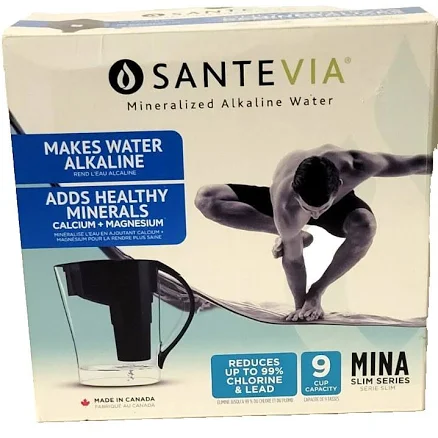
Santevia Alkaline Water Pitcher
Lower concern due to carbon filter construction; no PFAS disclosures found, but no known red flags either.
Santevia's pitcher relies on activated carbon and mineral cartridges to raise pH, not nonstick or water-resistant coatings. No PFAS claims or third-party verification exist in public brand materials.
We flunk more products than we pass. This one earned its grade. How we grade
Material
Plastic pitcher body with carbon/mineral alkalinity cartridge
Brand disclosure
Brand is silent on PFAS
Lab data
No public lab test
What Santevia Alkaline Water Pitcher is made of, ingredients and materials
The Santevia pitcher uses a plastic housing (typically BPA-free polypropylene or similar food-grade polymer) paired with a replaceable cartridge containing activated carbon and mineral media (likely calcium/magnesium compounds for alkalinity adjustment). The filter design avoids the boiling-water exposure risks of metal cookware and does not use Teflon-type coating or teflon-type coatings. The main chemical exposure pathway is leaching from the plastic housing during storage and through contact with filtered water, and potential bacterial colonization inside the cartridge if maintenance intervals are not followed.
What’s concerning
No PFAS disclosure
No public statement from the brand about PFAS in this product.
Bacterial growth in cartridge / filter media
Pitcher filters create warm, moist environments where bacteria and fungi can colonize the carbon and mineral media if cartridges are not replaced on schedule or if the pitcher is left undisturbed for extended periods. This is a known hazard across all pitcher-filter products, not unique to Santevia, but depends entirely on user maintenance.
Off-gassing from plastic pitcher body (volatile organics)
New plastic pitchers may emit low levels of volatile organic compounds (VOCs) during the first weeks of use. This typically dissipates but can be reduced by rinsing thoroughly and airing the pitcher before first use.
What’s reassuring
Base material not linked to PFAS
The main material recorded for this product is not one associated with PFAS.
BPA & bisphenols
Santevia does not disclose the specific resin type or confirm BPA-free status in public materials. Food-grade polypropylene used in most pitchers is considered low-leach under normal conditions, but no third-party testing of Santevia housing is on record to confirm this claim.
Source, FDA ↗Heavy metals
The alkalinity cartridge likely contains calcium/magnesium compounds to raise pH, but the source and purity of these minerals are not disclosed. No published testing shows lead, cadmium, or arsenic contamination in Santevia cartridges, but independent verification is absent.
Source, FDA ↗Water contact with cartridge casing materials
The cartridge housing materials and any adhesives or binders are not publicly detailed by Santevia. Standard food-grade practices should apply, but no third-party certification (NSF, WQA) is cited in the product documentation.
The full breakdown
The brand's record and disclosure
Santevia does not publish detailed material safety data, third-party test results, or formal PFAS/BPA certifications on their website or typical marketing materials. The brand has maintained a relatively low public controversy profile in water-filter safety literature. No recalls or safety warnings from Health Canada, FDA, or consumer safety agencies appear in open records for this specific product line. Independent testing or long-term safety studies by the brand are not publicly available.
How it compares in its category
Alkaline pitcher filters sit midway in the home-water-filter spectrum, less regulated and studied than whole-house systems, but simpler and lower-risk than complex ionizer devices. Most competing pitchers (Brita, PUR, ZeroWater) use similar plastic housings and face identical bacterial/leaching concerns; Santevia's carbon-and-mineral approach is conventional and does not introduce unique material hazards. The main differentiator is cartridge replacement frequency and mineral media composition, which varies by brand but is rarely disclosed in full.
If you buy it
Replace the cartridge every 2-3 months or per the manufacturer's guidance, regardless of visual wear, to prevent bacterial biofilm buildup inside the filter media. Do not leave standing filtered water in the pitcher for more than 48 hours at room temperature. Store the pitcher in a cool, dark place away from direct sunlight to minimize plastic off-gassing and microbial growth. Rinse the pitcher body and lid thoroughly with hot water before first use and weekly during regular operation.
What we don’t know
- Basis
- Model estimate, 72% confidence, not a lab result
- Lab test
- None on record for this exact product
- Brand statement
- Santevia has made none
Formulations change between production runs, so check the current label. How we grade.
Better-graded alternatives in Water Filters

Aquamira
Water Storage Treatment 2 oz Glass Bottles 60 gallons Purification
- glass bottles, sodium dichloroisocyanurate treatment chemical
- We found no PFAS statement from the brand
- Chemical overdose or misuse
5 hazards checked on this product. See all of them.

Big Berkey
Empty Housing with NO Filters Included
- Stainless steel housing and spigot
- We found no PFAS statement from the brand
- Bacterial growth and biofilm if filters not replaced
5 hazards checked on this product. See all of them.
LifeStraw
Home Glass Water Filter Pitcher
- Borosilicate glass pitcher, replaceable activated-carbon filter cartridge
- Bacterial growth in filter cartridge if unmaintained
5 hazards checked on this product. See all of them.
More water filters grades
How we score, every product runs through the same public 0-100 rubric based on materials, coatings, brand disclosure, lab findings, and recalls. See the full methodology → Spotted a mistake? Report an error.