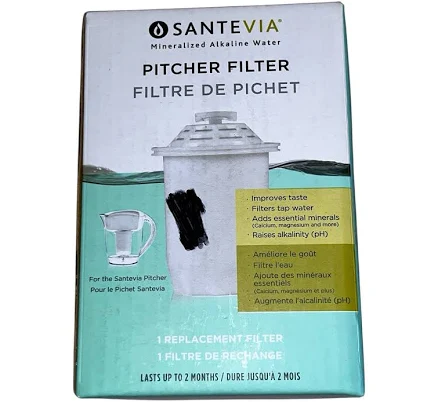
Santevia Alkaline Water Pitcher Filter
Lower concern; no red flags, but brand makes no PFAS disclosure.
Santevia's alkaline pitcher uses standard activated carbon and ion-exchange resin filtration not typically associated with PFAS contamination. The plastic housing has no Teflon-family coating coatings or water-repellent treatments.
We flunk more products than we pass. This one earned its grade. How we grade
Material
Activated carbon/ion-exchange resin filter media; plastic pitcher housing
Brand disclosure
Brand is silent on PFAS
Lab data
No public lab test
What Santevia Alkaline Water Pitcher Filter is made of, ingredients and materials
Santevia alkaline pitchers use activated carbon and ion-exchange resin cartridges to filter water and adjust pH upward. Activated carbon is inert and well-established for removing chlorine, odors, and some contaminants without introducing new substances. Ion-exchange resin beads swap hydrogen or sodium ions for dissolved minerals, which is chemically stable. The pitcher housing is polypropylene or similar food-grade plastic, which does not typically leach at room temperature in contact with water.
What’s concerning
No PFAS disclosure
No public statement from the brand about PFAS in this product.
Bacterial growth in filter media and dead zones
Any pitcher filter can become a growth medium for bacteria if cartridges are not replaced regularly or if water sits unused for extended periods. Resin beds are especially vulnerable if moisture is retained. Santevia provides no published antimicrobial treatment data for cartridges.
Mineral balance and electrolyte content after alkalizing
Alkaline pitchers adjust pH by adding or retaining minerals via ion exchange. The long-term health impact of consuming consistently alkalinized water is debated in scientific literature; no major adverse health outcome is established, but the clinical benefit is also unproven. Santevia does not provide mineral composition data.
What’s reassuring
Base material not linked to PFAS
The main material recorded for this product is not one associated with PFAS.
Plastic leaching (polypropylene housing)
Food-grade polypropylene is chemically stable at room temperature in aqueous contact. No leaching of BPA or phthalates is expected, but long-term exposure to UV or heat stress can cause minor polymer breakdown; this is not documented as a safety issue for Santevia pitchers in published data.
Ion-exchange resin durability and particulate shedding
Ion-exchange resins are durable and do not shed microplastics under normal use. No safety warnings or recalls from Santevia or regulators document cartridge degradation or particle escape into filtered water.
Filter cartridge supply chain transparency
No public data on whether replacement cartridges are manufactured to the same standards as the original pitcher or sourced from different suppliers. Counterfeit cartridges sold online pose unknown contamination risk, but this is a retail integrity issue rather than an inherent Santevia product hazard.
The full breakdown
The brand's record and disclosure
Santevia markets alkaline water solutions and maintains a presence in wellness channels but makes no published statement on PFAS use in filter media or pitcher housing. No major recalls or safety actions are on record for this product line. The brand does not provide third-party lab certifications (NSF, WQA) for the pitcher itself, though cartridges are sometimes tested independently. Absence of disclosure is not absence of safety, but limits independent verification.
How it compares in its category
Alkaline pitcher filters occupy a niche separate from standard carbon filters. Compared to plain activated-carbon pitchers (like Brita), Santevia adds ion-exchange resin, which is similarly low-hazard but may increase cartridge cost and complexity. Compared to under-sink reverse-osmosis systems, pitchers present lower risk of bacterial contamination if used casually, but also deliver less thorough filtration. This product is middle-ground in safety and performance within the pitcher category.
If you buy it
Replace cartridges every 2-3 months or per manufacturer guidance to prevent bacterial growth in stagnant resin; standing water in any filter pitcher can harbor microbes if left unused. Store the pitcher at room temperature away from direct sunlight, which can degrade plastic over years. Do not use boiling or near-boiling water in the pitcher, as polypropylene can soften above 70-80 degrees Celsius. Rinse the pitcher and cartridge with tap water before first use.
What we don’t know
- Basis
- Model estimate, 68% confidence, not a lab result
- Lab test
- None on record for this exact product
- Brand statement
- Santevia has made none
Formulations change between production runs, so check the current label. How we grade.
Better-graded alternatives in Water Filters

Aquamira
Water Storage Treatment 2 oz Glass Bottles 60 gallons Purification
- glass bottles, sodium dichloroisocyanurate treatment chemical
- We found no PFAS statement from the brand
- Chemical overdose or misuse
5 hazards checked on this product. See all of them.

Big Berkey
Empty Housing with NO Filters Included
- Stainless steel housing and spigot
- We found no PFAS statement from the brand
- Bacterial growth and biofilm if filters not replaced
5 hazards checked on this product. See all of them.
LifeStraw
Home Glass Water Filter Pitcher
- Borosilicate glass pitcher, replaceable activated-carbon filter cartridge
- Bacterial growth in filter cartridge if unmaintained
5 hazards checked on this product. See all of them.
More water filters grades
How we score, every product runs through the same public 0-100 rubric based on materials, coatings, brand disclosure, lab findings, and recalls. See the full methodology → Spotted a mistake? Report an error.