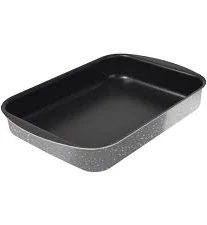
Tefal Cook Natural 220910206 Rectangular Oven Tray, Size 30 Cm - Grey, Is It Non-Toxic?
Don't buy without Tefal's nonstick coating disclosure.
Tefal hasn't disclosed what material creates the nonstick surface on this steel tray, leaving the PFAS question unanswered. Cast iron or ceramic trays present a clearer choice.
The better-graded swap
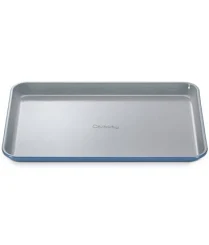
Caraway
Caraway Nonstick Ceramic Medium Baking Sheet
100/100 safety
Same rubric that flunked this product. The swap earned Excellent.
Still want this one anyway? Check the price on Amazon. We’d swap it.
Material
Steel oven tray with unspecified non-stick coating
Brand disclosure
Brand is silent on PFAS
Lab data
No public lab test
You may also be interested in
Top-graded picks in the categories readers replace first, every one scored on the same rubric.

- polypropylene filter housing, carbon/sediment cartridge
- We found no PFAS statement from the brand
- Bacterial growth in spent cartridges
3 hazards checked on this product, all on its full breakdown.

Aquasure
Premier Series 75 GPD Under Sink Reverse Osmosis Water Filtration System
- RO membrane, carbon filters, stainless steel housing
- We found no PFAS statement from the brand
- Bacterial and microbial growth in housing and filters
4 hazards checked on this product, all on its full breakdown.

Avocado
Vegan Mattress
- organic cotton, natural latex, coconut coir, recycled steel coils
- The brand calls it PFAS-free, which we have not verified
- Heavy metals
2 hazards checked on this product, all on its full breakdown.
Is Tefal Cook Natural 220910206 Grey non-toxic? What it is made of
This is a steel baking tray with an applied non-stick coating of unspecified chemistry. T-fal does not publicly disclose whether this coating is Teflon-type coating-based (Teflon-type) or ceramic-polymer hybrid. Steel substrate itself is food-safe, but the coating is the critical variable, traditional Teflon-type coating releases fumes above 260°C; newer alternatives may pose fewer fume risks but are not confirmed here. The grey color suggests a dark anodized or enameled finish, which aids heat distribution but provides no additional safety data from the manufacturer.
What’s concerning
Category baseline
The starting point for this type of product, before anything specific to this product is counted.
No PFAS disclosure
No public statement from the brand about PFAS in this product.
Non-stick, chemistry undisclosed
Marketed as non-stick without stating the coating chemistry.
Teflon-type coating fume risk (non-stick coating)
T-fal has not disclosed whether the coating is Teflon-type coating or an alternative. If Teflon-type coating, temperatures above 260°C can release toxic fumes (polymer fume fever). Unspecified coating chemistry means this risk cannot be ruled out and is inherent to the product's lack of transparency.
Coating degradation and microparticle release
Steel trays with applied non-stick coatings are prone to chipping and peeling with heavy use or dishwasher cycling. Shed coating particles are typically inert but can accumulate; replacement is advisable when visible wear occurs. T-fal does not specify expected coating lifespan or degradation protocols.
What’s reassuring
Steel leaching (low risk)
Steel itself does not leach toxic elements under normal baking conditions. Chromium and nickel in stainless steel are not bioavailable in food at typical levels. No recall or safety data suggests this tray poses leaching hazards from the substrate.
Lead
The grey/dark coating appears to be a non-stick polymer or anodized layer, not a traditional ceramic enamel glaze. No public safety data or recalls indicate heavy metal contamination. However, manufacturer documentation would confirm this; absence of disclosure leaves a minor knowledge gap.
Source, ATSDR ↗Off-gassing of volatile organic compounds (low risk)
Steel with applied non-stick coating poses minimal VOC off-gassing during normal use. Risk is primarily confined to high-temperature scenarios (>260°C) where coating degradation becomes the limiting concern, not off-gassing.
How is this PFAS grade calculated?
The brand's record and disclosure
T-fal (Groupe SEB subsidiary) has not published detailed PFAS or coating-chemistry transparency reports for this specific product line. The brand has faced no major recalls for this tray model on record, but their silence on non-stick chemistry is typical of many cookware manufacturers and does not confirm safety. T-fal markets 'Cook Natural' as a mainstream product without third-party certification (e.g., Greenguard, carbon-neutral, or toxicology testing seals).
How it compares in its category
Steel baking trays with unknown coatings sit in the mid-range of bakeware safety. Uncoated steel or ceramic-coated alternatives offer better transparency and eliminate fume risk. Non-stick steel trays are cheaper and more convenient than bare steel but trade durability for the coating uncertainty. This model offers no performance advantage over budget uncoated steel or premium ceramic-coated competitors.
If you buy it
Keep oven temperature below 260°C (500°F) to minimize any fume risk from the coating. Hand-wash only; dishwasher use accelerates coating wear. Inspect the coating annually for scratches, peeling, or discoloration. Replace the tray if the coating degrades significantly or if cooking produces unusual odors. Do not use for broiling or direct flame. Store in a cool, dry place to extend coating life.
What is not known about PFAS in this product?
- Basis
- Model estimate, 35% confidence, not a lab result
- Lab test
- None on record for this exact product
- Brand statement
- Tefal has made none
Formulations change between production runs, so check the current label. How we grade.
What are the PFAS-free alternatives to Tefal Cook Natural 220910206 Rectangular Oven Tray, Size 30 Cm - Grey?
- ceramic nonstick coating
- A third party reports verifying it as PFAS-free
- Ceramic coating degradation over time
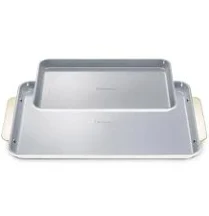
- ceramic nonstick coating
- A third party reports verifying it as PFAS-free
- Coating degradation and durability
2 hazards checked on this product, all on its full breakdown.
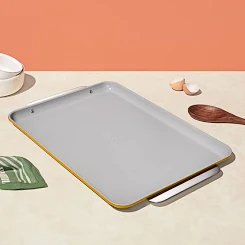
- ceramic nonstick coating
- The brand calls it PFAS-free, which we have not verified
- Ceramic coating degradation and particle shedding
3 hazards checked on this product, all on its full breakdown.
More bakeware grades
How we score, every product runs through the same public 0-100 rubric based on materials, coatings, brand disclosure, lab findings, and recalls. See the full methodology → Spotted a mistake? Report an error.