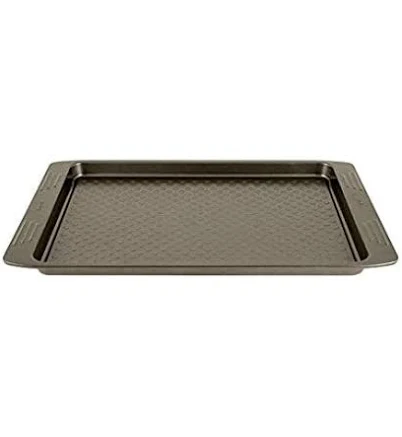
TEFAL Baking Tray Easy Grip 29.5 x 41 cm Baking, Is It Non-Toxic?
Skip if PFAS matters to you because the coating is undisclosed.
Tefal doesn't reveal what nonstick coating this tray has. Standard nonstick pans often contain Teflon-type coating or other Teflon-family coating, so ask the brand before you purchase.
The better-graded swap
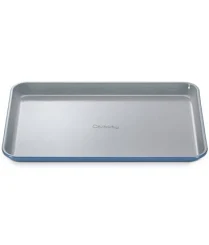
Caraway
Caraway Nonstick Ceramic Medium Baking Sheet
100/100 safety
Same rubric that flunked this product. The swap earned Excellent.
Still want this one anyway? Check the price on Amazon. We’d swap it.
Material
Steel with nonstick coating, type unspecified
Brand disclosure
Brand is silent on PFAS
Lab data
No public lab test
You may also be interested in
Top-graded picks in the categories readers replace first, every one scored on the same rubric.

- polypropylene filter housing, carbon/sediment cartridge
- We found no PFAS statement from the brand
- Bacterial growth in spent cartridges
3 hazards checked on this product, all on its full breakdown.

Aquasure
Premier Series 75 GPD Under Sink Reverse Osmosis Water Filtration System
- RO membrane, carbon filters, stainless steel housing
- We found no PFAS statement from the brand
- Bacterial and microbial growth in housing and filters
4 hazards checked on this product, all on its full breakdown.

Avocado
Vegan Mattress
- organic cotton, natural latex, coconut coir, recycled steel coils
- The brand calls it PFAS-free, which we have not verified
- Heavy metals
2 hazards checked on this product, all on its full breakdown.
Is TEFAL Baking Tray Easy Grip 29.5 Baking non-toxic? What it is made of
This tray combines a steel substrate with a nonstick coating of unspecified chemistry. Tefal does not publicly disclose whether the coating is Teflon-type coating-based (traditional Teflon), ceramic, or another polymer. Steel itself is not a material linked to PFAS, but the nonstick layer is where chemical leaching and thermal decomposition risks concentrate. Without material specification, you cannot assess whether PFAS or other synthetic polymers are present.
What’s concerning
Category baseline
The starting point for this type of product, before anything specific to this product is counted.
No PFAS disclosure
No public statement from the brand about PFAS in this product.
Non-stick, chemistry undisclosed
Marketed as non-stick without stating the coating chemistry.
Teflon-type coating thermal decomposition (fume risk)
If the nonstick coating is Teflon-type coating-based, overheating above 260C can release polymer fumes. Tefal does not disclose temperature limits on retail packaging for this model, creating user confusion and accidental exposure risk.
Coating degradation and particle shedding
Any nonstick bakeware degrades over time with use and washing. As the coating flakes or wears, inert steel particles dominate, but underlying coating chemistry fragments enter food if the base polymer is degraded, especially in acidic or fatty foods.
PFAS
Industry-wide, nonstick cookware coatings frequently contain PFAS or related Teflon-family coating. Tefal's lack of explicit 'PFAS-free' or material certification on this product suggests either conventional Teflon-type coating use or deliberate non-disclosure, both of which elevate concern for informed consumers.
Source, ATSDR ↗Improper disposal and environmental persistence
If the coating contains legacy Teflon-family coating, disposal as household waste releases PFAS-containing materials into landfill leachate. Tefal does not advertise take-back or recycling schemes for nonstick cookware in most markets.
What’s reassuring
Heavy metals
Tefal baking trays use food-grade steel that complies with EU and North American food contact standards. No recalls or documented leaching of iron, nickel, or chromium from this product line are on record.
Source, FDA ↗How is this PFAS grade calculated?
The brand's record and disclosure
Tefal (Groupe SEB subsidiary) manufactures nonstick cookware globally but has maintained silence on PFAS phase-out timelines and coating chemistry specifications for consumer products. The brand does not prominently advertise PFAS-free certification or detailed material declarations on retail packaging. This contrasts with competitors who label coatings explicitly (e.g., ceramic, Teflon-type coating-free alternatives) and suggests either continued use of conventional Teflon-family coating or reluctance to communicate reformulation progress.
How it compares in its category
Bakeware nonstick coatings range from older Teflon-type coating formulations to modern ceramic and polymer alternatives. Tefal's position in the mid-market means it likely uses proven commercial coatings rather than experimental ones, but also lacks the transparency of premium eco-focused brands or the regulatory compliance guarantees of medical-grade cookware. Steel substrate is a plus compared to aluminum (no leaching risk); the coating opacity is the category-wide problem here.
If you buy it
Keep oven temperature at or below 260C (manufacturer should specify; check packaging). Hand-wash only and avoid metal utensils or abrasive scrubbers that degrade the coating. Inspect regularly for peeling, scratching, or discoloration; discard if coating integrity is compromised. Do not preheat empty or expose to direct flame. Replace every 3-5 years or sooner if damage appears, as a worn coating increases particle shedding and potential leaching.
What is not known about PFAS in this product?
- Basis
- Model estimate, 35% confidence, not a lab result
- Lab test
- None on record for this exact product
- Brand statement
- Tefal has made none
Formulations change between production runs, so check the current label. How we grade.
What are the PFAS-free alternatives to TEFAL Baking Tray Easy Grip 29.5 x 41 cm Baking?
- ceramic nonstick coating
- A third party reports verifying it as PFAS-free
- Ceramic coating degradation over time
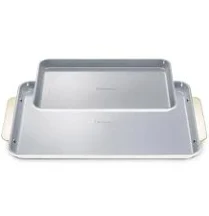
- ceramic nonstick coating
- A third party reports verifying it as PFAS-free
- Coating degradation and durability
2 hazards checked on this product, all on its full breakdown.
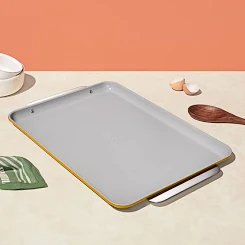
- ceramic nonstick coating
- The brand calls it PFAS-free, which we have not verified
- Ceramic coating degradation and particle shedding
3 hazards checked on this product, all on its full breakdown.
More bakeware grades
How we score, every product runs through the same public 0-100 rubric based on materials, coatings, brand disclosure, lab findings, and recalls. See the full methodology → Spotted a mistake? Report an error.