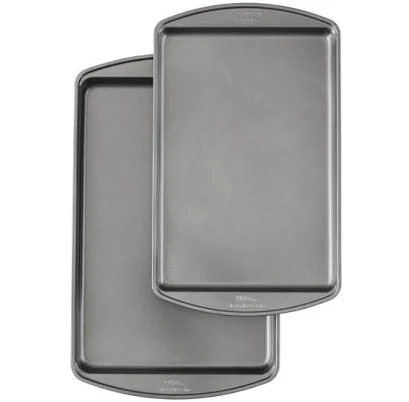
Wilton Perfect Results Premium Non-Stick Bakeware Cookie Baking Sheets Set, Is It Non-Toxic?
Avoid until Wilton reveals the non-stick coating chemistry.
Wilton hasn't disclosed the chemistry behind this premium non-stick coating or addressed PFAS concerns. Most traditional non-stick bakeware uses Teflon-family coating, creating uncertainty without verification.
The better-graded swap
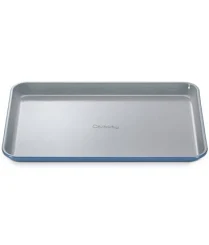
Caraway
Caraway Nonstick Ceramic Medium Baking Sheet
100/100 safety
Same rubric that flunked this product. The swap earned Excellent.
Still want this one anyway? Check the price on Amazon. We’d swap it.
Material
steel with non-stick coating (unspecified)
Brand disclosure
Brand is silent on PFAS
Lab data
No public lab test
You may also be interested in
Top-graded picks in the categories readers replace first, every one scored on the same rubric.

- polypropylene filter housing, carbon/sediment cartridge
- We found no PFAS statement from the brand
- Bacterial growth in spent cartridges
3 hazards checked on this product, all on its full breakdown.

Aquasure
Premier Series 75 GPD Under Sink Reverse Osmosis Water Filtration System
- RO membrane, carbon filters, stainless steel housing
- We found no PFAS statement from the brand
- Bacterial and microbial growth in housing and filters
4 hazards checked on this product, all on its full breakdown.

Avocado
Vegan Mattress
- organic cotton, natural latex, coconut coir, recycled steel coils
- The brand calls it PFAS-free, which we have not verified
- Heavy metals
2 hazards checked on this product, all on its full breakdown.
Is Wilton Perfect Results Premium Sheets Set non-toxic? What it is made of
These baking sheets are steel with an applied non-stick coating of unspecified chemistry. Wilton does not publicly disclose whether the coating is Teflon-type coating-based (traditional Teflon), ceramic, or a proprietary blend. The steel substrate itself is not a material linked to PFAS for baking; the risk profile depends entirely on the coating formulation and its behavior under the moderate heat of oven baking (typically 200-500°F for cookies).
What’s concerning
Category baseline
The starting point for this type of product, before anything specific to this product is counted.
Vague safety claims only
Uses vague language ("eco-friendly", "clean") without a specific PFAS statement.
Non-stick, chemistry undisclosed
Marketed as non-stick without stating the coating chemistry.
Teflon-type coating fume risk
If the non-stick coating is Teflon-type coating-based and used above 500°F, polymeric fume inhalation is a documented hazard. Wilton does not specify heat limits or coating type, leaving users unable to assess this risk. Cookie baking (typically 350-375°F) presents lower concern, but accidental overheating could trigger fume release.
Non-stick coating degradation and leaching
Any non-stick coating degrades with repeated washing, metal contact, and thermal cycling. As the coating wears, direct contact between food and the steel substrate becomes possible. Steel itself is food-safe, but degraded coatings can release microscopic particles and absorbed compounds into food.
PFAS
Wilton's silence on PFAS-free certification or PFOA-phase-out status means traditional PFAS-containing non-stick chemistry cannot be ruled out. The PFAS grade of 20/100 reflects this uncertainty and the industry baseline of older Teflon-type coating coatings in mid-tier products.
Source, ATSDR ↗What’s reassuring
Heavy metals
Product is marketed as steel; if the steel is not ferrous steel throughout or if aluminum is used as a base layer, acidic foods (e.g., tomato sauces rarely baked on sheets) could leach small amounts. Cookie dough is pH-neutral and low-risk, making aluminum leaching unlikely for typical use.
Source, FDA ↗Heavy metals
No public recalls or testing has documented lead, cadmium, or other heavy metals in Wilton non-stick coatings. Standard food-contact coatings are regulated by FDA, but disclosure of pigment or adhesive composition is not required.
Source, FDA ↗How is this PFAS grade calculated?
The brand's record and disclosure
Wilton is a legacy baking-products brand owned by KKR (formerly part of Illinois Tool Works). The company has not published public statements about PFAS content, Teflon-type coating alternatives, or coating certifications. No major recalls specific to non-stick coating safety have been documented for this line. Wilton's silence on non-stick chemistry is typical of mid-tier bakeware manufacturers and differs from brands that explicitly certify Teflon-type coating-free or PFOA-free status.
How it compares in its category
Premium non-stick bakeware typically costs $20-50 for a set and uses either Teflon-type coating (Teflon) or ceramic coatings. Wilton's positioning and pricing suggest a likely Teflon-type coating-based coating, which is proven effective but carries PFAS risk if the brand does not source from PFOA-free manufacturers. Competing brands like OXO and Our Table offer similar price points but often disclose PFOA-free status; ceramic alternatives (GreenPan, Caraway) are more expensive but avoid PFAS entirely.
If you buy it
Keep sheets below 500°F to avoid coating degradation and potential fume release. Hand-wash rather than use high-heat dishwashers to extend coating life. Do not use metal utensils, which can scratch the coating and expose steel underneath. Replace sheets if the coating becomes visibly chipped, peeling, or discolored, as degradation increases leaching risk. Store in a cool, dry place to slow coating wear.
What is not known about PFAS in this product?
- Basis
- Model estimate, 35% confidence, not a lab result
- Lab test
- None on record for this exact product
- Brand statement
- Wilton has made none
Formulations change between production runs, so check the current label. How we grade.
What are the PFAS-free alternatives to Wilton Perfect Results Premium Non-Stick Bakeware Cookie Baking Sheets Set?
- ceramic nonstick coating
- A third party reports verifying it as PFAS-free
- Ceramic coating degradation over time
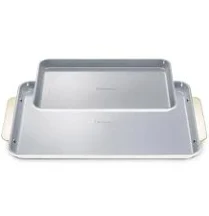
- ceramic nonstick coating
- A third party reports verifying it as PFAS-free
- Coating degradation and durability
2 hazards checked on this product, all on its full breakdown.
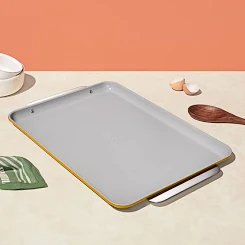
- ceramic nonstick coating
- The brand calls it PFAS-free, which we have not verified
- Ceramic coating degradation and particle shedding
3 hazards checked on this product, all on its full breakdown.
More bakeware grades
How we score, every product runs through the same public 0-100 rubric based on materials, coatings, brand disclosure, lab findings, and recalls. See the full methodology → Spotted a mistake? Report an error.