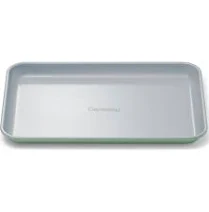
Caraway Small Baking Sheet
Skip; nonstick coating type undisclosed, PFAS risk unclear.
Caraway's baking sheet has a nonstick coating but the brand does not disclose whether it contains Teflon-type coating or other Teflon-family coating. Without specification or third-party testing, PFAS risk cannot be ruled out.
The better-graded swap
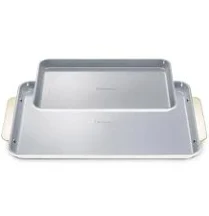
Caraway
Caraway Ceramic Nonstick Baking Sheet Duo
100/100 safety
Same rubric that flunked this product. The swap earned Excellent.
Still want this one anyway? Check the price on Amazon. We’d swap it.
Material
carbon steel with unspecified nonstick coating
Lab data
No public lab test
Is Caraway Small Baking Sheet non-toxic? What it is made of
This baking sheet is carbon steel, a durable iron-carbon alloy that resists rust better than plain steel and conducts heat evenly for baking. The nonstick coating type is not specified by Caraway in available product documentation, which is the critical gap, carbon steel itself poses no chemical hazard, but the identity of the topcoat determines whether Teflon-type coating, silicone, ceramic, or other polymers are in contact with food. Without coating disclosure, the thermal stability and degradation profile cannot be assessed.
What’s concerning
Non-stick, chemistry undisclosed
Marketed as non-stick without stating the coating chemistry.
Category baseline
The starting point for this type of product, before anything specific to this product is counted.
No PFAS disclosure
No public statement from the brand about PFAS in this product.
Nonstick coating integrity and degradation
The unspecified coating may degrade with repeated heating, cooling, or abrasion. If polymers break down, particles or volatile compounds may be ingested or inhaled; risk level depends on the coating type and use conditions, which Caraway has not clarified.
Teflon-type coating fume risk (if coating is Teflon-type coating)
If the nonstick coating is Teflon-type coating-based and exposed to temperatures above 500-600°F, degradation can release fumes associated with polymer fume fever in susceptible individuals. Caraway's silence on coating type means Teflon-type coating cannot be ruled out for this product.
Coating adhesion and peeling
Nonstick coatings on carbon steel can flake if the substrate is not properly prepared or if mechanical stress is applied. Once compromised, the bare steel or underlying coat is exposed, and particles may contaminate food or the product becomes unusable.
What’s reassuring
Aluminum leaching
This sheet is stated to be carbon steel, not aluminum, so aluminum leaching is not a concern for this specific product.
Lead
No recalls or reports of heavy metal contamination in Caraway cookware are on record. Carbon steel and modern nonstick coatings are not typical sources of lead or cadmium, but third-party testing of this batch would provide certainty.
Source, ATSDR ↗The full breakdown
The brand's record and disclosure
Caraway has marketed cookware as a PFAS-free alternative and emphasizes clean ingredients, but does not publicly disclose the specific nonstick coating chemistry for this baking sheet. The brand has not published third-party certifications (e.g., from NSF or independent labs) confirming the coating composition or thermal safety limits. This silence on a basic material specification is inconsistent with transparency claims and prevents independent verification of safety at typical baking temperatures.
How it compares in its category
Carbon steel baking sheets are less common than steel or aluminum in retail cookware; most nonstick baking sheets use Teflon-type coating, ceramic, or silicone coatings. Caraway's positioning as a PFAS alternative is appealing, but without disclosed coating type, it is harder to verify than brands that name their coating (e.g., 'ceramic,' 'Thermolon'). Uncoated carbon steel or well-seasoned cast iron baking sheets avoid coating ambiguity entirely, though they require more maintenance.
If you buy it
Contact Caraway directly and request the specific nonstick coating name and PFAS test results before purchase to confirm composition. Use at standard baking temperatures (up to 450-500°F for most nonstick; check product label). Hand wash; avoid high-heat broiling or abrasive scouring, which degrade coatings faster. If the coating peels, flakes, or discolors, discontinue use and replace; degraded coatings may release particles or unidentified polymer fragments.
What we don’t know
- Basis
- Model estimate, 35% confidence, not a lab result
- Lab test
- None on record for this exact product
- Brand statement
- Caraway has made a specific claim
Formulations change between production runs, so check the current label. How we grade.
Better-graded alternatives in Bakeware
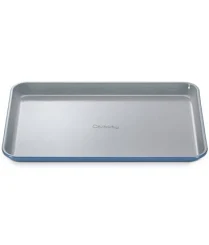
Caraway
Nonstick Ceramic Medium Baking Sheet
- ceramic nonstick coating
- A third party reports verifying it as PFAS-free
- Ceramic coating degradation over time
Caraway
Ceramic Nonstick Baking Sheet Duo
- ceramic nonstick coating
- A third party reports verifying it as PFAS-free
- Coating degradation and durability
2 hazards checked on this product. See all of them.
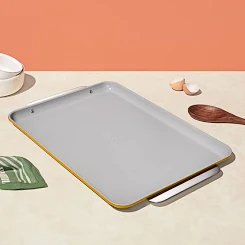
Caraway
Nonstick Ceramic Large Baking Sheet
- ceramic nonstick coating
- The brand calls it PFAS-free, which we have not verified
- Ceramic coating degradation and particle shedding
3 hazards checked on this product. See all of them.
More bakeware grades
How we score, every product runs through the same public 0-100 rubric based on materials, coatings, brand disclosure, lab findings, and recalls. See the full methodology → Spotted a mistake? Report an error.