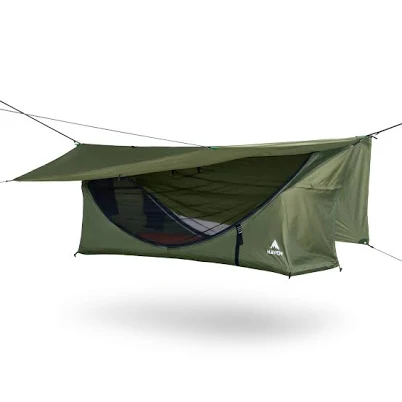
Haven Tent · Camping Tents & Tarps
Haven Lay Flat Hammock Tent
Avoid unless Hammock Gear confirms PFAS-free water-repellent coating treatment.
Hammock Gear's Haven Lay Flat hammock tent features ripstop nylon with water-repellent coating finish, but the brand does not disclose whether the water-repellent treatment uses PFAS or fluorine-free alternatives. Most commercial nylon gear relies on fluorinated water-repellent coating.
Still want this one anyway? Check the price on Amazon. We’d swap it.
Material
Ripstop nylon with water-repellent coating (water-repellent coating) finish
Brand disclosure
Brand is silent on PFAS
Lab data
No public lab test
You may also be interested in
Top-graded picks in the categories readers replace first, every one scored on the same rubric.

- polypropylene filter housing, carbon/sediment cartridge
- We found no PFAS statement from the brand
- Bacterial growth in spent cartridges
3 hazards checked on this product, all on its full breakdown.

Aquasure
Premier Series 75 GPD Under Sink Reverse Osmosis Water Filtration System
- RO membrane, carbon filters, stainless steel housing
- We found no PFAS statement from the brand
- Bacterial and microbial growth in housing and filters
4 hazards checked on this product, all on its full breakdown.

Avocado
Vegan Mattress
- organic cotton, natural latex, coconut coir, recycled steel coils
- The brand calls it PFAS-free, which we have not verified
- Heavy metals
2 hazards checked on this product, all on its full breakdown.
What Haven Lay Flat Hammock Tent is made of, ingredients and materials
The Haven Lay Flat uses ripstop nylon, a densely woven polyamide fabric that resists tearing and is standard in lightweight camping gear. Ripstop nylon itself is chemically inert and does not off-gas formaldehyde or volatile organics under normal use. The concern here is the water-repellent coating (water-repellent coating) finish applied to the fabric surface. Modern water-repellent coating coatings are often fluorinated compounds designed to repel water and oils; if this finish is a PFAS-based formulation (common in outdoor gear), it presents a bioaccumulation risk, particularly if the tent is used in proximity to food preparation or sleeping areas.
What’s concerning
Category baseline
The starting point for this type of product, before anything specific to this product is counted.
No PFAS disclosure
No public statement from the brand about PFAS in this product.
Waterproof / stain-resistant treatment
Water-repellent coating treatments have historically used PFAS.
PFAS
Standard water-repellent coating treatments in ripstop nylon tents are often PFAS compounds. Hammock Gear has not disclosed the chemistry; confirmation is required. Potential exposure is primarily dermal and inhalation if fabric off-gases in warm, enclosed sleeping conditions.
Source, ATSDR ↗Adhesive or sealing compound toxicity
Hammock Gear does not disclose whether seams are sealed with polyurethane adhesives or other chemical sealants. If present, these compounds may release volatile organics during initial use or in warm, humid conditions. Ventilation during first deployment minimizes inhalation risk.
What’s reassuring
Microplastics
Ripstop nylon does not shed microfibers significantly under normal camping use or abrasion. This is a negligible concern for a tent used for shelter rather than worn as apparel.
Source, EPA ↗Formaldehyde / VOCs
Ripstop nylon in outdoor applications typically uses minimal formaldehyde-releasing resins. The fabric is not treated with wrinkle-resistant or starch-based finishes common in consumer textiles. No public reports of formaldehyde concerns in this product line.
Source, ATSDR ↗Mold or bacterial growth in stored fabric
Nylon does not inherently promote mold growth; risk depends on storage moisture and conditions, not material chemistry. Proper drying and storage in cool, dry environments prevents colonization.
How is this PFAS grade calculated?
The brand's record and disclosure
Hammock Gear has not publicly disclosed the specific chemistry of its water-repellent coating treatment or provided PFAS-free certification for this product line. The brand does not appear in major third-party sustainable textile databases or list PFAS-free commitments on its website as of available public records. This silence is a red flag in an outdoor industry where competitors (Arc'teryx, Patagonia, some cottage makers) now explicitly market PFAS-free alternatives. Without direct contact with Hammock Gear, you cannot confirm whether the water-repellent coating is fluorinated.
How it compares in its category
Hammock tents occupy a niche within the camping tent market, and ripstop nylon is the material standard. Most competitors (including established brands like ENO and cottage ultralight makers) use identical or similar ripstop nylon with water-repellent coating finishes, so the Haven is not uniquely risky. However, brands like Zpacks and some ultralight cottage producers now explicitly offer PFAS-free nylon options, making this product category increasingly addressable without PFAS exposure. If PFAS avoidance is a priority, alternatives do exist at similar price points.
If you buy it
Contact Hammock Gear directly before purchase and ask whether the water-repellent coating finish is fluorinated or PFAS-free; request a material safety data sheet or technical specification. Store the tent dry and avoid washing unless necessary; if cleaning is needed, rinse gently with cool water and air-dry away from food preparation areas. Ripstop nylon does not degrade under UV or normal temperature cycling, so durability is not a safety concern. Replace the tent if seams fail or fabric tears, as resealing with field patches introduces uncertainty about coating integrity.
What is not known about PFAS in this product?
- Basis
- Model estimate, 45% confidence, not a lab result
- Lab test
- None on record for this exact product
- Brand statement
- Haven Tent has made none
Formulations change between production runs, so check the current label. How we grade.
More camping tents & tarps grades
How we score, every product runs through the same public 0-100 rubric based on materials, coatings, brand disclosure, lab findings, and recalls. See the full methodology → Spotted a mistake? Report an error.