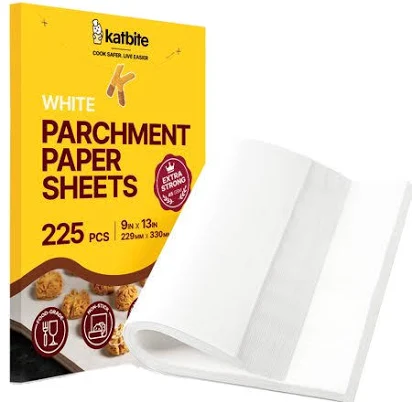
· Parchment Paper & Baking Liners
225-Count Heavy Duty Unbleached Parchment Paper Sheets
Likely lower risk; parchment typically uses silicone instead of PFAS.
Parchment is conventionally coated with silicone for heat resistance and release, not Teflon-family coating. Won't disclose treatment specifics, though silicone-coated parchment generally carries lower PFAS risk than grease-resistant wrappers.
The better-graded swap
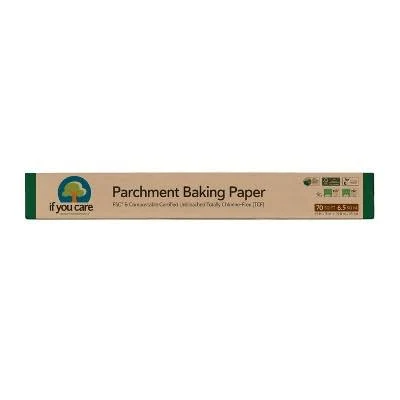
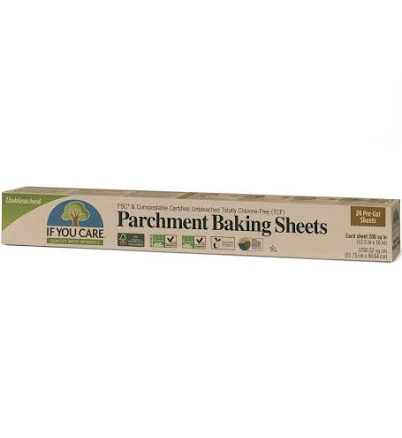
If You Care
If You Care Parchment Baking Paper
90/100 safety
Same rubric that flunked this product. The swap earned Excellent.
Still want this one anyway? Check the price on Amazon. We’d swap it.
Material
unbleached cellulose paper with silicone coating
Brand disclosure
Brand is silent on PFAS
Lab data
No public lab test
You may also be interested in
Top-graded picks in the categories readers replace first, every one scored on the same rubric.

- polypropylene filter housing, carbon/sediment cartridge
- We found no PFAS statement from the brand
- Bacterial growth in spent cartridges
3 hazards checked on this product, all on its full breakdown.

Aquasure
Premier Series 75 GPD Under Sink Reverse Osmosis Water Filtration System
- RO membrane, carbon filters, stainless steel housing
- We found no PFAS statement from the brand
- Bacterial and microbial growth in housing and filters
4 hazards checked on this product, all on its full breakdown.

Avocado
Vegan Mattress
- organic cotton, natural latex, coconut coir, recycled steel coils
- The brand calls it PFAS-free, which we have not verified
- Heavy metals
2 hazards checked on this product, all on its full breakdown.
What 225-Count Heavy Duty Paper Sheets is made of, ingredients and materials
This product is cellulose paper (wood pulp) coated with food-grade silicone, not Teflon-family coating like Teflon-type coating. The unbleached designation means it skips chlorine-based whitening, reducing chemical processing residues. Silicone is inert at typical baking temperatures (up to 420-450 degrees Fahrenheit), does not leach into food, and breaks down into silica and carbon when exposed to extreme heat rather than releasing toxic fumes. The coating is what makes parchment nonstick and heat-resistant; without it, you have plain paper that sticks and may char.
What’s concerning
Category baseline
The starting point for this type of product, before anything specific to this product is counted.
No PFAS disclosure
No public statement from the brand about PFAS in this product.
Waterproof / stain-resistant treatment
Water-repellent coating treatments have historically used PFAS.
Silicone coating degradation at high heat
Silicone is stable to 420-450 degrees F; above that threshold, coating may discolor or lose nonstick properties. No toxicological risk is documented, but degraded coatings perform poorly. This is a functional, not safety, concern for most home baking.
What’s reassuring
Chlorine residues from bleaching (bleached variants)
This product is unbleached, so this hazard does not apply. Bleached parchment paper has not shown measurable chlorine residue problems in food contact scenarios according to available data.
Microplastic or coating particle migration into food
Silicone is not a plastic polymer and does not fragment into microparticles under normal baking conditions. FDA approval for food contact silicones is based on migration studies showing negligible transfer at typical use temperatures.
Heavy metals
Wood pulp parchment paper is not manufactured with heavy metal pigments or fillers. No documented cases of lead, cadmium, or arsenic in cellulose-based baking liners exist in public safety records.
Source, FDA ↗Formaldehyde / VOCs
Parchment paper coatings are silicone-based, not formaldehyde-releasing resins typical of textiles or wood finishes. Cellulose sizing agents in paper do not commonly contain or release formaldehyde at food-contact temperatures.
Source, ATSDR ↗How is this PFAS grade calculated?
The brand's record and disclosure
The brand is a Reynolds Consumer Products brand with no published transparency statement on parchment paper chemistry or third-party certification. No FDA warnings, product recalls, or safety controversies are publicly documented for parchment paper specifically. The brand does not advertise PFAS-free status (which is common silence in the category rather than a red flag). Lack of disclosure is neutral here because parchment paper manufacturing is mature and silicone coatings are industry standard for nonstick baking liners.
How it compares in its category
Unbleached parchment sits at the mainstream middle of the category, cheaper and more accessible than premium brands like If You Care (which emphasize chlorine-free processing and sustainability), but functionally equivalent in safety. Silicone-coated parchment is the dominant formulation across all major brands; the real difference between products is durability (sheet thickness, coating wear resistance) and environmental footprint, not toxicity. Bleached parchment poses no additional hazard, so the unbleached choice is driven by preference, not safety necessity.
If you buy it
Use sheets up to the stated temperature limit (usually 420-450 degrees F; check package instructions). Replace sheets if the silicone coating starts to peel, chip, or show visible wear, as degraded coating loses nonstick properties but does not become unsafe at normal oven heat. Store in a cool, dry place away from direct sunlight to prevent silicone brittleness over months. Do not reuse sheets excessively (after 5-8 uses, coating naturally wears); single-use or limited-use products like this are designed for disposal, not indefinite reuse.
What is not known about PFAS in this product?
- Basis
- Model estimate, 62% confidence, not a lab result
- Lab test
- None on record for this exact product
- Brand statement
- has made none
Formulations change between production runs, so check the current label. How we grade.
What are the PFAS-free alternatives to 225-Count Heavy Duty Unbleached Parchment Paper Sheets?
- silicone-coated parchment paper
- The brand calls it PFAS-free, which we have not verified
- Paper degradation and particulate shedding
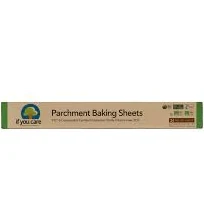
- unbleached paper with silicone coating
- The brand calls it PFAS-free, which we have not verified
- Silicone coating degradation at high heat
- bleached paper with silicone coating
- The brand calls it PFAS-free, which we have not verified
- Paper degradation and fragmentation
More parchment paper & baking liners grades
How we score, every product runs through the same public 0-100 rubric based on materials, coatings, brand disclosure, lab findings, and recalls. See the full methodology → Spotted a mistake? Report an error.