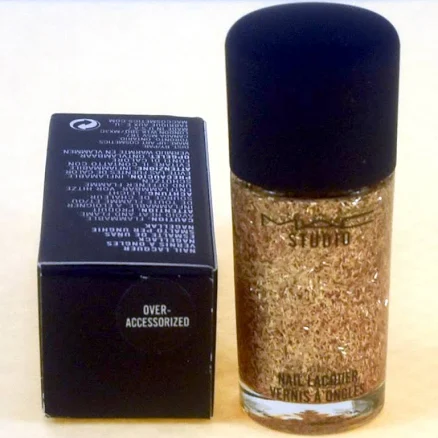
Mac Cosmetics Mac Nail Lacquer Polish Over-Accessorized (Pink Gold Glitter ) Boxed
Nail polish poses lower PFAS concern. No waterproofing claims on this product.
MAC nail lacquer is a standard cosmetic polish without water-resistant or stain-resistant treatments typically requiring PFAS. No public PFAS disclosure from the brand.
We flunk more products than we pass. This one earned its grade. How we grade
Material
nitrocellulose, plasticizers, pigments, resins
Lab data
No public lab test
You may also be interested in
Top-graded picks in the categories readers replace first, every one scored on the same rubric.

- polypropylene filter housing, carbon/sediment cartridge
- We found no PFAS statement from the brand
- Bacterial growth in spent cartridges
3 hazards checked on this product, all on its full breakdown.

Aquasure
Premier Series 75 GPD Under Sink Reverse Osmosis Water Filtration System
- RO membrane, carbon filters, stainless steel housing
- We found no PFAS statement from the brand
- Bacterial and microbial growth in housing and filters
4 hazards checked on this product, all on its full breakdown.

Avocado
Vegan Mattress
- organic cotton, natural latex, coconut coir, recycled steel coils
- The brand calls it PFAS-free, which we have not verified
- Heavy metals
2 hazards checked on this product, all on its full breakdown.
What Mac Cosmetics Mac Nail Glitter ) Boxed is made of, ingredients and materials
MAC Nail Lacquer is a solvent-based formula built on nitrocellulose film-former, plasticizers (likely dibutyl phthalate or modern alternatives), and synthetic/mica pigments for color and glitter effect. The glitter component in this specific shade introduces fine particles that pose inhalation risk during application if ventilation is poor. Nitrocellulose itself is not toxic when cured; hazard comes from volatile organic compounds (VOCs) released during application and from potential contaminants in pigment batches.
What’s concerning
Category baseline
The starting point for this type of product, before anything specific to this product is counted.
No PFAS disclosure
No public statement from the brand about PFAS in this product.
Volatile organic compounds (VOCs) and solvent inhalation
Nitrocellulose lacquers release toluene, xylene, and other VOCs during and shortly after application. Glitter formulas may require additional solvents for particle suspension, increasing cumulative VOC load. Exposure is acute during application and dissipates with ventilation but is not eliminated.
Phthalate plasticizers
MAC does not disclose whether this formula uses dibutyl phthalate (DBP) or newer alternatives. Industry trend is replacement, but without MAC's explicit statement, older formulations may still contain DBP, which is a reproductive health concern with chronic low-dose dermal exposure.
Heavy metals
Gold and pink glitter pigments (likely iron oxides, titanium dioxide, or synthetic colorants) can carry trace lead or cadmium if sourcing is not rigorous. MAC does not publish heavy metal limits for nail lacquer. Risk is inhalation during application and absorption through abraded skin, not ingestion.
Source, FDA ↗Formaldehyde / VOCs
Some lacquer resins (tosylamide/formaldehyde resin) release low levels of formaldehyde during cure and wear. MAC's formula disclosure does not confirm or exclude these; they are legal but a known contact allergen concern for frequent users and nail technicians.
Source, ATSDR ↗Microinhalation of glitter particles
Sparkle and glitter polishes shed fine particles during application, wear, and removal. While not classified as a major toxin, chronic inhalation of mica and synthetic particles may irritate respiratory tissue, especially for professional nail technicians with daily exposure.
What’s reassuring
Base material not linked to PFAS
The main material recorded for this product is not one associated with PFAS.
How is this PFAS grade calculated?
The brand's record and disclosure
MAC (Estee Lauder subsidiary) does not publicly disclose detailed ingredient sourcing, heavy metal testing limits, or formaldehyde-releaser content for nail lacquers, though the brand is regulated under FDA cosmetics rules. No major recalls or safety controversies specific to MAC nail lacquer have been established in public records. The brand markets 'professional' positioning but provides minimal transparency on solvent safety or phthalate replacement strategies compared to competitors like Zoya or Ella+Mila.
How it compares in its category
Standard three-component nail lacquer formulas (solvent, film-former, colorant) carry consistent low-to-moderate risk across mass-market brands. MAC sits mid-range, more rigorously manufactured than budget brands but less transparent and less reformulated away from classic solvents than premium indie or 'clean' lines. Glitter nail polishes across all brands pose slightly higher VOC and particulate exposure than solid colors due to suspension agents and particle load.
If you buy it
Apply in well-ventilated spaces (open window or fan) to minimize solvent vapor inhalation. Wear it for 7-14 days before removal; extended wear increases solvent absorption through the nail bed. Remove with acetone or non-acetone remover in ventilation; never use in enclosed bathrooms. Replace if formula thickens, separates, or smells rancid (sign of solvent degradation), typically after 2-3 years of storage. Pregnant individuals should consult their provider about exposure frequency.
What is not known about PFAS in this product?
- Basis
- Model estimate, 72% confidence, not a lab result
- Lab test
- None on record for this exact product
- Brand statement
- MAC has made a specific claim
Formulations change between production runs, so check the current label. How we grade.
More cosmetic color products grades
How we score, every product runs through the same public 0-100 rubric based on materials, coatings, brand disclosure, lab findings, and recalls. See the full methodology → Spotted a mistake? Report an error.