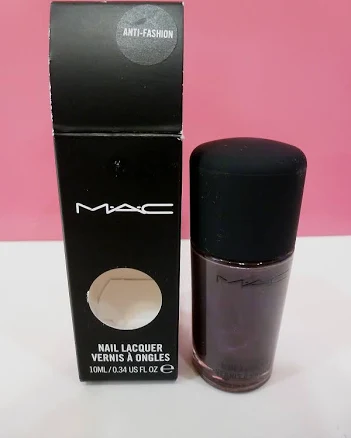
Mac Nail Lacquer
Standard nail lacquer carries no identified PFAS risk.
Traditional nail lacquer with organic pigments and resins that has no water-resistance function or Teflon-family coating coatings where PFAS typically hide.
We flunk more products than we pass. This one earned its grade. How we grade
Material
Organic pigments, resins, solvents in liquid lacquer
Lab data
No public lab test
You may also be interested in
Top-graded picks in the categories readers replace first, every one scored on the same rubric.

- polypropylene filter housing, carbon/sediment cartridge
- We found no PFAS statement from the brand
- Bacterial growth in spent cartridges
3 hazards checked on this product, all on its full breakdown.

Aquasure
Premier Series 75 GPD Under Sink Reverse Osmosis Water Filtration System
- RO membrane, carbon filters, stainless steel housing
- We found no PFAS statement from the brand
- Bacterial and microbial growth in housing and filters
4 hazards checked on this product, all on its full breakdown.

Avocado
Vegan Mattress
- organic cotton, natural latex, coconut coir, recycled steel coils
- The brand calls it PFAS-free, which we have not verified
- Heavy metals
2 hazards checked on this product, all on its full breakdown.
What Mac Nail Lacquer is made of, ingredients and materials
MAC Fix+ is a liquid nail lacquer composed of organic pigments, film-forming resins, and volatile organic solvents (likely toluene, ethyl acetate, or similar standard lacquer components). The formulation dries by solvent evaporation, leaving a hard resin film on the nail. Organic pigments in nail lacquers are generally lower toxicity than heavy-metal lakes, but their safety depends on which specific pigments are used and whether any are contaminated with trace metals during synthesis or sourcing.
What’s concerning
Category baseline
The starting point for this type of product, before anything specific to this product is counted.
No PFAS disclosure
No public statement from the brand about PFAS in this product.
Volatile organic solvents (VOCs)
Nail lacquers inherently release toluene, ethyl acetate, and xylene during application and drying. MAC does not disclose its specific solvent composition. Short-term inhalation at typical home doses is not acutely harmful, but prolonged or occupational exposure carries respiratory and neurological risks.
Phthalates
MAC does not market this product as phthalate-free or '5-free,' implying potential presence of DBP as a plasticizer in the resin. Phthalates in nail lacquers pose minimal risk during topical use but inhalation of vapors during application is a known concern in occupational settings.
Source, ATSDR ↗Fragrance and allergen sensitizers
MAC Fix+ likely contains fragrance compounds typical of cosmetic nail lacquers, which may include contact allergens or sensitizers in susceptible individuals. The brand does not disclose fragrance constituents or allergen warnings specific to nail products.
What’s reassuring
Base material not linked to PFAS
The main material recorded for this product is not one associated with PFAS.
Heavy metals
No recalls or public test reports document lead, cadmium, or arsenic in MAC Fix+ or its specific pigment lots. Organic pigments are inherently lower-metal-risk than lakes, but third-party testing by MAC is not published; risk remains assessable only through regulatory compliance history.
Source, FDA ↗Formaldehyde / VOCs
Nail lacquers do not typically require formaldehyde as a hardener (unlike some gel polishes); no public evidence or recalls suggest MAC Fix+ contains formaldehyde or releasers. However, MAC does not explicitly exclude it from the formula.
Source, ATSDR ↗How is this PFAS grade calculated?
The brand's record and disclosure
MAC Cosmetics (Estée Lauder group) does not publicly disclose detailed ingredient safety certifications or third-party testing for nail products. The brand has not faced significant nail lacquer-specific safety recalls in the U.S. or EU in recent years. MAC maintains general cosmetic compliance with FDA and EU regulations but does not independently publish heavy-metal or solvent testing results for nail lines. No substantive sustainability or formulation transparency initiative specific to nail lacquers has been announced.
How it compares in its category
MAC Fix+ sits in the mainstream cosmetic nail lacquer segment, neither premium-marketed as 'clean' nor budget-tier. Most conventional nail lacquers (including major brands like Essie, OPI, Sally Hansen) use similar solvent and resin profiles. 'Non-toxic' or '5-free/7-free' alternatives (e.g., Zoya, Ella+Mila) explicitly exclude toluene, formaldehyde, and dibutyl phthalate, whereas MAC does not market such restrictions. For a standard product, MAC Fix+ carries typical category risk rather than elevated or reduced exposure.
If you buy it
Use in well-ventilated spaces to minimize inhalation of volatile solvents; lacquer fumes are not acutely toxic at typical home exposure but prolonged inhalation is not advised. Replace the cap immediately after application to limit solvent off-gassing. Remove with acetone-based remover or non-acetone alternatives; neither method poses unusual safety concerns for occasional use. Discard dried or clumpy lacquer rather than thinning with additional solvent, as this degrades the resin film quality and increases solvent exposure.
What is not known about PFAS in this product?
- Basis
- Model estimate, 72% confidence, not a lab result
- Lab test
- None on record for this exact product
- Brand statement
- MAC has made a specific claim
Formulations change between production runs, so check the current label. How we grade.
More cosmetic color products grades
How we score, every product runs through the same public 0-100 rubric based on materials, coatings, brand disclosure, lab findings, and recalls. See the full methodology → Spotted a mistake? Report an error.