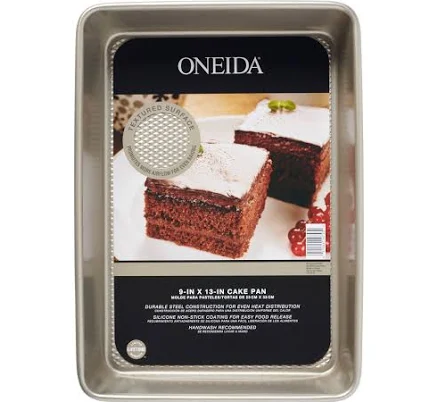
Oneida Kitchen Textured Cake Pan 9 x 13, Is It Non-Toxic?
Nonstick coating type unknown; PFAS risk unconfirmed.
This Oneida cake pan has textured nonstick coating but Oneida won't disclose what it's made of or its PFAS content. Standard nonstick finishes create uncertain PFAS exposure without more details.
The better-graded swap

Caraway
Caraway Nonstick Ceramic Large Baking Sheet
90/100 safety
Same rubric that flunked this product. The swap earned Excellent.
Still want this one anyway? Check the price on Amazon. We’d swap it.
Material
Steel cake pan, textured nonstick coating, type unspecified
Brand disclosure
Brand is silent on PFAS
Lab data
No public lab test
You may also be interested in
Top-graded picks in the categories readers replace first, every one scored on the same rubric.

- polypropylene filter housing, carbon/sediment cartridge
- We found no PFAS statement from the brand
- Bacterial growth in spent cartridges
3 hazards checked on this product, all on its full breakdown.

Aquasure
Premier Series 75 GPD Under Sink Reverse Osmosis Water Filtration System
- RO membrane, carbon filters, stainless steel housing
- We found no PFAS statement from the brand
- Bacterial and microbial growth in housing and filters
4 hazards checked on this product, all on its full breakdown.

Avocado
Vegan Mattress
- organic cotton, natural latex, coconut coir, recycled steel coils
- The brand calls it PFAS-free, which we have not verified
- Heavy metals
2 hazards checked on this product, all on its full breakdown.
Is Oneida Kitchen Textured Cake Pan 9 x 13 non-toxic? What it is made of
This is a steel baking pan with a textured nonstick coating applied to the surface. Steel itself is food-safe and thermally stable, but the nonstick formula is the critical unknown, Oneida has not publicly disclosed whether the coating contains Teflon-type coating (Teflon) or a Teflon-type coating-free alternative. The textured surface is meant to improve grip and food release, but coating durability under repeated heating and cleaning determines whether flaking or leaching becomes a concern.
What’s concerning
Category baseline
The starting point for this type of product, before anything specific to this product is counted.
No PFAS disclosure
No public statement from the brand about PFAS in this product.
Non-stick, chemistry undisclosed
Marketed as non-stick without stating the coating chemistry.
Nonstick coating degradation and flaking
With an undisclosed nonstick formula, coating breakdown over time is a plausible risk if it is Teflon-type coating-based or a lower-grade alternative. Flaking particles in baked food are a mechanical hazard rather than a chemical one, but signal that the pan should be retired.
Thermal fume risk (unspecified coating)
If the coating is Teflon-type coating without explicit temperature disclosure, accidental high-heat exposure (above 400-500F) during baking could release fumes, though standard oven baking typically stays below this threshold. Risk is lower than stovetop use but present with misuse.
Coating-substrate adhesion failure
Repeated thermal cycling and dishwashing can weaken the bond between steel and nonstick coating, leading to peeling or separation. Oneida has not published durability or adhesion testing data for this specific product.
Teflon-type coating inhalation risk (undisclosed)
Without confirmation of the nonstick type, Teflon-type coating-related fume inhalation cannot be ruled out if the pan is overheated, though normal baking use poses minimal risk. Disclosure would allow informed mitigation.
What’s reassuring
Steel substrate leaching
Steel itself does not leach heavy metals or harmful substances under normal baking conditions. The nonstick coating acts as a complete barrier, so the steel substrate is not a direct food-contact hazard.
How is this PFAS grade calculated?
The brand's record and disclosure
Oneida is a well-established kitchenware manufacturer but maintains minimal public transparency on nonstick chemistry and PFAS content across its product lines. No independent certifications (such as GreenGuard or third-party nonstick safety standards) are documented for this specific pan. The brand has not issued statements addressing PFAS phase-out plans or safer-coating initiatives, which is a transparency gap relative to competitors like Caraway or GreenPan.
How it compares in its category
Standard steel cake pans with traditional Teflon-type coating nonstick coatings are common, but this product sits in a middle tier, cheaper than premium ceramic or ceramic-hybrid nonstick alternatives, yet offering no documented lower concern profile than them. Ceramic-coated competitors (e.g., GreenPan, Caraway) explicitly market Teflon-type coating-free and low-PFAS claims; stainless steel uncoated pans eliminate coating uncertainty altogether. The undisclosed coating type makes direct safety comparison difficult.
If you buy it
Do not preheat empty above 400F (the nonstick coating's typical temperature limit); always use low to medium heat for baking. Hand-wash rather than dishwashing to minimize coating wear and potential flaking. Inspect the surface regularly for cracks, peeling, or discoloration; replace within 3-5 years if degradation appears. Ensure good kitchen ventilation during baking in case of unintended high-heat exposure, as the undisclosed coating may release fumes if overheated.
What is not known about PFAS in this product?
- Basis
- Model estimate, 35% confidence, not a lab result
- Lab test
- None on record for this exact product
- Brand statement
- Oneida has made none
Formulations change between production runs, so check the current label. How we grade.
What are the PFAS-free alternatives to Oneida Kitchen Textured Cake Pan 9 x 13?
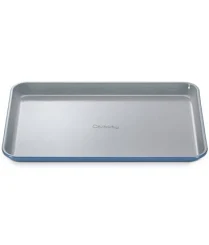
- ceramic nonstick coating
- A third party reports verifying it as PFAS-free
- Ceramic coating degradation over time
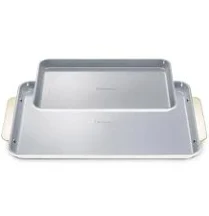
- ceramic nonstick coating
- A third party reports verifying it as PFAS-free
- Coating degradation and durability
2 hazards checked on this product, all on its full breakdown.
- ceramic nonstick coating
- The brand calls it PFAS-free, which we have not verified
- Ceramic coating degradation and particle shedding
3 hazards checked on this product, all on its full breakdown.
More bakeware grades
How we score, every product runs through the same public 0-100 rubric based on materials, coatings, brand disclosure, lab findings, and recalls. See the full methodology → Spotted a mistake? Report an error.