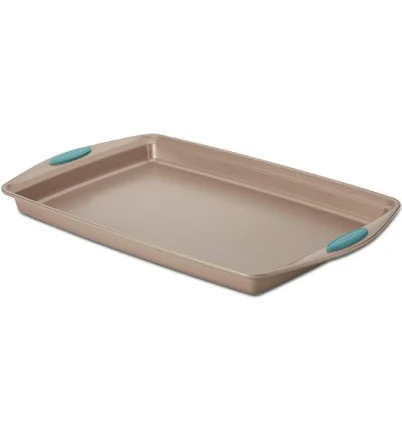
Rachael Ray Cucina Nonstick Baking Sheet, Is It Non-Toxic?
Avoid until coating details are disclosed; nonstick cookware without PFAS transparency raises concern.
Rachael Ray does not publicly disclose the nonstick coating chemistry on this baking sheet. Standard nonstick coatings commonly contain Teflon-type coating or other Teflon-family coating linked to PFAS.
The better-graded swap
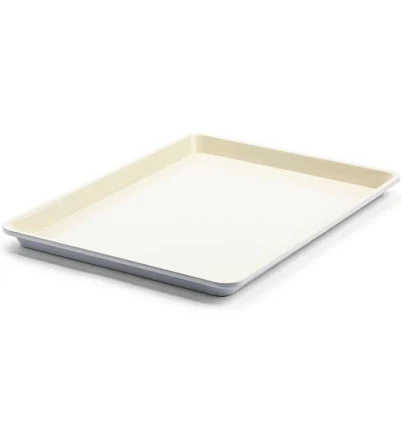
GreenPan
GreenPan GreenLife Ceramic Nonstick Cookie Sheet
70/100 safety
Same rubric that flunked this product. The swap earned Good.
Still want this one anyway? Check the price on Amazon. We’d swap it.
Material
Nonstick coating, type unspecified
Brand disclosure
Brand is silent on PFAS
Lab data
No public lab test
You may also be interested in
Top-graded picks in the categories readers replace first, every one scored on the same rubric.

- polypropylene filter housing, carbon/sediment cartridge
- We found no PFAS statement from the brand
- Bacterial growth in spent cartridges
3 hazards checked on this product, all on its full breakdown.

Aquasure
Premier Series 75 GPD Under Sink Reverse Osmosis Water Filtration System
- RO membrane, carbon filters, stainless steel housing
- We found no PFAS statement from the brand
- Bacterial and microbial growth in housing and filters
4 hazards checked on this product, all on its full breakdown.

Avocado
Vegan Mattress
- organic cotton, natural latex, coconut coir, recycled steel coils
- The brand calls it PFAS-free, which we have not verified
- Heavy metals
2 hazards checked on this product, all on its full breakdown.
Is Rachael Ray Cucina Nonstick Baking Sheet non-toxic? What it is made of
Rachael Ray Cucina baking sheets use a nonstick coating applied to a steel or aluminum substrate, but the manufacturer does not publicly disclose the specific coating chemistry (Teflon-type coating-based, ceramic-hybrid, or proprietary alternative). This opacity is the primary concern, traditional Teflon-type coating coatings can release fumes above 500F, but without transparency, users cannot verify whether this product uses alternatives with lower concern. The substrate material (aluminum vs. steel) also affects potential leaching under acidic or salty conditions, yet this too remains unspecified in widely available product information.
What’s concerning
Category baseline
The starting point for this type of product, before anything specific to this product is counted.
No PFAS disclosure
No public statement from the brand about PFAS in this product.
Non-stick, chemistry undisclosed
Marketed as non-stick without stating the coating chemistry.
Teflon-type coating fume risk (thermal degradation)
Unspecified coating chemistry means Teflon-type coating cannot be ruled out. Overheating any traditional nonstick sheet above 500F can release fumes potentially harmful to respiratory system; risk is mitigated only by user discipline and product transparency.
Aluminum leaching
If the substrate is aluminum (common in this price tier), acidic foods (tomato sauce, vinegar, citrus) or extended storage of prepared foods can promote leaching. Risk increases as nonstick coating degrades with age.
Coating degradation and microflaking
Repeated washing, metal utensil contact, or age-related wear can cause nonstick coating to flake into food. No recalls specific to this product exist, but flaking nonstick coatings are a known concern across all brands in this category.
What’s reassuring
Lead
No recalls or reports of heavy metal contamination in Rachael Ray Cucina baking sheets have been documented. Modern US-manufactured cookware is unlikely to contain these metals, though absence of third-party testing data prevents full certainty.
Source, ATSDR ↗Off-gassing of volatile organic compounds
No reports of odor, fume, or VOC issues specific to this product. Nonstick baking sheets typically off-gas minimally compared to cookware used on stovetops, but initial manufacturing residues may produce slight odor on first use.
How is this PFAS grade calculated?
The brand's record and disclosure
Rachael Ray and its parent company (Instant Brands/Groupe SEB) have not publicly committed to PFAS-free manufacturing or issued detailed material safety statements for their cookware lines. No major recalls specific to nonstick coating degradation or fume incidents have been widely documented for this product, but the brand's silence on coating composition is notable in an industry where competitors increasingly market Teflon-type coating-free or PFOA-free claims. The lack of third-party certification (e.g., GreenGuard, NSF) or voluntary PFAS disclosure is a red flag for informed buyers.
How it compares in its category
Most budget and mid-range nonstick baking sheets (including Rachael Ray) offer similar or lower disclosure standards than premium brands like Le Creuset or OXO, which explicitly state coating materials and temperature limits. Ceramic-coated or Teflon-type coating-free alternatives (e.g.Caraway, Our Place) command higher prices but present lower concern regarding PFAS. Rachael Ray Cucina positions itself as affordable cookware without premium transparency, making it a typical middle-of-the-road choice for nonstick baking.
If you buy it
Never exceed 400-450F; use only in conventional ovens (not toaster ovens, which concentrate heat) and avoid preheating empty. Hand-wash only; dishwashers degrade nonstick coatings faster. Inspect the sheet before each use for flaking, discoloration, or worn spots; replace within 3-5 years or immediately if coating integrity is visibly compromised. Use parchment paper or silicone mats as a secondary barrier to reduce direct contact with the coating.
What is not known about PFAS in this product?
- Basis
- Model estimate, 35% confidence, not a lab result
- Lab test
- None on record for this exact product
- Brand statement
- Rachael Ray has made none
Formulations change between production runs, so check the current label. How we grade.
What are the PFAS-free alternatives to Rachael Ray Cucina Nonstick Baking Sheet?
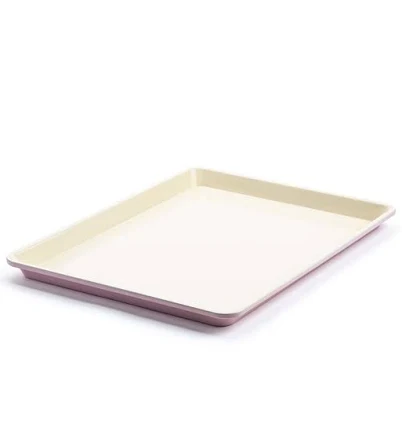
- ceramic nonstick coating
- The brand calls it PFAS-free, which we have not verified
- Ceramic coating degradation over time
3 hazards checked on this product, all on its full breakdown.
- Ceramic nonstick coating
- The brand calls it PFAS-free, which we have not verified
- Ceramic coating degradation and microflaking
2 hazards checked on this product, all on its full breakdown.
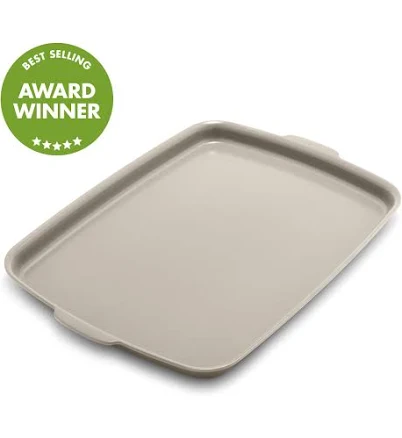
- Ceramic nonstick coating
- The brand calls it PFAS-free, which we have not verified
- Ceramic coating degradation and chipping
2 hazards checked on this product, all on its full breakdown.
More cookie sheets grades
How we score, every product runs through the same public 0-100 rubric based on materials, coatings, brand disclosure, lab findings, and recalls. See the full methodology → Spotted a mistake? Report an error.