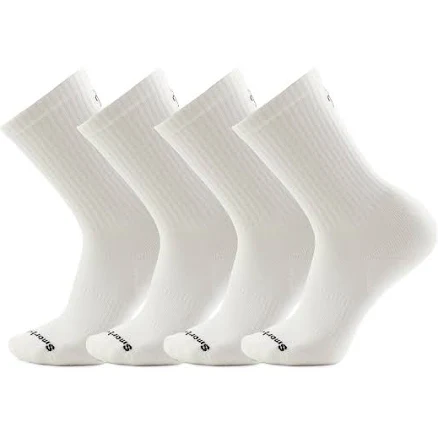
Smartwool 4-Pack Everyday Athletic Crew Socks
Lower PFAS concern for basic merino socks, but Smartwool doesn't publicly disclose water-repellent coating chemistry.
Smartwool's everyday athletic crew socks are primarily merino wool, a natural fiber with inherently lower PFAS risk than synthetic coatings. Smartwool doesn't disclose whether water-repellent coating or stain-resistant treatments are applied to this line or what chemistry they use.
Still want this one anyway? Check the price on Amazon. We’d swap it.
Material
merino wool blend (primary fiber)
Brand disclosure
Brand is silent on PFAS
Lab data
No public lab test
You may also be interested in
Top-graded picks in the categories readers replace first, every one scored on the same rubric.

- polypropylene filter housing, carbon/sediment cartridge
- We found no PFAS statement from the brand
- Bacterial growth in spent cartridges
3 hazards checked on this product, all on its full breakdown.

Aquasure
Premier Series 75 GPD Under Sink Reverse Osmosis Water Filtration System
- RO membrane, carbon filters, stainless steel housing
- We found no PFAS statement from the brand
- Bacterial and microbial growth in housing and filters
4 hazards checked on this product, all on its full breakdown.

Avocado
Vegan Mattress
- organic cotton, natural latex, coconut coir, recycled steel coils
- The brand calls it PFAS-free, which we have not verified
- Heavy metals
2 hazards checked on this product, all on its full breakdown.
What Smartwool 4-Pack Everyday Crew Socks is made of, ingredients and materials
Smartwool's everyday crew socks are primarily merino wool blended with nylon and elastane for durability and stretch. Merino wool itself is a natural protein fiber with minimal synthetic chemical load during growth; the hazard profile depends on finishing treatments (dyeing, water-repellency coating, antimicrobial finishes if present). Nylon and elastane additions introduce synthetic polymer risk, though at low concentrations in socks. The spinning, dyeing, and finishing steps in manufacturing are where chemical exposure peaks.
What’s concerning
Category baseline
The starting point for this type of product, before anything specific to this product is counted.
No PFAS disclosure
No public statement from the brand about PFAS in this product.
Azo dyes (aniline-derived synthetic colorants)
Merino socks are dyed during manufacturing; textile dyehouses in some regions use azo dyes banned in Europe but permitted in other jurisdictions. Smartwool does not publicly specify azo-free certification, though RWS standards encourage lower concern chemistry.
Elastane (spandex) degradation and skin contact
Elastane fibers can degrade under heat, UV, or chlorine, releasing oligomers that may irritate sensitive skin. This is a minor risk during normal wear and wash but increases if socks are dried hot or worn in chlorinated pools frequently.
Durable-water-repellent (water-repellent coating) coating composition
Smartwool uses a water-repellent coating treatment on athletic socks to improve moisture management; the specific chemistry (fluorocarbon vs. non-fluorocarbon) is not disclosed. Alternatives with lower azo concern exist but Smartwool has not committed publicly to either.
What’s reassuring
Base material not linked to PFAS
The main material recorded for this product is not one associated with PFAS.
Formaldehyde / VOCs
No formaldehyde-based wrinkle-resist or flame-retardant finishes are standard on athletic socks; Smartwool does not advertise these treatments. Risk is minimal unless undisclosed finishing is applied.
Source, ATSDR ↗Antimony in polyester/nylon content
Antimony is a polyester catalyst; nylon in Smartwool socks is present in low proportion (blend, not dominant fiber) and antimony residues are typically negligible in finished fibers. No documented issue for this product.
How is this PFAS grade calculated?
The brand's record and disclosure
Smartwool (owned by Timberland, part of VF Corporation) markets sustainability and uses third-party certifications including Responsible Wool Standard (RWS) for animal welfare and traceability. The brand does not publicly disclose the chemical formulation of its water-repellent durable-water-repellent (water-repellent coating) coatings, nor does it publish full restricted-substance lists for finished socks. No major safety recalls or chemical controversies have been documented for Smartwool socks in public databases. The brand's silence on water-repellent coating chemistry is typical industry-wide but leaves some ambiguity.
How it compares in its category
Performance merino socks from Smartwool occupy the premium-safe segment, merino-dominant blends are generally lower-risk than 100% synthetic athletic socks (which may contain azo dyes, antimony in polyester, or higher flame-retardant loads). Smartwool's RWS certification and scale give it higher transparency than niche brands, though less than some competitors (e.g., Patagonia explicitly discloses some chemistry). Price reflects quality control, which often correlates with cleaner manufacturing.
If you buy it
Wash in cool water and mild detergent; avoid bleach and fabric softeners, which can degrade merino and trigger skin sensitivity in some users. Dry flat or hang-dry; heat (dryer, high iron) can degrade elastane and nylon elasticity, shortening lifespan. Replace when elastic waistband loses grip or fiber pilling becomes excessive (typically 1-2 years with weekly wear). Store in a cool, dry place; merino resists odor, so frequent washing is not necessary, reducing cumulative chemical exposure from detergent.
What is not known about PFAS in this product?
- Basis
- Model estimate, 72% confidence, not a lab result
- Lab test
- None on record for this exact product
- Brand statement
- Smartwool has made none
Formulations change between production runs, so check the current label. How we grade.
More performance socks grades
How we score, every product runs through the same public 0-100 rubric based on materials, coatings, brand disclosure, lab findings, and recalls. See the full methodology → Spotted a mistake? Report an error.