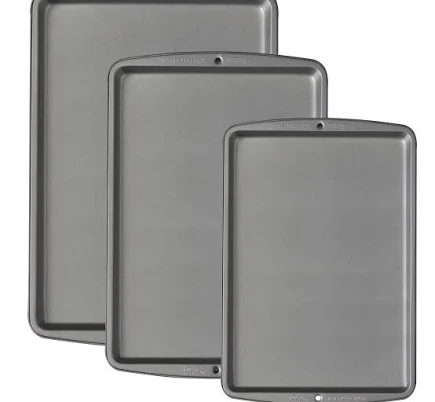
Wilton Bake It Better 3-Piece Cookie Sheet Pan Set, Is It Non-Toxic?
Don't buy until Wilton discloses the nonstick type.
Wilton's three-piece set doesn't specify what nonstick coating is used, and most mass-market nonstick cookware relies on Teflon-family coating that contain PFAS. The brand needs to be transparent.
The better-graded swap
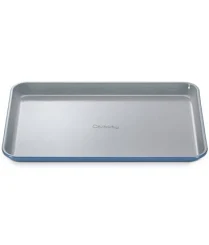
Caraway
Caraway Nonstick Ceramic Medium Baking Sheet
100/100 safety
Same rubric that flunked this product. The swap earned Excellent.
Still want this one anyway? Check the price on Amazon. We’d swap it.
Material
Steel with nonstick coating (type unspecified)
Brand disclosure
Brand is silent on PFAS
Lab data
No public lab test
You may also be interested in
Top-graded picks in the categories readers replace first, every one scored on the same rubric.

- polypropylene filter housing, carbon/sediment cartridge
- We found no PFAS statement from the brand
- Bacterial growth in spent cartridges
3 hazards checked on this product, all on its full breakdown.

Aquasure
Premier Series 75 GPD Under Sink Reverse Osmosis Water Filtration System
- RO membrane, carbon filters, stainless steel housing
- We found no PFAS statement from the brand
- Bacterial and microbial growth in housing and filters
4 hazards checked on this product, all on its full breakdown.

Avocado
Vegan Mattress
- organic cotton, natural latex, coconut coir, recycled steel coils
- The brand calls it PFAS-free, which we have not verified
- Heavy metals
2 hazards checked on this product, all on its full breakdown.
Is Wilton Bake It Better Sheet Pan Set non-toxic? What it is made of
These pans are steel substrate with an applied nonstick coating of unspecified chemistry. Wilton does not publicly disclose whether the coating is Teflon-type coating-based (traditional Teflon-type), ceramic, or another polymer. Steel itself is not a material linked to PFAS; the hazard lies entirely in the coating. Nonstick coatings can degrade through scratching, high heat, or mechanical wear, potentially releasing particles or volatile compounds into food or air.
What’s concerning
Category baseline
The starting point for this type of product, before anything specific to this product is counted.
No PFAS disclosure
No public statement from the brand about PFAS in this product.
Non-stick, chemistry undisclosed
Marketed as non-stick without stating the coating chemistry.
Teflon-type coating fume risk and coating identity uncertainty
Wilton has not disclosed the nonstick formulation. If Teflon-type coating-based, overheating above 500F can release perfluorooctanoic acid (PFOA) precursors and other volatile compounds; ceramic alternatives do not carry this risk. The company's silence makes it impossible to assess or mitigate this hazard definitively.
Coating degradation and particle release
Nonstick cookware coatings can chip, peel, or flake with mechanical stress (scratching, dishwashing, thermal shock). No recalls specific to this Wilton set are on record, but this is a general failure mode for all applied nonstick surfaces, especially lower-cost variants.
Steel substrate rust and corrosion
If the coating is damaged or edges are exposed, bare steel can rust, particularly if pans are stored wet or in humid conditions. Rust particles are not immediately toxic in small amounts but render the pan unusable and can discolor baked goods.
What’s reassuring
Aluminum leaching from potential undercoating
Wilton does not disclose the full layer structure. If an aluminum layer is present under the steel (common in composite pan construction), no leaching risk applies because steel is the contact surface. This hazard is listed as none_known given the steel-front design, but full layer composition is unconfirmed.
Lead
No recalls or test results linking Wilton bakeware to lead or cadmium contamination have been published. Modern nonstick formulations in the US market are unlikely to contain these elements, but Wilton's lack of third-party certification means this cannot be verified independently.
Source, ATSDR ↗How is this PFAS grade calculated?
The brand's record and disclosure
Wilton, owned by Essentialware Group, has not published a commitment to lower PFAS concern in cookware or transparent coating specifications. The company does not advertise independent certifications for nonstick coatings (e.g., GreenPan partnership, Teflon-type coating-free labeling). No major product safety recalls specific to this bakeware line have been reported to the CPSC, though this absence does not guarantee safety. Wilton's silence on formulation is the primary concern for informed purchase.
How it compares in its category
Cookie sheet pans are lower-risk than stovetop cookware because they are typically used at moderate oven temperatures (350-425F) rather than high direct heat, reducing coating stress. Many competitors now explicitly market PFAS-free ceramic or ceramic-hybrid coatings (Our Place, Caraway, GreenPan), while others clearly state Teflon-type coating formulation. Wilton's refusal to specify puts it behind market transparency standards, though steel substrate quality is generally competitive for the price point.
If you buy it
Keep oven temperature below 500F to minimize coating stress and fume risk. Hand wash with soft sponges to avoid scratching; dishwasher use may accelerate coating degradation. Inspect the surface monthly for chips, peeling, or discoloration. Replace the pan immediately if the coating shows visible damage, as degraded nonstick surfaces can shed particles into baked goods. Store in a dry location to prevent rust at steel edges.
What is not known about PFAS in this product?
- Basis
- Model estimate, 45% confidence, not a lab result
- Lab test
- None on record for this exact product
- Brand statement
- Wilton has made none
Formulations change between production runs, so check the current label. How we grade.
What are the PFAS-free alternatives to Wilton Bake It Better 3-Piece Cookie Sheet Pan Set?
- ceramic nonstick coating
- A third party reports verifying it as PFAS-free
- Ceramic coating degradation over time
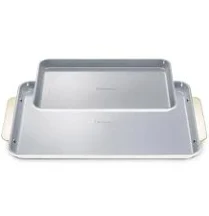
- ceramic nonstick coating
- A third party reports verifying it as PFAS-free
- Coating degradation and durability
2 hazards checked on this product, all on its full breakdown.
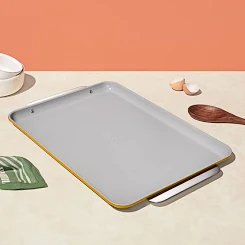
- ceramic nonstick coating
- The brand calls it PFAS-free, which we have not verified
- Ceramic coating degradation and particle shedding
3 hazards checked on this product, all on its full breakdown.
More bakeware grades
How we score, every product runs through the same public 0-100 rubric based on materials, coatings, brand disclosure, lab findings, and recalls. See the full methodology → Spotted a mistake? Report an error.