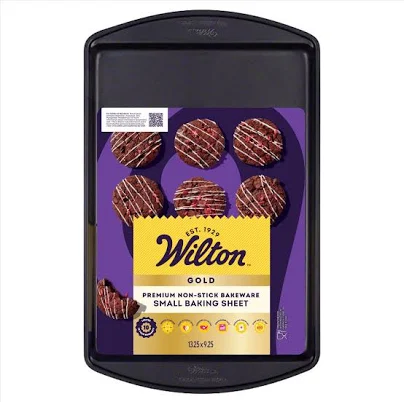
Wilton Gold Non-Stick Baking Sheet 9X13", Is It Non-Toxic?
Don't buy unless Wilton discloses the coating type.
Wilton provides no details on what chemical creates the gold nonstick coating on this baking sheet. Gold finishes typically mean Teflon-type coating or Teflon-family coating, but Wilton won't confirm.
The better-graded swap
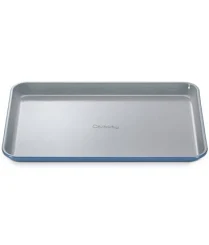
Caraway
Caraway Nonstick Ceramic Medium Baking Sheet
100/100 safety
Same rubric that flunked this product. The swap earned Excellent.
Still want this one anyway? Check the price on Amazon. We’d swap it.
Material
Steel with gold non-stick coating (type unspecified)
Brand disclosure
Brand is silent on PFAS
Lab data
No public lab test
You may also be interested in
Top-graded picks in the categories readers replace first, every one scored on the same rubric.

- polypropylene filter housing, carbon/sediment cartridge
- We found no PFAS statement from the brand
- Bacterial growth in spent cartridges
3 hazards checked on this product, all on its full breakdown.

Aquasure
Premier Series 75 GPD Under Sink Reverse Osmosis Water Filtration System
- RO membrane, carbon filters, stainless steel housing
- We found no PFAS statement from the brand
- Bacterial and microbial growth in housing and filters
4 hazards checked on this product, all on its full breakdown.

Avocado
Vegan Mattress
- organic cotton, natural latex, coconut coir, recycled steel coils
- The brand calls it PFAS-free, which we have not verified
- Heavy metals
2 hazards checked on this product, all on its full breakdown.
Is Wilton Gold Non-Stick Baking Sheet 9X13" non-toxic? What it is made of
This sheet is steel with an applied gold-colored non-stick coating. The steel substrate itself poses no chemical leaching risk under normal use. The critical unknown is the non-stick coating formulation, Wilton does not publicly specify whether this uses Teflon-type coating (Teflon), silicone, ceramic, or another polymer. Without this disclosure, consumers cannot assess perfluorocarbon exposure or thermal degradation risk at high heat.
What’s concerning
Category baseline
The starting point for this type of product, before anything specific to this product is counted.
No PFAS disclosure
No public statement from the brand about PFAS in this product.
Non-stick, chemistry undisclosed
Marketed as non-stick without stating the coating chemistry.
Teflon-type coating thermal degradation and fume inhalation
If the non-stick coating is Teflon-type coating-based (not disclosed), overheating above manufacturer limits can release hydrogen fluoride and other Teflon-family coating breakdown products. Wilton does not specify safe temperature limits on packaging readily available online, increasing misuse risk.
Coating flaking and ingestion of non-stick particles
Steel bakeware with applied non-stick coatings is prone to chipping and peeling with repeated use and aggressive cleaning. Consumers have reported visible coating fragments in baked goods with older non-stick bakeware; risk is minimized with hand-wash-only care.
Loss of non-stick efficacy over time without safety loss
Gold non-stick coatings on steel sheets are known to wear faster than black or silver Teflon-type coating coatings, reducing performance after 2-3 years of regular use. This is a quality issue rather than a safety hazard, but replacement may prompt disposal.
What’s reassuring
Aluminum leaching from underlying substrate
This product is steel, not aluminum, so direct aluminum migration is not a hazard. However, if any coating perforation occurs, the steel substrate will not leach the problematic minerals that bare aluminum can.
Heavy metals
The gold color is likely a cosmetic pigment in or on the coating layer. No recalls or test reports linking Wilton bakeware to lead, cadmium, or other heavy metals in coatings have been published. However, the undisclosed coating formulation means this cannot be ruled out.
Source, FDA ↗How is this PFAS grade calculated?
The brand's record and disclosure
Wilton is a major bakeware manufacturer owned by Elkay Manufacturing and has not published detailed ingredient or chemical composition statements for its non-stick coatings. The brand is silent on PFAS use, PFOA phase-out timelines, or third-party testing. No major recalls specific to this model have been publicly documented, but Wilton's lack of transparency on coating chemistry is a red flag compared to competitors who explicitly disclose Teflon-type coating-free or ceramic formulations.
How it compares in its category
Most mainstream bakeware brands (Calphalon, T-fal, OXO) now explicitly label coatings as Teflon-type coating-free, ceramic, or silicone-based. Wilton's silence on coating type is unusual and places this product in a middle tier, not as transparent as premium ceramic-coated alternatives, but not as risky as older Teflon-type coating products with known degradation issues. Steel sheets without non-stick coating (bare or parchment-backed) avoid this ambiguity entirely.
If you buy it
Hand wash only; dishwasher use accelerates coating wear and potential flaking. Do not use above 400-425°F (check product label); temperatures above this may cause Teflon-type coating off-gassing or silicone breakdown depending on actual coating chemistry. Replace the sheet if the coating visibly peels, chips, or shows bare metal. Store flat and avoid stacking with sharp utensils to minimize mechanical damage.
What is not known about PFAS in this product?
- Basis
- Model estimate, 35% confidence, not a lab result
- Lab test
- None on record for this exact product
- Brand statement
- Wilton has made none
Formulations change between production runs, so check the current label. How we grade.
What are the PFAS-free alternatives to Wilton Gold Non-Stick Baking Sheet 9X13"?
- ceramic nonstick coating
- A third party reports verifying it as PFAS-free
- Ceramic coating degradation over time
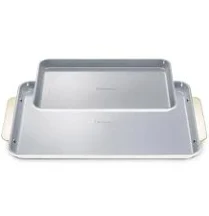
- ceramic nonstick coating
- A third party reports verifying it as PFAS-free
- Coating degradation and durability
2 hazards checked on this product, all on its full breakdown.
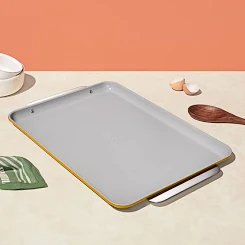
- ceramic nonstick coating
- The brand calls it PFAS-free, which we have not verified
- Ceramic coating degradation and particle shedding
3 hazards checked on this product, all on its full breakdown.
More bakeware grades
How we score, every product runs through the same public 0-100 rubric based on materials, coatings, brand disclosure, lab findings, and recalls. See the full methodology → Spotted a mistake? Report an error.