By PFAS Authority · Updated September 16, 2026
Top grades to buy
Eco-Products
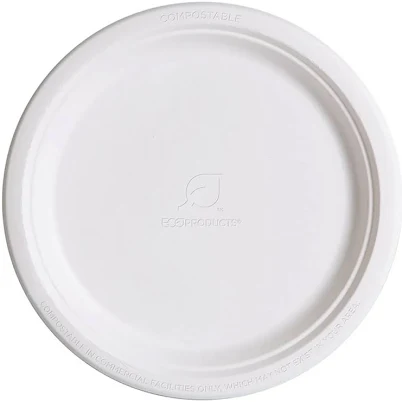
Eco Products Sugarcane Plates
Total Home
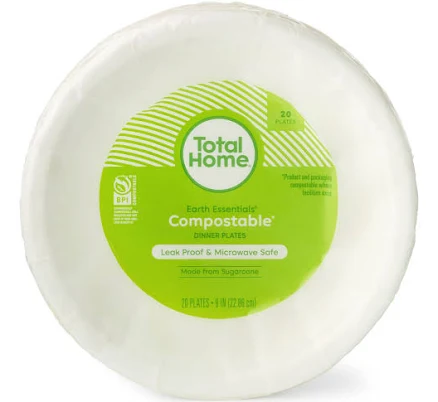
Earth Essentials Compostable Dinner Plate
Eco-Products
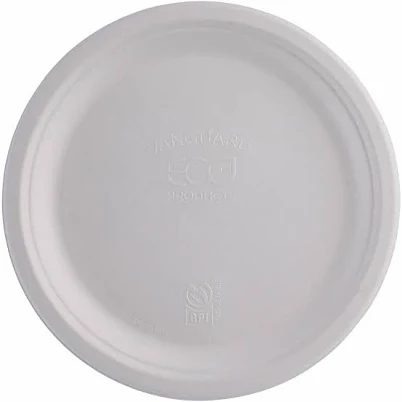
Eco Products Vanguard Renewable and Compostable Sugarcane Plates
Model-based grades, not lab tests. We flunk more than we pass. How grading works
PFAS in Disposable Plates, Why Uncoated Bagasse Grades Best and Coated Paper Does Not
This category produces one of the starkest results in our database, and it lands squarely on the brands most people actually buy. The two top plates, both molded fiber with BPI compostability certification recorded, grade 100 out of 100. Every coated paper and foam plate we graded from Dixie, Chinet and Hefty sits at 25, described in each case as carrying a grease-resistant coating whose composition is not disclosed.
Hefty is the clearest illustration, because it appears at both ends. The Hefty EcoSave Compostable Plates are bagasse fiber and grade 70, while five other Hefty paper and foam plates grade 25. Same brand, and the difference is whether the plate relies on a grease-resistant coating to work. Below we break down the graded plates.
Summary comparison table
| Product | PFAS grade | Verdict |
|---|---|---|
| Eco-Products Sugarcane Plates | Excellent, 100/100 | Uncoated molded bagasse, BPI certified |
| Total Home Earth Essentials Compostable Dinner Plate | Excellent, 100/100 | Compostable fiber with a plant-based coating, BPI certified |
| Eco-Products Vanguard Compostable Sugarcane Plates | Good, 70/100 | Bagasse fiber, no certification recorded |
| Hefty EcoSave Compostable Plates | Good, 70/100 | Plant-based bagasse fiber, no grease coating described |
| Chinet Classic Premium Dinner Paper Plates | Poor, 25/100 | Coated paper with a grease-resistant treatment, composition not given |
| Chinet Classic Dinner Paper Plates | Poor, 25/100 | Grease-resistant coating, composition not given |
| Chinet Classic White Dinner Plates | Poor, 25/100 | Molded bleached kraft pulp with a coating |
| Dixie Disposable Paper Plates | Poor, 25/100 | Paper with a grease-resistant coating, composition not given |
| Dixie Everyday Heavy Duty Disposable Plates | Poor, 25/100 | Paperboard with a grease-resistant coating |
| Dixie 8.5" Paper Plates | Poor, 25/100 | Grease-resistant coating our record infers is likely fluorinated |
| Hefty Everyday Soak Proof Disposable Plates | Poor, 25/100 | Coated paperboard with a grease-resistant finish |
| Hefty Paper Plates, Assorted Designs | Poor, 25/100 | Paper with an unspecified grease-resistant coating |
| Hefty Supreme Foam Plates, 6 inch | Poor, 25/100 | Polystyrene foam with a grease-resistant coating |
| Hefty Supreme 3-Compartment Foam Plates | Poor, 25/100 | Polystyrene foam with a proprietary grease-resistant treatment |
| Hefty Super Weight Foam Plate, 8 7/8 inch | Poor, 25/100 | Polystyrene foam, grease resistance presumed in our record |
How we graded these plates
Every grade in this article is a model-based estimate built from publicly available materials disclosures, manufacturing descriptions and brand documentation, not a lab test performed by our team. A high score means lower concern based on reviewed sources, never PFAS-free and never safe. No plate in this category carried published independent lab data. The recorded concerns were PFAS in grease-resistant coatings described as fluorinated layers, coating migration where composition is unspecified, thermal degradation of a coating at elevated temperature, and moisture degradation with structural failure. You can compare any specific plate using our PFAS product finder.
Two inferences in our record, marked as inferences
On the Dixie 8.5" Paper Plates our record describes the grease-resistant coating as likely fluorinated, and on the Hefty Super Weight Foam Plate it records grease resistance as presumed rather than stated. Both are our record's inference from the product type, not statements from the manufacturers and not test results. We are flagging them because a reader deserves to know which parts of a grade rest on a description and which rest on an assumption, and no lab data exists for either product.
The Excellent and Good tiers, 70 to 100 out of 100
Four plates sit above the rest and all four are molded plant fiber rather than coated paper.
Eco-Products Sugarcane Plates lead at 100, described as uncoated molded bagasse with BPI compostability certification recorded. BPI certification requires under 100 ppm total fluorine, and our model credits it as third-party verification, on top of a credit for the fiber itself. Pros include an uncoated fiber that gets its rigidity from the material rather than a treatment. Cons include that a total fluorine limit is a ceiling rather than a non-detect result, and no lab data for this plate is in our record.
The Total Home Earth Essentials Compostable Dinner Plate also grades 100, and it is worth noting that it does carry a coating, described as plant-based. It sits alongside the uncoated plate because it also carries BPI certification in our record, not because of how the coating is described.
Hefty EcoSave Compostable Plates at 70 are the most useful entry for most shoppers, because Hefty is a mainstream brand available in ordinary supermarkets. Pros include bagasse fiber with no grease coating described, from a brand whose other plates grade 25. Cons include no certification recorded and no brand PFAS statement.
The Eco-Products Vanguard Compostable Sugarcane Plates also grade 70, with the same fiber credit and no certification recorded for that line.
The Poor tier, 25 out of 100
Eleven plates share the bottom grade and they represent the mainstream of this aisle. Three Dixie products, three Chinet products and five Hefty paper and foam products all carry grease-resistant coatings that are not chemically described.
The foam plates are a slightly different case worth separating. Expanded polystyrene is itself a material people have opinions about, but the PFAS question here is the grease-resistant treatment applied to it, not the foam. There are no pros to highlight from a PFAS grading standpoint across this tier. The con is the same in every case, the plate is sold on holding up to greasy food and the barrier that achieves it is never named.
What to avoid
- Plates sold on soak-proof, grease-proof or heavy-duty performance where the coating is not described. That is all eleven products in the bottom tier.
- Reading compostable as uncoated. One of the top-graded plates here does carry a coating, described as plant-based, and it grades 100 because of its BPI certification, not because it is uncoated.
- Treating every compostable label as equal. BPI certification requires under 100 ppm total fluorine, while a compostable claim without it tells you nothing about fluorine. The two uncertified fiber plates here grade 70, not 100.
- Assuming a brand grades consistently. Hefty appears at 70 on its compostable line and 25 across its paper and foam plates.
If you are buying disposables more broadly, our compostable bowls guide covers the same materials question for bowls, and our disposable food containers and food packaging categories cover related products. The PFAS hazard page explains how grease-resistant coatings became standard in food packaging.
Our pick
Based on available materials and data, the Eco-Products Sugarcane Plates are our top pick at 100 out of 100, as uncoated molded bagasse with BPI certification recorded. If you want something stocked in an ordinary supermarket rather than a foodservice supplier, the Hefty EcoSave Compostable Plates are the realistic choice at 70, and they come from the same brand as several of the 25s, so check the line and not the logo. Be aware of the trade-off, since uncoated fiber plates soften under hot greasy food faster than coated paper does, which is precisely why the coatings exist. These are estimates built from disclosed materials and recorded claims, not laboratory proof, and no product here is being called PFAS-free or safe by us.
FAQ
Do Dixie, Chinet and Hefty paper plates contain PFAS?
Our data cannot say that, and it does not. What it records is that the coated paper and foam plates from all three grade 25 out of 100 because each carries a grease-resistant coating whose composition the manufacturer does not disclose. On one Dixie product our record goes further and infers the coating is likely fluorinated, which we flag as an inference rather than a test result. No lab data exists for any of them in our record.
Are compostable plates automatically better?
Not automatically. The two plates at 100 carry BPI certification in our record, which requires under 100 ppm total fluorine, plus a credit for the fiber. The two fiber plates without a certification get the fiber credit but no certification credit and grade 70. A compostable label on its own does not tell you whether the plate has been screened for fluorine.
Is a foam plate worse than a paper one?
Not on this measure. The foam and paper plates here grade the same 25 out of 100, because in both cases the flag is the grease-resistant treatment rather than the base material. Polystyrene foam raises separate environmental questions that our PFAS grade does not measure.
Should I be worried about health effects from a lower-graded plate?
Any discussion of PFAS and health in our guides describes association, not proven causation, and grades measure estimated chemical concern based on materials and disclosure, not a medical risk assessment for any individual. If you want to reduce potential exposure from food packaging, cross-reference products using our PFAS product finder alongside categories like food packaging.
Now check your own stuff
See every product we’ve graded in this category, best-graded first.
Get the graded list, free.
The products we score each week, and the best-graded alternative in every category.
No spam. Unsubscribe anytime.