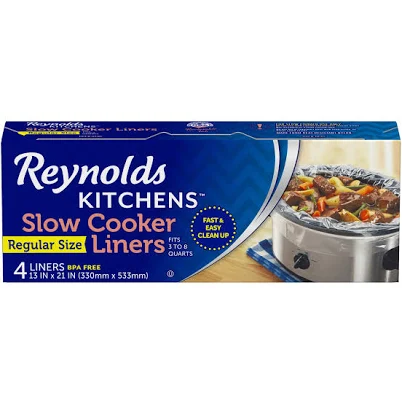
Reynolds Slow Cooker Liners
Skip; zero material transparency prevents risk assessment.
Reynolds won't disclose the composition of these plastic film liners or address PFAS. The plastic coating suggests potential PFAS use, but no public testing or claims exist.
The better-graded swap
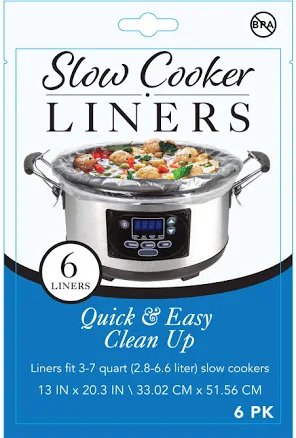
Slow Cooking Liners
90/100 safety
Same rubric that flunked this product. The swap earned Excellent.
Still want this one anyway? Check the price on Amazon. We’d swap it.
Material
Plastic film liner (composition unspecified)
Lab data
No public lab test
You may also be interested in
Top-graded picks in the categories readers replace first, every one scored on the same rubric.

- polypropylene filter housing, carbon/sediment cartridge
- We found no PFAS statement from the brand
- Bacterial growth in spent cartridges
3 hazards checked on this product, all on its full breakdown.

Aquasure
Premier Series 75 GPD Under Sink Reverse Osmosis Water Filtration System
- RO membrane, carbon filters, stainless steel housing
- We found no PFAS statement from the brand
- Bacterial and microbial growth in housing and filters
4 hazards checked on this product, all on its full breakdown.

Avocado
Vegan Mattress
- organic cotton, natural latex, coconut coir, recycled steel coils
- The brand calls it PFAS-free, which we have not verified
- Heavy metals
2 hazards checked on this product, all on its full breakdown.
What Reynolds Slow Cooker Liners is made of, ingredients and materials
Reynolds Slow Cooker Liners are a plastic film designed to line the interior of slow cookers during cooking. The exact polymer composition (polyethylene, polypropylene, or proprietary blend) and additives are not disclosed on packaging or Reynolds' website based on available public records. Without material specification, it is difficult to assess migration risk of plasticizers or other heat-activated compounds into food during extended cooking at temperatures that can reach 180-210°F (82-99°C).
What’s concerning
Category baseline
The starting point for this type of product, before anything specific to this product is counted.
No PFAS disclosure
No public statement from the brand about PFAS in this product.
Plasticizer and additive migration
Slow cookers sustain heat for 4-8 hours at temperatures near boiling. Without polymer identification, the risk of plasticizers (phthalates, BPA alternatives) or slip agents migrating into fatty or acidic foods cannot be ruled out, particularly if the film is touched by the hot ceramic or condensate accumulates against it.
Microplastics
Prolonged exposure to sustained heat can cause polymer breakdown and fragmentation. If the liner weakens, tears, or develops micro-cracks during cooking, fragments may shed into food; risk is highest in slow cookers that exceed manufacturer temperature tolerances or if the liner is reused.
Source, EPA ↗Unidentified additives (opacity agents, stabilizers)
Food-contact plastics often contain proprietary additives to improve clarity, heat stability, or slip properties. Reynolds does not disclose these on product packaging or in available safety documentation, leaving uncertainty about compounds like antimony trioxide or heavy metal-based colorants.
Flame retardants
Reynolds explicitly warns against liner contact with the slow cooker's heating element. Melting or charring at contact points can release volatile compounds and render the liner unusable. This is a known hazard mitigated only by user compliance with instructions.
Source, EPA ↗What’s reassuring
Base material not linked to PFAS
The main material recorded for this product is not one associated with PFAS.
Manufacturing contaminants (residual monomers)
No public reports of illness or contamination linked to Reynolds slow cooker liners. However, all plastic films carry theoretical risk of residual unreacted monomers if resin purity or polymerization processes are not tightly controlled; Reynolds does not publish process validation data for consumer inspection.
How is this PFAS grade calculated?
The brand's record and disclosure
Reynolds is a division of Aleoa and has a long history in food packaging but maintains minimal transparency on polymer sourcing and chemical additives in this product line. The company does not publish material safety data sheets (MSDS) or third-party safety certifications for slow cooker liners in publicly accessible sources. No significant recalls or safety warnings specific to this product have been issued by the FDA or CPSC, though absence of reported issues does not confirm safety at all use conditions.
How it compares in its category
Slow cooker liners are a convenience product with few direct competitors; most alternatives are either unbranded generic films or glass/ceramic slow cooker inserts (which eliminate polymer contact entirely). Reynolds' market dominance means limited choice for consumers seeking this product type. Competitors rarely disclose material composition either, making comparative safety assessment difficult across the category.
If you buy it
Follow Reynolds' printed instructions, do not use liners on the heating element, ensure they do not touch the lid (which can trap condensation and heat), and do not exceed the slow cooker's maximum temperature setting. Replace the liner after each use; reuse is not recommended and increases risk of film degradation and potential particle shedding. If the liner tears or shows signs of melting, discard immediately and do not consume food that contacted the damaged film.
What is not known about PFAS in this product?
- Basis
- Model estimate, 35% confidence, not a lab result
- Lab test
- None on record for this exact product
- Brand statement
- Reynolds has made a specific claim
Formulations change between production runs, so check the current label. How we grade.
What are the PFAS-free alternatives to Reynolds Slow Cooker Liners?
Slow Cooking Liners
- Unbleached parchment paper
- The brand calls it PFAS-free, which we have not verified
- Thermal degradation and smoke release
2 hazards checked on this product, all on its full breakdown.
More slow cooker liners grades
How we score, every product runs through the same public 0-100 rubric based on materials, coatings, brand disclosure, lab findings, and recalls. See the full methodology → Spotted a mistake? Report an error.