
Summersalt Women's Swim Summersalt The Sidestroke One-Piece Blue & White Swimsuit
Lower concern for typical swimwear with no known water-repellent coating treatment disclosed.
This one-piece uses standard nylon-polyester-elastane blends typical of swimwear with no public evidence of Teflon-family coating coatings or water-repellent treatments. Summersalt does not disclose PFAS information.
The better-graded swap
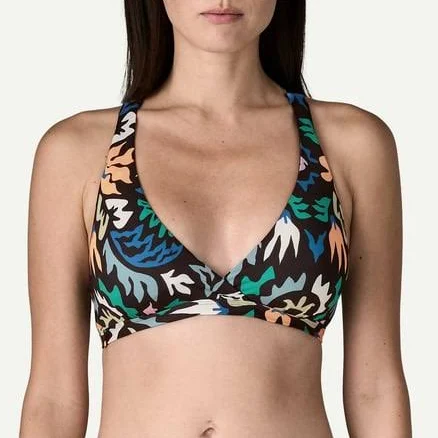
Patagonia
Patagonia Women's Bottom Turn Racerback Bikini Top
90/100 safety
Same rubric that flunked this product. The swap earned Excellent.
Still want this one anyway? Check the price on Amazon. We’d swap it.
Material
Nylon/polyester blend with elastane
Brand disclosure
Brand is silent on PFAS
Lab data
No public lab test
What Summersalt Women's Swim Summersalt is made of, ingredients and materials
This one-piece uses a nylon and polyester blend with elastane (spandex), a standard construction for performance swimwear. Nylon and polyester are synthetic thermoplastics that do not leach into skin or water in normal wear because they are stable polymers; the main risk occurs during manufacturing or if the fabric is damaged and sheds microfibers. Elastane adds stretch and recovery but degrades faster than the base fibers with UV exposure and chlorine contact, which is normal and expected in swimwear.
What’s concerning
Category baseline
The starting point for this type of product, before anything specific to this product is counted.
No PFAS disclosure
No public statement from the brand about PFAS in this product.
Azo dyes and synthetic dye residues
The blue and white colorants are not disclosed by brand. Most swimwear uses disperse dyes applied at high temperature; residual unreacted dyes can leach slightly in early washes but are not systematically tested by Summersalt. No specific reports of dermatitis linked to this product exist.
Microplastic shedding from elastane degradation
Elastane fibers shed microplastics over time, especially with UV and chlorine exposure. This is inherent to all spandex swimwear and occurs whether the suit is high-end or budget; rinsing in fresh water reduces chlorine acceleration of degradation.
Antimony in polyester
Polyester is synthesized with antimony trioxide as a catalyst; trace residual antimony can remain in the finished fiber. Skin contact migration is minimal and no health effect has been established at typical swimwear exposure levels, but the content is not disclosed.
What’s reassuring
Base material not linked to PFAS
The main material recorded for this product is not one associated with PFAS.
Formaldehyde / VOCs
Nylon and polyester swimwear typically do not receive formaldehyde-based wrinkle-resistance treatment because swimwear does not require it; however, off-gassing during early use is not ruled out if an unknown finish is applied. No evidence of formaldehyde use in Summersalt swimwear has been reported.
Source, ATSDR ↗Heavy metals
No testing data or recalls indicate contamination of this product with lead, cadmium, or other heavy metals. Risk is low for nylon/polyester dyes but not independently verified by brand.
Source, FDA ↗The full breakdown
The brand's record and disclosure
Summersalt does not publicly disclose detailed material sourcing, dye standards, or testing certifications (such as Oeko-Tex or GOTS) for this product. The brand markets itself as sustainability-focused but provides limited transparency on chemical inputs during dyeing, finishing, or elastane treatment. No major recalls or chemical controversies have been reported for Summersalt swimwear as of available records. Their silence on PFAS aligns with the industry norm for non-technical swimwear without explicit water-repellent coatings.
How it compares in its category
Most mainstream swimwear uses identical nylon/polyester/elastane blends; Summersalt's offering is conventionally constructed with no unusual material choices. Competitors like Speedo, Target's Kona Sol, and Amazon Essentials use similar compositions and offer similarly limited chemical transparency. Premium alternatives (Rip Curl, O'Neill) sometimes cite environmental certifications but rarely disclose full dye chemistry. This product sits at the typical transparency and safety level for direct-to-consumer swimwear without premium certification claims.
If you buy it
Rinse thoroughly in fresh water immediately after ocean or chlorine use to prevent salt and chemical buildup that accelerates elastane degradation. Wash in cool water with mild detergent; avoid hot water, fabric softener, and bleach, which degrade elastane. Air dry flat or hang; do not machine dry. Expect visible elastane breakdown (sagging, loss of stretch) after 50-80 wears depending on chlorine frequency; this is material fatigue, not a safety defect. Replace when elastane no longer recovers or seams separate.
What we don’t know
- Basis
- Model estimate, 72% confidence, not a lab result
- Lab test
- None on record for this exact product
- Brand statement
- Summersalt has made none
Formulations change between production runs, so check the current label. How we grade.
Better-graded alternatives in Swimwear
Patagonia
Women's Bottom Turn Racerback Bikini Top
- Nylon/polyester blend with elastane (standard swimwear)
- The brand calls it PFAS-free, which we have not verified
- Elastane (spandex) degradation under heat or chlorine
More swimwear grades
How we score, every product runs through the same public 0-100 rubric based on materials, coatings, brand disclosure, lab findings, and recalls. See the full methodology → Spotted a mistake? Report an error.