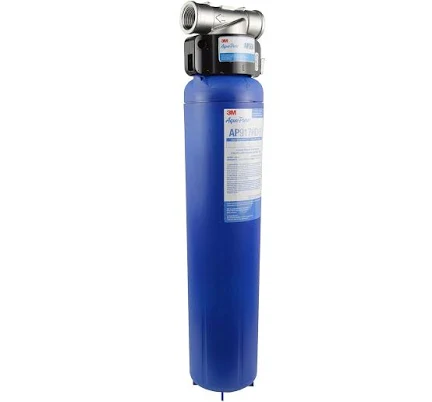
3M Aqua-Pure Whole House Sanitary Quick-Change Water Filter System AP904
Lower-concern choice; activated carbon filters lack typical PFAS sources, but no 3M public commitment.
The AP904 uses activated carbon filtration, a well-established, lower-PFAS-risk material category with no Teflon-family coating coatings or stain or water-resistant treatments typically involved. However, 3M does not disclose PFAS content or claim PFAS-free status.
We flunk more products than we pass. This one earned its grade. How we grade
Material
activated carbon filter media, plastic housing
Brand disclosure
Brand is silent on PFAS
Lab data
No public lab test
You may also be interested in
Top-graded picks in the categories readers replace first, every one scored on the same rubric.

Aquasure
Premier Series 75 GPD Under Sink Reverse Osmosis Water Filtration System
- RO membrane, carbon filters, stainless steel housing
- We found no PFAS statement from the brand
- Bacterial and microbial growth in housing and filters
4 hazards checked on this product, all on its full breakdown.

Avocado
Vegan Mattress
- organic cotton, natural latex, coconut coir, recycled steel coils
- The brand calls it PFAS-free, which we have not verified
- Heavy metals
2 hazards checked on this product, all on its full breakdown.

- polyurethane foam
- We found no PFAS statement from the brand
- Volatile Organic Compound (VOC) Off-Gassing
4 hazards checked on this product, all on its full breakdown.
What 3M Aqua-Pure Whole House System AP904 is made of, ingredients and materials
The AP904 uses activated carbon as its primary filtration media, which is inert and does not leach contaminants into water under normal use. The plastic housing is polypropylene or similar food-grade thermoplastic, chosen for resistance to corrosion and pressure stability. Activated carbon adsorbs rather than dissolves, meaning the filter itself does not shed particles or chemical byproducts into the treated water. The quick-change cartridge design minimizes user contact with contaminated media during replacement.
What’s concerning
No PFAS disclosure
No public statement from the brand about PFAS in this product.
Bacterial growth in filter media if maintenance is neglected
Activated carbon is a nutrient source for biofilm if water sits stagnant or cartridge replacement is delayed significantly beyond recommended intervals. Regular replacement mitigates this; no reported contamination incidents specific to AP904 are on record.
Carbon dust inhalation during cartridge replacement
Loose activated carbon particles can escape during quick-change cartridge removal if flushing is skipped. This is a handling hazard, not a water quality issue; mitigated by following the 5-minute flush procedure and changing cartridges away from breathing directly into the unit.
Cross-contamination from contaminated incoming water if housing seals fail
No failures specific to AP904 seals are on record, but whole-house filter housings can crack under physical impact or over-torquing of the cartridge head. Impact is rare and visible; inspect housing annually for hairline cracks.
Incomplete documentation of cartridge material composition
3M does not publicly disclose the binder resin or additives in the carbon cartridge itself, only that media is NSF-certified. Activated carbon itself has no hazard of this kind on record, but proprietary binder chemistry is not independently verifiable by consumers.
What’s reassuring
Base material not linked to PFAS
The main material recorded for this product is not one associated with PFAS.
Plastic housing degradation under sustained high pressure or temperature
Polypropylene housing is rated for standard residential water pressure and temperature; no published failures or leachate concerns are documented for this model. Risk increases only in non-standard installations (e.g., hot water inlet exceeding 43 degrees Celsius).
How is this PFAS grade calculated?
The brand's record and disclosure
3M's water filtration division maintains NSF/ANSI certification (NSF 42 and NSF 53 standards), which require third-party testing for contaminant removal and material safety. The parent company 3M has faced litigation over legacy PFAS contamination but does not publicly market water filters as PFAS-removal products, and the Aqua-Pure line does not make explicit PFAS claims. Certifications suggest rigorous material vetting for leachables, though 3M has not issued a dedicated PFAS commitment for this product line. No product-specific recalls related to contamination or housing degradation are on record.
How it compares in its category
Whole-house activated carbon filters are generally considered lower-risk compared to reverse-osmosis or ion-exchange systems, which involve more complex plastic and resin components prone to degradation. The AP904's quick-change design reduces bacterial biofilm accumulation risk compared to cartridges that remain pressurized for years without replacement. NSF certification is more robust than many budget whole-house filters that lack third-party validation. This sits in the mainstream-safety tier for whole-house filters, not premium but not budget-corner-cutting.
If you buy it
Replace cartridges every 6 to 12 months depending on water hardness and sediment load, as carbon loses adsorption capacity over time and stagnant filter media can harbor bacteria. Flush the system for 5 minutes after installation to clear any carbon dust. Monitor water flow and pressure gauge; a sharp drop signals saturation. Do not attempt to open or reuse cartridges; they are single-use. Store replacement cartridges in a cool, dry place away from direct sunlight.
What is not known about PFAS in this product?
- Basis
- Model estimate, 72% confidence, not a lab result
- Lab test
- None on record for this exact product
- Brand statement
- 3M has made none
Formulations change between production runs, so check the current label. How we grade.
More whole-house filters grades
How we score, every product runs through the same public 0-100 rubric based on materials, coatings, brand disclosure, lab findings, and recalls. See the full methodology → Spotted a mistake? Report an error.