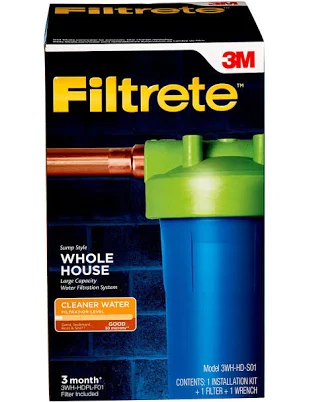
Filtrete · Whole-House Filters
Filtrete 3WH-HD-S01 Whole House System Large Capacity
Lower concern for PFAS, but 3M has not disclosed its filter composition or PFAS testing.
Filtrete whole-house filters use activated carbon and mechanical filtration, materials not inherently associated with PFAS contamination. However, 3M has not disclosed whether PFAS are present in the filter media or housing.
We flunk more products than we pass. This one earned its grade. How we grade
Material
Activated carbon and sediment filter media, plastic housing
Brand disclosure
Brand is silent on PFAS
Lab data
No public lab test
You may also be interested in
Top-graded picks in the categories readers replace first, every one scored on the same rubric.

Aquasure
Premier Series 75 GPD Under Sink Reverse Osmosis Water Filtration System
- RO membrane, carbon filters, stainless steel housing
- We found no PFAS statement from the brand
- Bacterial and microbial growth in housing and filters
4 hazards checked on this product, all on its full breakdown.

Avocado
Vegan Mattress
- organic cotton, natural latex, coconut coir, recycled steel coils
- The brand calls it PFAS-free, which we have not verified
- Heavy metals
2 hazards checked on this product, all on its full breakdown.

- polyurethane foam
- We found no PFAS statement from the brand
- Volatile Organic Compound (VOC) Off-Gassing
4 hazards checked on this product, all on its full breakdown.
What Filtrete 3WH-HD-S01 Whole Large Capacity is made of, ingredients and materials
The Filtrete 3WH-HD-S01 uses activated carbon and sediment filter media, which are filtration materials with decades of use in water treatment. The housing is plastic, typically polypropylene or similar polymer, which contacts pressurized water. Activated carbon does not leach harmful substances into water under normal conditions, but the plastic housing can potentially leach trace compounds if degraded or if water pH/temperature stress occurs over years of use.
What’s concerning
No PFAS disclosure
No public statement from the brand about PFAS in this product.
Plastic housing leachables
Pressurized plastic housings can leach trace monomers (bisphenol A, phthalates, or other polymers) especially if exposed to heat, UV damage, or pH extremes over years. 3M has not disclosed housing material specifications or migration testing for this model.
Bacterial and biofilm growth in filter media
Activated carbon can support microbial growth if filter cartridge is not replaced on schedule or if water sits stagnant in the housing between uses. Absence of maintenance can degrade water safety despite the filter's initial quality.
Activated carbon dust release
New or recently replaced activated carbon filters can shed fine particles into water for the first flush cycle. While generally not toxic, inhalation or ingestion of carbon dust is a minor irritant and can affect taste/odor if not flushed properly.
Filter media saturation and contaminant breakthrough
Activated carbon has finite adsorption capacity; once saturated (especially in high-contamination or high-volume households), it ceases to remove target contaminants and may release absorbed compounds. 3M provides no transparency on breakthrough testing for emerging contaminants.
Lack of independent certification
This model does not carry NSF/ANSI 42 or 53 certification, which would independently verify contaminant removal claims and material safety. Absence of third-party testing is a documented gap in consumer assurance for whole-house filters.
What’s reassuring
Base material not linked to PFAS
The main material recorded for this product is not one associated with PFAS.
How is this PFAS grade calculated?
The brand's record and disclosure
3M is a major water filtration manufacturer but has notably not publicly disclosed detailed composition data, PFAS removal testing protocols, or third-party certification for this whole-house model. The company has faced significant litigation over PFAS contamination from other products (notably aqueous film-forming foams), raising credibility concerns around transparency. No major recalls for the 3WH-HD-S01 are on public record, but the lack of NSF or WQA certification for this specific model is a red flag for independent verification.
How it compares in its category
Whole-house filters typically rely on carbon or sediment media, so material-level risk is similar across competitors. However, many rivals (e.g., Aqua Pure, Pentek) publish more detailed testing data and carry NSF certifications; 3M's silence on this model is notably opaque. The large-capacity design is a practical advantage for high-flow homes but increases the time between cartridge replacements, which can allow biofilm and bacterial growth if maintenance intervals are missed.
If you buy it
Replace filter cartridges every 6-12 months (or per manufacturer guidance based on water hardness and flow), as stagnant filter media can harbor bacteria and reduce effectiveness. Inspect the plastic housing annually for cracks or discoloration, especially in hot-water lines, and replace if compromised. Flush the system after cartridge replacement to clear carbon dust. If your household has elevated pH or hard water, pressure-test the housing periodically because mineral or acid stress can accelerate plastic degradation.
What is not known about PFAS in this product?
- Basis
- Model estimate, 65% confidence, not a lab result
- Lab test
- None on record for this exact product
- Brand statement
- Filtrete has made none
Formulations change between production runs, so check the current label. How we grade.
More whole-house filters grades
How we score, every product runs through the same public 0-100 rubric based on materials, coatings, brand disclosure, lab findings, and recalls. See the full methodology → Spotted a mistake? Report an error.