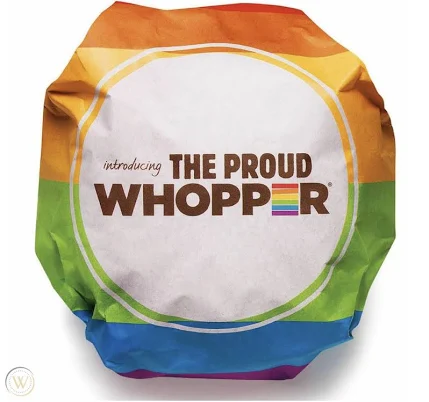
Burger King · Fast-Casual Food Packaging
Burger King's Gay Rights Wrapper
Skip. Grease-resistant wrapper coating composition unknown.
This wrapper likely uses grease and water-resistant coating, but composition remains undisclosed. Typical grease-resistant food packaging contains PFAS without brand transparency.
Still want this one anyway? Check the price on Amazon. We’d swap it.
Material
coated paper/cardboard with unknown water/grease-resistant treatment
Brand disclosure
Brand is silent on PFAS
Lab data
No public lab test
You may also be interested in
Top-graded picks in the categories readers replace first, every one scored on the same rubric.

- polypropylene filter housing, carbon/sediment cartridge
- We found no PFAS statement from the brand
- Bacterial growth in spent cartridges
3 hazards checked on this product, all on its full breakdown.

Aquasure
Premier Series 75 GPD Under Sink Reverse Osmosis Water Filtration System
- RO membrane, carbon filters, stainless steel housing
- We found no PFAS statement from the brand
- Bacterial and microbial growth in housing and filters
4 hazards checked on this product, all on its full breakdown.

Avocado
Vegan Mattress
- organic cotton, natural latex, coconut coir, recycled steel coils
- The brand calls it PFAS-free, which we have not verified
- Heavy metals
2 hazards checked on this product, all on its full breakdown.
What Burger King's Gay Rights Wrapper is made of, ingredients and materials
Burger King's wrapper is coated paperboard, likely with a water and grease-resistant polymer or wax-based treatment to prevent food oils from soaking through during transport and storage. The specific chemistry of this coating is not disclosed by Burger King and is proprietary to their packaging supplier. Coated food-contact papers often rely on fluorinated compounds (PFAS) or other synthetic polymers to achieve grease resistance; without transparency, the presence and type cannot be verified. The cardboard substrate itself is standard waste fiber, but the coating is the primary safety concern.
What’s concerning
Category baseline
The starting point for this type of product, before anything specific to this product is counted.
No PFAS disclosure
No public statement from the brand about PFAS in this product.
Waterproof / stain-resistant treatment
Water-repellent coating treatments have historically used PFAS.
PFAS
Grease-resistant coatings on food-contact paper often release trace compounds into fatty foods; the specific chemistry here is undisclosed, making independent assessment impossible. Indirect migration risk is low for brief contact but non-zero, especially with hot or oily foods.
Source, ATSDR ↗Thermal degradation of coating under heat
Hot burgers may warm the wrapper coating; some synthetic polymers or wax treatments can soften or release volatile compounds under moderate heat. Risk is low for typical serving temperatures but increases if food is very hot or left wrapped for extended periods.
What’s reassuring
Microplastic or polymer particle shedding
No published cases of polymer coating shedding from burger wrappers into food. Visual inspection for flaking or degradation is a practical precaution for heavily handled or damaged wrappers.
Ink migration from printed graphics
The wrapper includes printed messaging; most food-contact inks are regulated, but without Burger King's ink formulation disclosure, heavy metal or solvent migration cannot be ruled out for very hot foods in prolonged contact.
How is this PFAS grade calculated?
The brand's record and disclosure
Burger King has not publicly disclosed the composition of its food-contact coatings or committed to PFAS-free packaging as of available information. The company has not released third-party testing or safety certifications specific to this wrapper or its chemical additives. Burger King's parent company (Restaurant Brands International) has not made prominent commitments to eliminate fluorinated water-resistant treatments across its packaging supply chain. This silence is notable given growing regulatory pressure and consumer awareness around PFAS in food packaging.
How it compares in its category
Most fast-casual burger wrappers use similar coated paperboard designs; competitors like Chick-fil-A and McDonald's also do not disclose coating chemistry broadly. Some chains have begun transitioning to certified PFAS-free or plant-based coatings, but this remains an industry-wide gap rather than a Burger King-specific failure. Relative to the market, Burger King is neither a leader nor a laggard in transparency; the category itself lacks standardized disclosure.
If you buy it
Single-use food wrappers are inherently low-exposure items since contact is brief and the food is eaten immediately after. The wrapper does not require care or maintenance. If concerned about coating chemicals, unwrap food as soon as possible to minimize prolonged contact. Dispose of the wrapper in standard waste; it is not suitable for composting due to the synthetic coating.
What is not known about PFAS in this product?
- Basis
- Model estimate, 35% confidence, not a lab result
- Lab test
- None on record for this exact product
- Brand statement
- Burger King has made none
Formulations change between production runs, so check the current label. How we grade.
More fast-casual food packaging grades
How we score, every product runs through the same public 0-100 rubric based on materials, coatings, brand disclosure, lab findings, and recalls. See the full methodology → Spotted a mistake? Report an error.