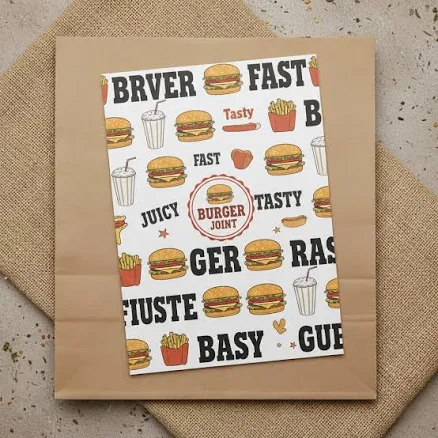
Burger Restaurant Wrapping Paper
Avoid if concerned, as grease-resistant food packaging often contains PFAS.
The brand's wrapping paper uses water and grease-resistant coatings common in fast food, likely PFAS-based. The company offers no PFAS disclosure or third-party testing, and coating sources remain unknown.
Still want this one anyway? Check the price on Amazon. We’d swap it.
Material
bleached paper with grease-resistant coating (likely PFAS-based)
Brand disclosure
Brand is silent on PFAS
Lab data
No public lab test
You may also be interested in
Top-graded picks in the categories readers replace first, every one scored on the same rubric.

- polypropylene filter housing, carbon/sediment cartridge
- We found no PFAS statement from the brand
- Bacterial growth in spent cartridges
3 hazards checked on this product, all on its full breakdown.

Aquasure
Premier Series 75 GPD Under Sink Reverse Osmosis Water Filtration System
- RO membrane, carbon filters, stainless steel housing
- We found no PFAS statement from the brand
- Bacterial and microbial growth in housing and filters
4 hazards checked on this product, all on its full breakdown.

Avocado
Vegan Mattress
- organic cotton, natural latex, coconut coir, recycled steel coils
- The brand calls it PFAS-free, which we have not verified
- Heavy metals
2 hazards checked on this product, all on its full breakdown.
What Burger Restaurant Wrapping Paper is made of, ingredients and materials
Wrapping paper is bleached kraft paper treated with a grease-resistant coating designed to prevent oil and moisture from soaking through during food transport. The coating is almost certainly a fluorinated compound (PFAS-based), a chemical family chosen because fluorine bonds are extremely stable and water- and oil-repellent. This durability is what makes it effective for fast-food use, but the same property means PFAS does not break down in the environment or human body.
What’s concerning
Category baseline
The starting point for this type of product, before anything specific to this product is counted.
No PFAS disclosure
No public statement from the brand about PFAS in this product.
Waterproof / stain-resistant treatment
Water-repellent coating treatments have historically used PFAS.
PFAS
This product is graded separately as Poor (25/100); typical fluorochemical coatings migrate minimally over minutes of contact but accumulate with repeated consumption. PFAS has been linked to thyroid disease, immune suppression, and liver effects in epidemiological studies, though individual exposure from one meal is negligible.
Source, ATSDR ↗Bleached paper residues (chlorine compounds)
Bleached kraft paper may contain trace dioxins or chlorinated compounds from processing; modern commercial bleaching has reduced but not eliminated this risk. Direct food contact for minutes is low-risk, but chronic exposure from frequent fast-food consumption warrants consideration.
Coating degradation and microparticle transfer
If the grease-resistant coating degrades (from heat, moisture, or age), microscopic particles could theoretically transfer to food. No specific recalls or studies document this for paper, but it remains a theoretical pathway for PFAS uptake.
What’s reassuring
Ink or print contaminants
The brand's wrapper inks are unlikely to leach into food under normal conditions (short contact, room temperature, no solvent exposure). No public incidents or testing data flagging ink toxicity for this product exist.
How is this PFAS grade calculated?
The brand's record and disclosure
The brand does not publicly disclose material composition or PFAS content in packaging, nor has the brand made commitments to phase out PFAS-based food contact materials. The fast-food industry broadly has been slow to adopt PFAS-free alternatives despite growing regulatory pressure in some U.S. states and the EU. No major recalls or safety violations specific to this wrapping paper are on record, but absence of disclosure does not indicate absence of concern.
How it compares in its category
Most major fast-casual chains (McDonald's, Wendy's, Chipotle) use similar bleached paper with grease-resistant coatings; industry-wide adoption of PFAS in this application remains standard. A small number of chains have committed to alternatives with no hazard of this kind on record, though cost and performance trade-offs have slowed rollout. The brand's positioning is representative of the majority practice, not an outlier.
If you buy it
This product is designed for single-use contact with food for minutes to hours only, which presents minimal migration risk compared to reusable food storage or cookware. Do not microwave or heat the wrapped food inside the paper, as heat accelerates chemical migration. If PFAS exposure is a personal health priority, request unwrapped service or choose competitors with documented PFAS-free packaging; the paper itself is not a hazard for typical short-contact food wrapping.
What is not known about PFAS in this product?
- Basis
- Model estimate, 45% confidence, not a lab result
- Lab test
- None on record for this exact product
- Brand statement
- has made none
Formulations change between production runs, so check the current label. How we grade.
More fast-casual food packaging grades
How we score, every product runs through the same public 0-100 rubric based on materials, coatings, brand disclosure, lab findings, and recalls. See the full methodology → Spotted a mistake? Report an error.