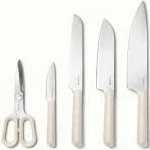
Caraway · Non-Stick Knife Sets
Caraway 5-Piece Knife Set, Is It Non-Toxic?
No coating of concern recorded, and no PFAS statement from the brand.
The brand has published no PFAS statement for this product that we could find.
Still want this one anyway? Check the price on Amazon. We’d swap it.
Material
German stainless steel blades
Lab data
No public lab test
You may also be interested in
Top-graded picks in the categories readers replace first, every one scored on the same rubric.

- polypropylene filter housing, carbon/sediment cartridge
- We found no PFAS statement from the brand
- Bacterial growth in spent cartridges
3 hazards checked on this product, all on its full breakdown.

Aquasure
Premier Series 75 GPD Under Sink Reverse Osmosis Water Filtration System
- RO membrane, carbon filters, stainless steel housing
- We found no PFAS statement from the brand
- Bacterial and microbial growth in housing and filters
4 hazards checked on this product, all on its full breakdown.

Avocado
Vegan Mattress
- organic cotton, natural latex, coconut coir, recycled steel coils
- The brand calls it PFAS-free, which we have not verified
- Heavy metals
2 hazards checked on this product, all on its full breakdown.
Is Caraway 5-Piece Knife Set non-toxic? What it is made of
Caraway's 5-piece set uses German stainless steel blades, a corrosion-resistant iron-chromium alloy that does not require non-stick coatings to function. Stainless steel knives do not shed microplastics, do not release Teflon-type coating fumes, and do not leach metals into food under normal use. The blade material itself carries no established acute safety hazard in culinary applications.
What’s concerning
No PFAS disclosure
No public statement from the brand about PFAS in this product.
Category baseline
The starting point for this type of product, before anything specific to this product is counted.
Handle material degradation
Caraway does not publicly disclose handle material composition (plastic, composite, or other). Without material confirmation, long-term leaching or off-gassing potential cannot be ruled out, though stainless steel blade-to-handle interface is lower-risk than riveted alternatives.
Microabrasion and particle release from handles
If handles are polymer or composite materials not explicitly FDA-approved for food contact, wear or micro-scratching could theoretically release small particles. No recalls or testing data exist for this product, so risk level is speculative.
What’s reassuring
Bare uncoated material
Recorded as a bare, uncoated material with no surface coating or treatment.
Heavy metals
German stainless steel specifications typically include nickel and molybdenum for corrosion resistance. These are present in standard concentration and do not migrate into food under normal use; individuals with nickel sensitivity should note prolonged skin contact with stainless blades is possible during handling.
Source, FDA ↗Chromium leaching under corrosion
Stainless steel does not corrode under normal kitchen conditions. Only in prolonged contact with salt water, bleach, or highly acidic media at elevated temperatures could chromium leach; proper hand washing and drying prevents this scenario.
How is this PFAS grade calculated?
The brand's record and disclosure
Caraway is known primarily for non-stick cookware and has made public commitments to PFAS-free products; however, the brand has not issued a specific safety statement for this knife set. No recalls, certifications, or documented safety controversies are on record for Caraway knives. The brand's broader cookware ethos suggests a baseline consumer-safety orientation, but limited third-party transparency on this specific product line.
How it compares in its category
Most non-stick knife sets use plastic handles and occasionally ceramic or polymer blade coatings that can degrade or shed particles over years of use. Caraway's stainless steel approach avoids those complexity layers. German stainless steel is a mid-to-premium material choice for knife sets, comparable to brands like Wusthof or Victorinox in durability, though without the depth of historical safety documentation those established cutlery houses carry.
If you buy it
Hand-wash rather than machine-wash to preserve edge and handle integrity. Avoid prolonged contact with salt water or highly acidic foods left sitting on the blade, as even stainless steel can pit under extreme conditions. Replace handles if they crack or show visible wear; do not attempt to seal or repair with adhesives. Sharpen or have professionally honed every 6-12 months depending on use frequency.
What is not known about PFAS in this product?
- Basis
- Model estimate, 75% confidence, not a lab result
- Lab test
- None on record for this exact product
- Brand statement
- Caraway has made a specific claim
Formulations change between production runs, so check the current label. How we grade.
More non-stick knife sets grades
How we score, every product runs through the same public 0-100 rubric based on materials, coatings, brand disclosure, lab findings, and recalls. See the full methodology → Spotted a mistake? Report an error.