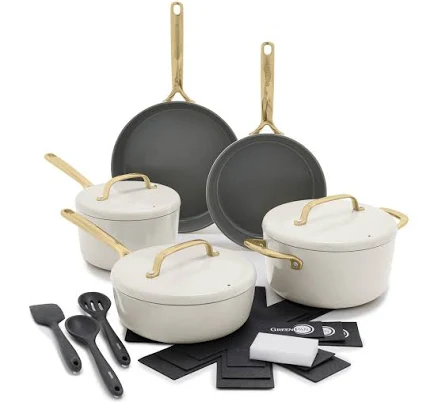
GREENPan GP5 Champagne Ceramic Non-stick Cookware Set, Is It Non-Toxic?
Named ceramic non-stick coating, with a brand PFAS statement we have not verified.
GreenPan says its Thermolon coated food contact surface is free of PFAS, including Teflon-type coating and PFOA. We record that as an unverified brand claim.
Brand says: “GreenPan says its Thermolon coated food contact surface is free of PFAS, including PTFE and PFOA.”
We flunk more products than we pass. This one earned its grade. How we grade
Material
Ceramic non-stick coating
Brand disclosure
Brand claims PFAS-free
Lab data
No public lab test
You may also be interested in
Top-graded picks in the categories readers replace first, every one scored on the same rubric.

- polypropylene filter housing, carbon/sediment cartridge
- We found no PFAS statement from the brand
- Bacterial growth in spent cartridges
3 hazards checked on this product, all on its full breakdown.

Aquasure
Premier Series 75 GPD Under Sink Reverse Osmosis Water Filtration System
- RO membrane, carbon filters, stainless steel housing
- We found no PFAS statement from the brand
- Bacterial and microbial growth in housing and filters
4 hazards checked on this product, all on its full breakdown.

Avocado
Vegan Mattress
- organic cotton, natural latex, coconut coir, recycled steel coils
- The brand calls it PFAS-free, which we have not verified
- Heavy metals
2 hazards checked on this product, all on its full breakdown.
Is GREENPan GP5 Champagne Cookware Set non-toxic? What it is made of
GreenPan GP5 uses a ceramic non-stick coating applied over aluminum cookware bodies. Ceramic coatings are inorganic mineral-based surfaces without Teflon-type coating (Teflon), which eliminates the fume-release risk associated with traditional Teflon-family coating non-sticks at high temperatures. The aluminum substrate requires validation that it does not leach significantly under normal cooking conditions; ceramic acts as a physical barrier, but coating integrity over time determines safety.
What’s concerning
Disclosed non-fluorinated coating
Coating is named and the brand states it is made without PFAS.
Category baseline
The starting point for this type of product, before anything specific to this product is counted.
Ceramic coating degradation and aluminum leaching
Ceramic non-stick coatings are more prone to chipping and flaking than Teflon-type coating over time. If the coating is breached, the underlying aluminum may contact acidic or salt-containing foods, potentially increasing aluminum leaching; no specific data on GP5 leaching rates is publicly available.
Thermal shock and coating adhesion
Rapid temperature changes (e.g., moving from stovetop to cold water) can cause ceramic coatings to separate from the aluminum substrate. GreenPan does not prominently disclose thermal shock limits; user behavior is a significant factor.
What’s reassuring
Brand-stated PFAS-free
The brand states this product is PFAS-free. We have not verified the claim.
Lead
No recalls or published test results indicating lead or cadmium contamination in GreenPan GP5 cookware. Ceramic coatings used in food-contact cookware are typically regulated, but independent certification data for this specific line is not widely documented.
Source, ATSDR ↗Teflon-type coating fume inhalation risk
By design, ceramic non-stick eliminates Teflon-type coating and Teflon-type coating-related fume hazards that occur when traditional non-stick cookware overheats. This is a material advantage of this product class.
Cookware handle safety (material not specified in known context)
The material composition of handles (e.g., silicone, phenolic, stainless steel) is not specified in available context; handles are not ceramic non-stick and carry separate durability and burn-risk considerations not addressed here.
How is this PFAS grade calculated?
The brand's record and disclosure
GreenPan publicly markets its cookware as PFAS-free and has positioned the ceramic coating as a PFOA and Teflon-type coating alternative. The brand has not faced major product recalls for lead or cadmium contamination in cookware based on available public records. However, the specific ceramic formulation and glaze composition have not been independently verified by third-party lab testing in widely published safety reports; the PFAS-free claim relies on brand statement.
How it compares in its category
Ceramic non-stick cookware occupies a middle ground between traditional Teflon-type coating and uncoated stainless steel. Compared to older non-stick lines, GreenPan eliminates Teflon-type coating fume risk and avoids legacy PFOA formulations. Ceramic coatings degrade faster than Teflon-type coating under heavy use and higher heat, meaning replacement cycles are shorter. This trade-off is transparent in the category, and GreenPan's positioning is consistent with other ceramic brands (Our Place, Caraway).
If you buy it
Use silicone or wood utensils only; metal utensils accelerate coating wear. Keep heat at medium to medium-high; ceramic coatings can degrade under sustained high heat or thermal shock. Hand wash or use gentle cycles; dishwashers may accelerate coating degradation. Inspect the cooking surface regularly for chips, flaking, or visible wear; if coating loss occurs, retire the pan to avoid potential aluminum leaching through bare spots.
What is not known about PFAS in this product?
- Basis
- Model estimate, 78% confidence, not a lab result
- Lab test
- None on record for this exact product
- Brand statement
- GreenPan has made a specific claim
Formulations change between production runs, so check the current label. How we grade.
What are the PFAS-free alternatives to GREENPan GP5 Champagne Ceramic Non-stick Cookware Set?
- Ceramic nonstick coating
- The brand calls it PFAS-free, which we have not verified
- Aluminum leaching
3 hazards checked on this product, all on its full breakdown.
- ceramic-coated aluminum cookware
- We found no PFAS statement from the brand
- Aluminum leaching
3 hazards checked on this product, all on its full breakdown.
More ceramic cookware grades
How we score, every product runs through the same public 0-100 rubric based on materials, coatings, brand disclosure, lab findings, and recalls. See the full methodology → Spotted a mistake? Report an error.