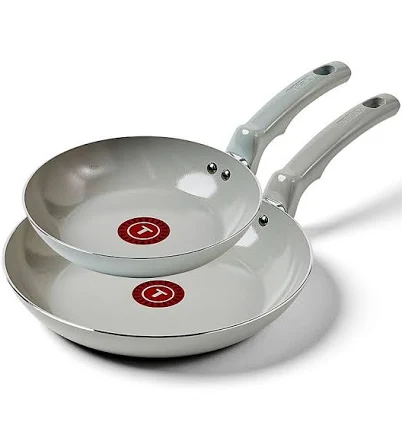
T-Fal Essentials Ceramic Fry Pan Set, Is It Non-Toxic?
Ceramic nonstick poses lower PFAS concern than Teflon-type coating; T-fal makes no public PFAS commitment.
T-Fal Essentials uses ceramic nonstick coating rather than traditional Teflon-type coating, which typically contains fewer PFAS concerns. The brand does not disclose PFAS testing or make PFAS-free claims.
The better-graded swap
GreenPan
Lima Hard Anodized Ceramic Nonstick 10 Inch Frying Pan
100/100 safety
Same rubric that flunked this product. The swap earned Excellent.
Still want this one anyway? Check the price on Amazon. We’d swap it.
Material
ceramic nonstick coating on aluminum base
Lab data
No public lab test
You may also be interested in
Top-graded picks in the categories readers replace first, every one scored on the same rubric.

- polypropylene filter housing, carbon/sediment cartridge
- We found no PFAS statement from the brand
- Bacterial growth in spent cartridges
3 hazards checked on this product, all on its full breakdown.

Aquasure
Premier Series 75 GPD Under Sink Reverse Osmosis Water Filtration System
- RO membrane, carbon filters, stainless steel housing
- We found no PFAS statement from the brand
- Bacterial and microbial growth in housing and filters
4 hazards checked on this product, all on its full breakdown.

Avocado
Vegan Mattress
- organic cotton, natural latex, coconut coir, recycled steel coils
- The brand calls it PFAS-free, which we have not verified
- Heavy metals
2 hazards checked on this product, all on its full breakdown.
Is T-Fal Essentials Ceramic Fry Pan Set non-toxic? What it is made of
T-Fal Essentials uses a ceramic-based nonstick coating applied over an aluminum core. Ceramic coatings are inorganic and do not require Teflon-type coating (Teflon) or PFOA, reducing Teflon-family coating risks. However, the aluminum substrate can leach if the ceramic coating degrades, and the durability of ceramic nonstick is typically lower than Teflon-type coating, meaning replacement cycles are shorter. The exact composition of T-Fal's ceramic formulation is not publicly detailed.
What’s concerning
Category baseline
The starting point for this type of product, before anything specific to this product is counted.
No PFAS disclosure
No public statement from the brand about PFAS in this product.
Non-stick, chemistry undisclosed
Marketed as non-stick without stating the coating chemistry.
Aluminum leaching (substrate exposure)
If ceramic coating chips or wears through, aluminum core can contact food, especially acidic foods (tomato, vinegar, citrus). T-Fal does not specify ceramic thickness or durability testing standards, making long-term safety prediction difficult.
Microplastics
Ceramic nonstick coatings are known to flake or peel with age. No peer-reviewed data specifically links T-Fal ceramic cookware to food contamination, but ceramic cookware in general has shorter effective lifespans than Teflon-type coating and shed particles during degradation.
Source, EPA ↗Thermal performance and heat distribution variability
Aluminum conducts heat rapidly; uneven or missing ceramic coating can create hot spots. This is a safety concern for burns and uneven cooking, though not a chemical hazard per se.
Lack of material transparency
T-Fal does not disclose the specific polymer binders, pigments, or additives in its ceramic coating formulation. This limits independent verification of contaminants such as formaldehyde resins or trace heavy metals used in pigmentation.
What’s reassuring
Lead
No recalls or reports of heavy metal contamination in T-Fal ceramic cookware have been documented. However, T-Fal does not publish third-party test results verifying absence of lead or cadmium in glazes, which is standard practice among higher-transparency brands.
Source, ATSDR ↗How is this PFAS grade calculated?
The brand's record and disclosure
T-Fal (Groupe SEB) has not published specific PFAS elimination commitments or detailed material safety data sheets for this product line. The brand does not highlight ceramic as a PFAS-free choice in marketing. No significant product recalls or safety controversies specific to T-Fal ceramic cookware have been widely documented, but the company's silence on chemical composition and sustainability is notable in an industry where transparency is increasingly expected.
How it compares in its category
Ceramic nonstick cookware as a category sits between Teflon-type coating (higher Teflon-family coating risk) and uncoated stainless steel (durability but no nonstick). T-Fal's ceramic offering is mid-market in price and performance. Competitors like GreenPan and Our Place actively promote PFOA-free and Teflon-type coating-free status; T-Fal does not emphasize this distinction, which may reflect confidence in the coating or simply a different marketing strategy. Ceramic coatings generally show higher wear rates than conventional Teflon-type coating after 1-3 years of regular use.
If you buy it
Keep heat below medium-high; ceramic nonstick can degrade faster at sustained high temperatures. Inspect the coating monthly for chips, scratches, or visible wear; discard the pan once coating integrity is compromised to prevent aluminum leaching. Hand wash gently; abrasive scrubbing and dishwasher use accelerate wear. Do not preheat the empty pan. Expect a replacement cycle of 2-4 years depending on frequency and care quality.
What is not known about PFAS in this product?
- Basis
- Model estimate, 72% confidence, not a lab result
- Lab test
- None on record for this exact product
- Brand statement
- T-fal has made a specific claim
Formulations change between production runs, so check the current label. How we grade.
What are the PFAS-free alternatives to T-Fal Essentials Ceramic Fry Pan Set?
- Ceramic nonstick coating
- The brand calls it PFAS-free, which we have not verified
- Aluminum leaching
3 hazards checked on this product, all on its full breakdown.
- ceramic-coated aluminum cookware
- We found no PFAS statement from the brand
- Aluminum leaching
3 hazards checked on this product, all on its full breakdown.
- ceramic nonstick coating (proprietary, PFAS-free)
- The brand calls it PFAS-free, which we have not verified
- Aluminum leaching (from core if coating fails)
3 hazards checked on this product, all on its full breakdown.
More ceramic cookware grades
How we score, every product runs through the same public 0-100 rubric based on materials, coatings, brand disclosure, lab findings, and recalls. See the full methodology → Spotted a mistake? Report an error.