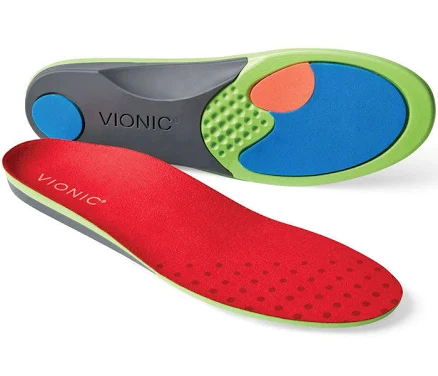
Vionic · Synthetic Athletic Insoles & Orthotics
Vionic Women's Active Full Length Insole
Lower concern for typical EVA insole; no PFAS disclosure needed.
Vionic makes no PFAS claims about this EVA foam insole. Standard EVA typically doesn't require water-resistant coatings and no lab testing is publicly available.
Still want this one anyway? Check the price on Amazon. We’d swap it.
Material
EVA foam, arch support structure
Brand disclosure
Brand is silent on PFAS
Lab data
No public lab test
You may also be interested in
Top-graded picks in the categories readers replace first, every one scored on the same rubric.

- polypropylene filter housing, carbon/sediment cartridge
- We found no PFAS statement from the brand
- Bacterial growth in spent cartridges
3 hazards checked on this product, all on its full breakdown.

Aquasure
Premier Series 75 GPD Under Sink Reverse Osmosis Water Filtration System
- RO membrane, carbon filters, stainless steel housing
- We found no PFAS statement from the brand
- Bacterial and microbial growth in housing and filters
4 hazards checked on this product, all on its full breakdown.

Avocado
Vegan Mattress
- organic cotton, natural latex, coconut coir, recycled steel coils
- The brand calls it PFAS-free, which we have not verified
- Heavy metals
2 hazards checked on this product, all on its full breakdown.
What Vionic Women's Active Full Length Insole is made of, ingredients and materials
Vionic's Active Full Length Insole is constructed from EVA (ethylene-vinyl acetate) foam, a closed-cell polymer commonly used in footwear because it is lightweight, compressible, and cushioning. EVA does not contain phthalates by default, though some formulations may include plasticizers or colorants added during manufacturing. The foam core is typically bonded to a fabric or synthetic top cover; the arch support structure itself adds no novel hazard class beyond standard footwear material concerns. EVA stability under normal foot-temperature conditions (below 60°C / 140°F) is well-established, making degradation or off-gassing a low risk during typical wear.
What’s concerning
Category baseline
The starting point for this type of product, before anything specific to this product is counted.
No PFAS disclosure
No public statement from the brand about PFAS in this product.
Phthalates
Standard EVA does not require phthalates, but some manufacturers add them to improve flexibility. Vionic does not disclose phthalate testing or sourcing. Migration from insole to skin during warm, moist conditions (sweating feet) is theoretically possible but not documented for this product.
Source, ATSDR ↗What’s reassuring
Base material not linked to PFAS
The main material recorded for this product is not one associated with PFAS.
Formaldehyde / VOCs
EVA foam itself does not off-gas formaldehyde, but bonding adhesives or fabric coatings on the cover could contain formaldehyde releasers. Vionic does not disclose formaldehyde testing or limits; no complaints of odor or dermal reaction are on record for this product line.
Source, ATSDR ↗Azo dyes (foam or fabric pigmentation)
If the insole is colored (not natural beige), synthetic dyes may have been used. Azo dyes banned in the EU are still permitted in US footwear; Vionic does not list testing against azo standards. Direct skin contact with insole color is minimal (covered by sock), reducing exposure risk.
Adhesive/solvent residue (glue volatilization)
New insoles may have minor odor from manufacturing adhesives (normal for foam footwear). Off-gassing during first week of use is typically minimal and non-toxic but can cause mild irritation in poorly ventilated spaces; airing out new insoles for 24, 48 hours is standard practice.
Heavy metals
No recalls or test data exist for Vionic insoles regarding cadmium, lead, or other metals in dyes. Risk is very low given that direct skin contact is brief and indirect (through sock or shoe lining).
Source, FDA ↗How is this PFAS grade calculated?
The brand's record and disclosure
Vionic is owned by Caleres (formerly Brown Shoe Company) and maintains no publicly available safety or materials disclosure statement on its website or product labels regarding formaldehyde, heavy metals, dyes, or flame retardants in insoles. The brand has not initiated third-party certifications (e.g., LWG, Cradle to Cradle, or OEKO-TEX) for footwear products that are publicly marketed. No major product recalls or safety complaints specific to Vionic insoles have been reported to the CPSC or documented in peer sources. Lack of disclosure does not indicate a hazard, but reflects limited transparency relative to category leaders.
How it compares in its category
Insole products span a wide range of materials, gel, memory foam, cork, latex, and EVA. EVA-based insoles are middle-of-the-road for safety; they avoid latex allergy risk and are less prone to off-gassing than polyurethane memory foam. Competitor brands (Superfeet, Powerstep, Scholl) similarly rely on EVA or similar foams without extensive third-party certification. Vionic's lack of published test results or eco-labeling places it in the mainstream, not a premium category for transparency, but also does not signal elevated risk compared to mass-market alternatives.
If you buy it
Replace insoles every 12, 18 months or when cushioning flattens noticeably; worn foam loses arch support and comfort, not safety. Avoid exposing insoles to direct heat sources (radiators, car dashboards in summer) or prolonged water immersion, as heat above 70°C may soften EVA and water can degrade adhesives over time. Wash with mild soap and air-dry only; do not machine wash or bleach. If irritation or odor develops, this is typically due to sweat or mold (moisture issue), not the material itself; allow insoles to dry fully between uses.
What is not known about PFAS in this product?
- Basis
- Model estimate, 72% confidence, not a lab result
- Lab test
- None on record for this exact product
- Brand statement
- Vionic has made none
Formulations change between production runs, so check the current label. How we grade.
More synthetic athletic insoles & orthotics grades
How we score, every product runs through the same public 0-100 rubric based on materials, coatings, brand disclosure, lab findings, and recalls. See the full methodology → Spotted a mistake? Report an error.