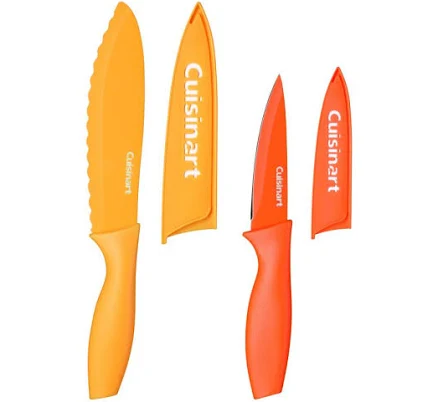
Cuisinart · Non-Stick Knife Sets
Cuisinart 4 Piece Nonstick Color Knife Set, Is It Non-Toxic?
Skip until Cuisinart clarifies nonstick coating chemistry.
Nonstick coating on the handles has unknown chemistry from Cuisinart. Nonstick coatings traditionally rely on Teflon-type coating and Teflon-family coating that may contain PFAS, yet Cuisinart provides no transparency.
Still want this one anyway? Check the price on Amazon. We’d swap it.
Material
Stainless steel blade; nonstick-coated handles (coating type unspecified)
Lab data
No public lab test
You may also be interested in
Top-graded picks in the categories readers replace first, every one scored on the same rubric.

- polypropylene filter housing, carbon/sediment cartridge
- We found no PFAS statement from the brand
- Bacterial growth in spent cartridges
3 hazards checked on this product, all on its full breakdown.

Aquasure
Premier Series 75 GPD Under Sink Reverse Osmosis Water Filtration System
- RO membrane, carbon filters, stainless steel housing
- We found no PFAS statement from the brand
- Bacterial and microbial growth in housing and filters
4 hazards checked on this product, all on its full breakdown.

Avocado
Vegan Mattress
- organic cotton, natural latex, coconut coir, recycled steel coils
- The brand calls it PFAS-free, which we have not verified
- Heavy metals
2 hazards checked on this product, all on its full breakdown.
Is Cuisinart 4 Piece Nonstick Color Knife Set non-toxic? What it is made of
This set pairs food-grade stainless steel blades (not a material linked to PFAS) with nonstick-coated handles. Cuisinart does not publicly specify whether handles use Teflon-type coating (Teflon), silicone, or other polymers. The nonstick coating durability and leaching risk cannot be assessed without knowing the exact resin chemistry. Handle coating degradation over years of washing and use is the primary concern if it contains fluorinated polymers.
What’s concerning
Category baseline
The starting point for this type of product, before anything specific to this product is counted.
No PFAS disclosure
No public statement from the brand about PFAS in this product.
Non-stick, chemistry undisclosed
Marketed as non-stick without stating the coating chemistry.
Nonstick coating degradation and leaching
Without specification of the nonstick polymer used, the leaching risk cannot be ruled out. If handles contain Teflon-type coating or similar fluorinated coatings, degradation from repeated washing and minor damage could release microparticles or residual monomers into food contact zones, though direct blade-to-food contact is minimal with knives.
Microplastic shedding from worn handle coating
If nonstick handles chip or peel from wear, small polymeric fragments could contaminate food or be ingested. This is a durability concern that depends on the coating quality and maintenance, not inherent to Cuisinart's design alone.
What’s reassuring
Handle polymer off-gassing or degradation over time
No specific off-gassing or durability issues are documented for this product. However, nonstick coatings in general can become brittle and shed if exposed to heat, impact, or abrasion; this is a material-class concern rather than a Cuisinart-specific defect.
Stainless steel blade corrosion or metal leaching
Food-grade stainless steel (typically 300 series alloys) does not leach harmful metals under normal cutting and storage use. No concerns are documented for this product.
Handle material allergenicity or skin sensitization
Nonstick polymer handles are not documented to cause dermatitis or contact allergies in the general population. Individual sensitivity to synthetic polymers is rare and unrelated to this specific product.
How is this PFAS grade calculated?
The brand's record and disclosure
Cuisinart has not published transparency statements on PFAS use in cookware handles or blade coatings. The brand has not sought third-party certifications (e.g., GreenGuard, NSF) for this product line that would independently verify coating safety. No public recalls or safety alerts are on record for this specific knife set, but the lack of disclosure itself is a red flag for informed purchasing.
How it compares in its category
Most nonstick knife handles in this price tier use either Teflon-type coating or proprietary polymer coatings with minimal disclosure. Premium alternatives (e.g., Victorinox Fibrox, Mercer ceramic-coated) publish material specs. Cuisinart's silence puts this product in the middle-of-the-road category where consumers cannot easily verify safety without contacting the manufacturer directly.
If you buy it
Hand-wash handles in lukewarm water only; avoid dishwasher and extreme heat (nonstick polymers can degrade). Do not heat or soak handles above 140F (60C) to minimize any potential leaching. Replace handles if coating flakes, cracks, or develops cloudiness. Request detailed coating specifications from Cuisinart customer service before purchase if PFAS avoidance is a priority.
What is not known about PFAS in this product?
- Basis
- Model estimate, 35% confidence, not a lab result
- Lab test
- None on record for this exact product
- Brand statement
- Cuisinart has made a specific claim
Formulations change between production runs, so check the current label. How we grade.
What are the PFAS-free alternatives to Cuisinart 4 Piece Nonstick Color Knife Set?

- Stainless steel blades; wood, plastic, or composite handles
- We found no PFAS statement from the brand
- Wood handle degradation and moisture damage
2 hazards checked on this product, all on its full breakdown.
Find an alternative on Amazon
- Stainless steel blades, Fibrox composite handles
- We found no PFAS statement from the brand
- Polymer leaching (Fibrox composite)
3 hazards checked on this product, all on its full breakdown.
Find an alternative on Amazon
- Stainless steel blades, hardwood handles
- We found no PFAS statement from the brand
- Wood handle microbial contamination and moisture damage
2 hazards checked on this product, all on its full breakdown.
Find an alternative on AmazonMore non-stick knife sets grades
How we score, every product runs through the same public 0-100 rubric based on materials, coatings, brand disclosure, lab findings, and recalls. See the full methodology → Spotted a mistake? Report an error.