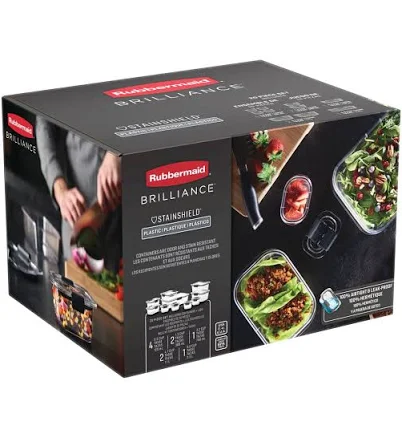
Rubbermaid · Food Storage Containers
Rubbermaid Brilliance 20-Piece Food Storage Container Set
Lower concern based on material, though brand has no PFAS statement on record.
This polypropylene and copolyester blend container set has no coating on record. The base material is not linked to PFAS. Rubbermaid has no public statement about PFAS in this product.
We flunk more products than we pass. This one earned its grade. How we grade
Material
Plastic polymer (polypropylene/copolyester blend) with clear lids
Brand disclosure
Brand is silent on PFAS
Lab data
No public lab test
You may also be interested in
Top-graded picks in the categories readers replace first, every one scored on the same rubric.

- polypropylene filter housing, carbon/sediment cartridge
- We found no PFAS statement from the brand
- Bacterial growth in spent cartridges
3 hazards checked on this product, all on its full breakdown.

Aquasure
Premier Series 75 GPD Under Sink Reverse Osmosis Water Filtration System
- RO membrane, carbon filters, stainless steel housing
- We found no PFAS statement from the brand
- Bacterial and microbial growth in housing and filters
4 hazards checked on this product, all on its full breakdown.

Avocado
Vegan Mattress
- organic cotton, natural latex, coconut coir, recycled steel coils
- The brand calls it PFAS-free, which we have not verified
- Heavy metals
2 hazards checked on this product, all on its full breakdown.
What Rubbermaid Brilliance Container Set is made of, ingredients and materials
Rubbermaid Brilliance containers are polypropylene (PP) or PP-copolyester blend with clear plastic lids, likely polystyrene or acrylic. Polypropylene is a thermoplastic with relatively low migration risk at room temperature and below 100°C. The copolyester blend may improve clarity and durability but does not introduce known chemical hazards beyond those of standard food-grade PP. Lids are a secondary concern point because seal integrity affects bacterial growth risk and the lid material itself can degrade over time.
What’s concerning
Category baseline
The starting point for this type of product, before anything specific to this product is counted.
No PFAS disclosure
No public statement from the brand about PFAS in this product.
Microplastic shedding and oligomer release
Polypropylene can release oligomeric fragments under stress (thermal cycling, mechanical damage, dishwasher abrasion). Risk is lower at room temperature and cold storage, but increases if containers are microwaved, filled with hot liquids, or exposed to prolonged dishwasher cycles. This is material-inherent, not brand-specific.
Lid seal degradation and bacterial growth risk
Polystyrene or acrylic lids degrade over time and develop micro-cracks that compromise seal integrity. If food is stored above 40°F in a container with a failed seal, pathogenic bacteria can multiply. This is a maintenance and replacement issue, not a chemical hazard, but affects food safety.
What’s reassuring
Base material not linked to PFAS
The main material recorded for this product is not one associated with PFAS.
BPA & bisphenols
Rubbermaid markets these as BPA-free, and no public recall or test report documents BPA/BPS in Brilliance containers. Polypropylene itself does not contain BPA; the hazard would arise only if non-disclosed additives were present.
Source, FDA ↗Phthalate migration
Polypropylene formulations used in food containers are not known to incorporate phthalates as plasticizers. No public record of phthalate contamination in this product line exists.
Odor and stain absorption
Polypropylene is hydrophobic and absorbs lipophilic compounds (oils, spices, dyes), leading to discoloration and odor retention. This is cosmetic and functional degradation, not a chemical safety issue, but shortens perceived product lifespan.
How is this PFAS grade calculated?
The brand's record and disclosure
Rubbermaid, owned by Newell Brands, has no major documented recalls specific to BPA, BPS, or phthalate migration in Brilliance containers on public record. The brand does not publish an explicit PFAS statement for this product line, and no independent testing showing PFAS contamination in Brilliance containers is on record. Rubbermaid markets these as BPA-free on packaging, though does not detail copolymer composition or long-term durability claims for coatings.
How it compares in its category
Polypropylene-based containers like Brilliance sit in the middle of the food storage market, more durable and less fragile than glass, but without the complete chemical inertness of glass or stainless steel. Compared to older acrylic or polycarbonate (PC) containers, PP carries lower migration risk. Compared to silicone or bamboo alternatives, PP offers better clarity and is more widely compatible with dishwashers and freezers, though it may absorb odors and stains over time.
If you buy it
Avoid contact with hot or boiling liquids; polypropylene begins to soften above 100°C and can release oligomers at higher temperatures. Do not microwave if the label does not explicitly approve it; many PP lids are not microwave-safe. Inspect lids regularly for cracks, warping, or seal degradation; a compromised seal increases bacterial growth risk if food is stored above 40°F for extended periods. Hand wash lids when possible to extend their lifespan, as dishwasher heat accelerates plastic aging.
What is not known about PFAS in this product?
- Basis
- Model estimate, 72% confidence, not a lab result
- Lab test
- None on record for this exact product
- Brand statement
- Rubbermaid has made none
Formulations change between production runs, so check the current label. How we grade.
What are the PFAS-free alternatives to Rubbermaid Brilliance 20-Piece Food Storage Container Set?
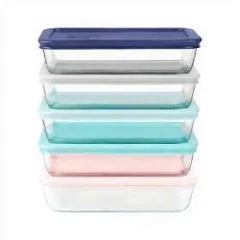
- borosilicate glass with metal lids (likely stainless steel or aluminum)
- Metal lid corrosion and leaching
3 hazards checked on this product, all on its full breakdown.
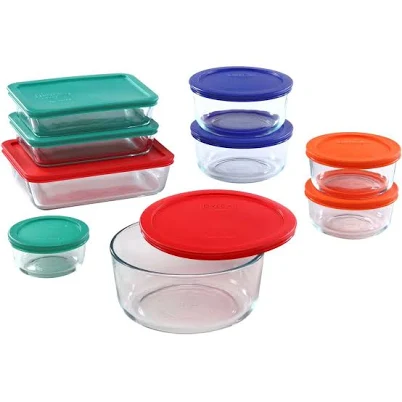
- borosilicate glass with plastic lids
- PFAS
4 hazards checked on this product, all on its full breakdown.
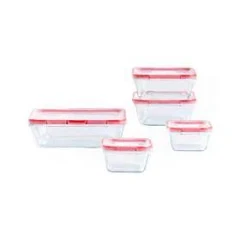
- Borosilicate glass containers with plastic lids (PP/TPE closure material unspecified)
- Microplastics
4 hazards checked on this product, all on its full breakdown.
More food storage containers grades
How we score, every product runs through the same public 0-100 rubric based on materials, coatings, brand disclosure, lab findings, and recalls. See the full methodology → Spotted a mistake? Report an error.