By PFAS Authority · Updated September 8, 2026
Top grades to buy
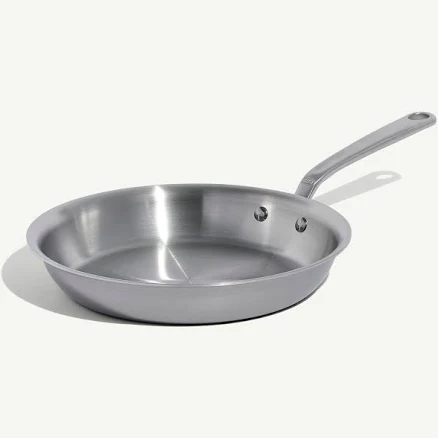
Made In
Stainless Clad Fry Pan
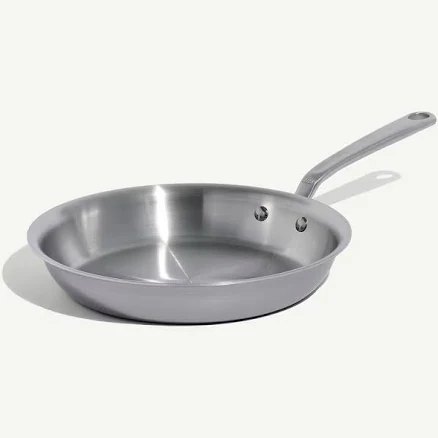
Made In
10' Stainless Clad Frying Pan
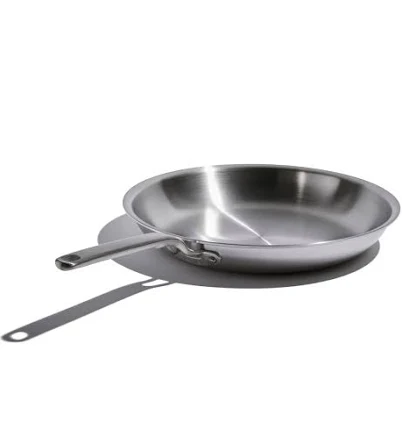
Heritage Steel
Eater Fry Pan
Model-based grades, not lab tests. We flunk more than we pass. How grading works
PFAS in Cookware, 285 Pans Graded From Bare Steel to Named PTFE
We graded 285 frying pans, pots and cookware sets from All-Clad, T-fal, Calphalon, KitchenAid, Tramontina, Rachael Ray, GreenPan, HexClad, Our Place, Caraway, Made In, Le Creuset, Lodge and others. 164 of them grade 15 out of 100, because they carry a non-stick coating the maker does not name and no PFAS statement. Another 24 grade 5, most of them because the brand itself says the coating is PTFE.
The top of the list is uncoated metal. Nine stainless steel pans from Heritage Steel and Made In grade 100, and 27 uncoated stainless steel and cast iron pieces from All-Clad, Demeyere, Tramontina, Calphalon, 360 Cookware, Mauviel and Lodge grade 75. If you want non-stick, 22 ceramic pans from GreenPan, HexClad, Our Place, Caraway and Made In grade 70, on a named coating and a brand PFAS statement we have not verified.
Summary comparison table
| Product | PFAS grade | Cooking surface as recorded |
|---|---|---|
| Heritage Steel Eater 12" Fry Pan with Lid | Excellent, 100/100 | Clad stainless steel, no coating, brand PFAS statement |
| Made In Stainless Clad Fry Pan | Excellent, 100/100 | Clad stainless steel, no coating, brand PFAS statement |
| All-Clad D3 Stainless Steel Fry Pan with Lid | Excellent, 75/100 | Uncoated stainless steel |
| Lodge Cast Iron Skillet | Excellent, 75/100 | Bare cast iron, seasoned |
| Demeyere Industry 5 Stainless Steel Fry Pan | Excellent, 75/100 | Uncoated stainless steel |
| Tramontina Tri-Ply Clad 10 Pc Stainless Steel Set | Excellent, 75/100 | Uncoated stainless steel, glass lids |
| GreenPan Chatham Ceramic Nonstick 10-Piece Set | Good, 70/100 | Thermolon ceramic non-stick, brand PFAS statement |
| HexClad Hybrid Fry Pan with Lid | Good, 70/100 | TerraBond ceramic non-stick, brand PFAS statement |
| Our Place Always Pan 2.0 | Good, 70/100 | Ceramic non-stick, brand PFAS statement |
| Caraway Stir Fry Pan | Good, 70/100 | Ceramic non-stick, brand PFAS statement |
| Le Creuset Enameled Cast Iron | Good, 65/100 | Enameled cast iron, no non-stick coating |
| KitchenAid Hard-Anodized Induction Nonstick Frying Pan | Bad, 15/100 | Non-stick coating, type not stated |
| Rachael Ray Cucina Hard Anodized Nonstick Skillet | Bad, 15/100 | Non-stick coating, type not stated |
| Scanpan Ceramic Titanium | Bad, 15/100 | Ceramic non-stick, chemistry not stated, no brand PFAS statement |
| All-Clad HA1 Expert Hard Anodized Nonstick Fry Pan 10" | Bad, 5/100 | PTFE non-stick, disclosed by All-Clad |
| T-fal Ultimate Hard Anodized Nonstick Fry Pan Set | Bad, 5/100 | PTFE non-stick, disclosed by T-fal |
| Made In Non-stick Frying Pan | Bad, 5/100 | PTFE non-stick, disclosed by Made In |
How we graded these
Every grade here is a model-based estimate built from publicly available product information and manufacturer disclosures, not a lab test performed by our team. A high score means lower concern based on reviewed sources, never PFAS-free and never safe. Across the 251 products the spread is nine at 100, 27 at 75, 22 at 70, five at 65, 164 at 15 and 24 at 5. No cookware brand here holds a third-party PFAS-free certification that we could confirm. Look up any pan in our PFAS product finder or browse the full cookware roundup.
Why most non-stick pans grade 15
A non-stick pan releases food because of a coating. For decades that coating was usually PTFE, a fluoropolymer in the PFAS family, and ceramic and other coatings are now sold alongside it. When a listing says only non-stick, and the brand makes no statement about PFAS, our model cannot tell which kind it is. That unresolved coating is the reason 164 pans grade 15.
KitchenAid, Tramontina, Rachael Ray, Prestige, Mirro, Milton, Imusa, Fissler, Amazon Basics, Mauviel, Stahl, Ninja, Farberware and Circulon all have non-stick pans in that group. It is not a finding that their coatings are PTFE. It is a record that none of these listings says.
The 24 pans recorded as PTFE
Three brands publish which of their non-stick lines are PTFE, and we grade those pans 5, the bottom of our scale. All-Clad says its nonstick contains PTFE, and names its HA1, Essentials, NS1, D3 and D5 nonstick lines. T-fal lists the ranges it says contain intentionally added PFAS, among them Easy Care, Essentials, Simply Cook, Stone Force, Ultimate Hard Anodized and Professional, and says those ranges are not sold in Minnesota from 2025, or in Maine and Colorado from 2026, under those states' cookware laws. Made In's California disclosure says its Non Stick products contain PTFE, FEP and PFA. Four Calphalon non-stick pans and one Tefal pan are also recorded as PTFE.
A named PTFE pan grades below an unnamed one on purpose. PTFE is a fluoropolymer by definition, while an unnamed coating may or may not be. The PTFE grade also says nothing about how the pan cooks. It answers one question, and the brand answered it first.
The same brand can sit at both ends. All-Clad's D3 stainless fry pan grades 75, and its HA1 non-stick fry pan grades 5. Made In's stainless clad fry pan grades 100, and its non-stick frying pan grades 5. The material decides the grade, not the logo.
Uncoated stainless steel and cast iron
A stainless steel or cast iron pan with no coating has nothing on its cooking surface to name. That is why 27 of them grade 75, including Lodge's cast iron skillet Demeyere's Industry 5, Tramontina's tri-ply clad sets, Calphalon's stainless sets and 360 Cookware's stainless sets.
The nine at 100 are uncoated too. The extra 25 points come from a PFAS statement on record from the brand. Heritage Steel says its cookware is made without PFAS of any kind and uses no chemical coatings, and Made In says its stainless clad cookware is made without PFAS, PTFE and PFOA. We record both as unverified brand statements.
Enameled cast iron sits just below. Le Creuset's enameled cast iron and two Staub pieces grade 65. Enamel is glass fused to the iron, not a non-stick coating and not a fluorinated material. Because it is an applied layer, our model gives it a smaller material credit than bare metal.
Ceramic non-stick, and what ceramic does not settle
Ceramic non-stick is still a coating, and the word ceramic alone does not tell you its chemistry. Mineral-sounding names settle nothing either, since T-fal's Stone Force range is on T-fal's own PTFE list. So we grade ceramic pans on two things, whether the coating is named and whether the brand makes a PFAS statement about it.
When both are on record, a ceramic pan grades 70. That covers GreenPan, which says its Thermolon coated food contact surface is free of PFAS, including PTFE and PFOA Our Place, which says its ceramic non-stick coating is made without PFAS, including PTFE and PFOA Caraway, which says its ceramic non-stick coating is made without PTFE, PFOA and PFAS, and Made In CeramiClad. None of these brands holds a third-party PFAS certification we could confirm, so the statements stay unverified.
When neither is on record, a ceramic pan grades 15, the same as any unnamed non-stick. That includes Scanpan Ceramic Titanium Fissler Ceratal Pyrex ceramic pans and T-fal's ceramic lines such as Preserve. Those pans may well be free of fluoropolymers. Their records just do not say so.
HexClad, and why an older pan may differ
HexClad says its cookware uses its TerraBond ceramic non-stick coating, which it describes as PTFE-free and PFAS-free, and its hybrid pans grade 70 on that statement. That has not always been the coating. A class action filed in Los Angeles alleged that HexClad pans bought between February 2022 and March 2024 were marketed as PFAS free while their non-stick contained PTFE, and it settled for $2.5 million. If you own a HexClad pan from those years, or are buying one secondhand, check that it is described as TerraBond.
A correction to this guide
An earlier version of this guide put GreenPan's ceramic sets and Scanpan Ceramic Titanium at 90, and Lodge, All-Clad D3, Le Creuset enameled cast iron and Pyrex ceramic pans at 80. On 16 and 17 September 2026 we regraded cookware and rewrote this guide. Ceramic non-stick is now graded as a coating, which moved GreenPan to 70 and Scanpan and Pyrex to 15. We removed non-stick coatings our records had invented for 360 Cookware, Demeyere and Staub pans that have none. We applied the PTFE disclosures All-Clad, T-fal and Made In publish, which moved 14 of these pans from 15 to 5, and HexClad's TerraBond statement, which moved seven HexClad pans from 15 to 70.
What to avoid
- Non-stick pans whose coating is not named and whose brand says nothing about PFAS. That is 164 of 251 here.
- Lines the brand itself discloses as PTFE, if avoiding fluoropolymers is your aim, including All-Clad HA1, T-fal Ultimate Hard Anodized and Made In Non Stick.
- Reading ceramic on a label as the answer. Ceramic pans here grade 70 or 15 depending on what the brand discloses.
- Heating an empty coated pan on high. Overheating a coated surface is what our Teflon flu explainer covers.
- Reading 15 as proof of PFAS. It reflects a coating nobody names.
For more, see whether PTFE is PFAS, our ceramic cookware guide, our cast iron skillets guide and our non-stick skillets guide.
Our pick
Based on available materials and data, we would choose the Made In Stainless Clad Fry Pan or the Heritage Steel Eater 12" Fry Pan, both at 100 out of 100, uncoated clad stainless steel with a brand PFAS statement on record. On a budget, the Lodge Cast Iron Skillet at 75 has no coating to wear. If you want non-stick release, a ceramic pan with a named coating and a brand statement, such as the GreenPan Chatham set or the Our Place Always Pan 2.0 at 70, is the best-graded coated option in our data. These grades are estimates built from disclosed materials, not laboratory proof, and nothing here is being called PFAS-free or safe by us.
FAQ
Which cookware grades best for PFAS?
Uncoated stainless steel and cast iron. Nine stainless pans from Heritage Steel and Made In grade 100 with a brand PFAS statement, and 27 uncoated stainless and cast iron pieces grade 75. We grade PFAS concern from disclosed materials, not overall safety.
Does All-Clad non-stick have PTFE?
All-Clad says its nonstick contains PTFE, and lists its HA1, Essentials, NS1, D3 and D5 nonstick lines among its PTFE coated products. Those pans grade 5 in our data. All-Clad's uncoated stainless lines, such as D3, grade 75.
Is T-fal cookware PFAS-free?
T-fal lists more than 20 of its non-stick ranges, including Easy Care, Essentials, Simply Cook, Stone Force and Ultimate Hard Anodized, as containing intentionally added PFAS, and says its nonstick contains PTFE. Pans from those ranges grade 5. T-fal's ceramic lines are not on that list, and without a PFAS statement from T-fal they grade 15.
Is HexClad PFAS-free?
HexClad says its current TerraBond ceramic non-stick coating is PTFE-free and PFAS-free, and its pans grade 70 on that statement, which we have not verified. A class action alleged that HexClad pans bought between February 2022 and March 2024 contained PTFE, and it settled for $2.5 million.
Is ceramic non-stick cookware PFAS-free?
Not by the word ceramic alone. A ceramic pan with a named coating and a brand PFAS statement, such as GreenPan, Our Place or Caraway, grades 70. A ceramic pan with neither, such as Scanpan Ceramic Titanium or Fissler Ceratal, grades 15.
Is Le Creuset PFAS-free?
Le Creuset's enameled cast iron has no non-stick coating on record and grades 65. Le Creuset discloses that its Toughened Non-stick PRO coating contains PTFE, FEP and PFA, and those pans grade 5.
Now check your own stuff
See every product we’ve graded in this category, best-graded first.
Get the graded list, free.
The products we score each week, and the best-graded alternative in every category.
No spam. Unsubscribe anytime.